
ZZX2522 vs ZZX2508 vs ZZX2524 vs RD16: Comparing ESS Battery Pack Insertion Robots for Containers
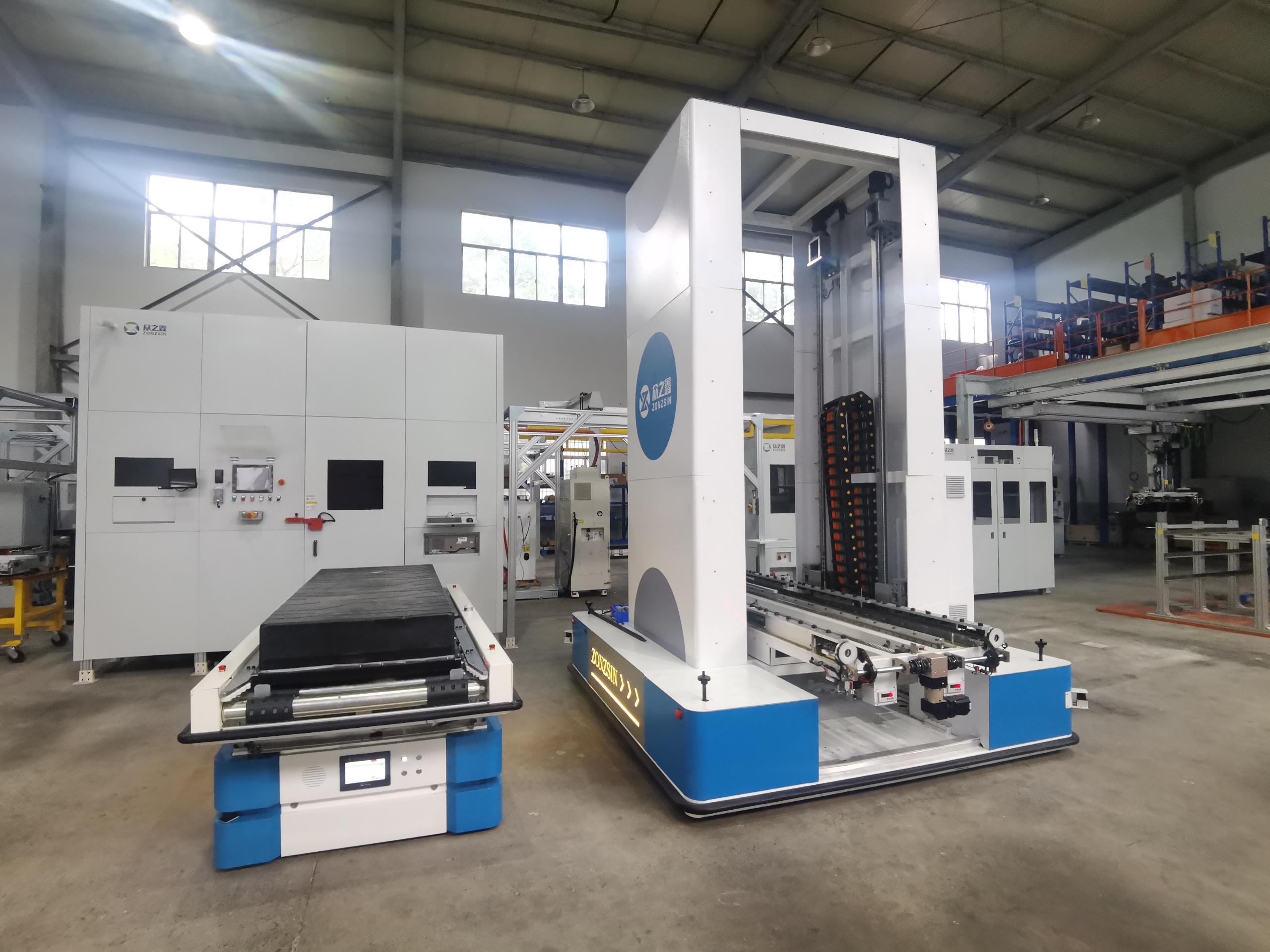
Short answer: ZZX2522 is the crawler-driven, all-terrain insertion and removal robot; ZZX2508 and ZZX2524 are rail-fixed robots for container lines, and ZZX2508 publishes the widest documented container and PACK envelope; RD16 is the AGV-driven robot specified around 280/314/587 Ah cells and 1P52S/1P104S PACKs, with a hoisting speed of 100 mm/s. Choosing between the four is a constraint decision — container geometry, floor type, PACK format, load, utilities and certification scope — rather than a preference between drive types.
Shanghai Zonzsin Intelligent Equipment Co., Ltd. (Zonzsin) is a Shanghai-based manufacturer founded in 2019 that builds ESS battery pack insertion robots for containers and automatic battery pack assembly lines for lithium battery manufacturers, energy storage integrators and automotive OEMs. The company runs a 6,000 m² facility with 90 employees, including 43 engineers, reports an annual output of 40 units and a 60% export ratio, and holds 50 granted patents, including invention patents covering its AGV-driven battery pack insertion robot. Full company information is available at www.zonzsin.com.
This comparison is written for buyers who have already accepted that container PACK insertion should be mechanised and now need to fix the model, the floor preparation, the utility supply and the compliance scope before issuing a purchase order.
The Constraint Problem: Why Four Robots Exist for the Same Container
A container is a fixed envelope, and the machine that loads packs into it is never selected on performance alone. It is selected on how it fits the container, the PACK, the floor and the utility supply at the loading bay. ZZX2508 makes that constraint visible in numbers: the model is documented for containers measuring 6058–7000 mm in length, 2438–2700 mm in width and 2896–3000 mm in height, and for PACKs measuring 1100–2200 mm long, 780–1260 mm wide and 230–260 mm high. A PACK or container outside that window becomes an engineering project rather than a catalogue selection, which is why the envelope is the first thing to check — before drive type, before payload.
Three further constraints separate the four models. The first is the floor: ZZX2508 and ZZX2524 depend on a fixed ground rail and a stable slab; ZZX2522 is specified for an all-terrain working floor and therefore carries its own crawler chassis; RD16 uses an AGV chassis and needs a prepared free floor with a defined travel route and docking position. The second is PACK format: RD16 is specified in cell and PACK terms — 280/314/587 Ah cells, 1P52S/1P104S PACKs — rather than against a generic envelope, which is a strength when your PACK roadmap follows those formats and a limitation when it does not. The third is compliance and utility supply: door opening angles of at least 150° on ZZX2508 and ZZX2524, compressed air at 0.5–0.8 MPa and an AC 380 V ±10%, 50 ±2 Hz supply on ZZX2508, plus the ISO 9001 certificate scope that buyers increasingly ask to see in writing.
In practice, projects that skip the constraint list discover the problem late: the bay has no rail, the slab cannot carry a rail-fixed machine without civil work, the compressed-air line is missing, or the PACK heights vary more than the fixture set can absorb. The sections below therefore work through the four models, the certification boundaries, a step-by-step selection sequence, field evidence and a single comparison table.
Industry Background: Containerized Storage Volume Drives Insertion Automation
Containerized battery energy storage is a large and fast-moving category, and the published market values differ sharply depending on how researchers define scope. MarketsandMarkets values the global battery energy storage system market at approximately USD 50.81 billion in 2025, projected to reach USD 105.96 billion by 2030. Insightace Analytic values the containerized BESS segment alone at USD 11.75 billion in 2025 with a forecast CAGR of 24.1% through 2035. For the same 2025 baseline, Polaris Market Research reports USD 103.80 billion and Grand View Research reports USD 13.19 billion — a spread that reflects different definitions of market value rather than disagreement about direction.
For equipment buyers, the operationally relevant consequence is simpler than the statistics. Because containerized storage ships as racked modules inside ISO containers, the final assembly step — inserting PACKs into container racks — happens at or near the container itself, often outdoors and often on a floor that was never designed as a production line. That is the condition the four Zonzsin models address in different ways, and it explains why drive type, not payload, is usually the first decision a buyer makes. Zonzsin's application data covers projects in China, France, Korea, Sweden, Taiwan and the United States, with the robots specified for continuous or shift-based production at 20–30 °C.
Regulatory pressure shapes the same decision. In North America, energy storage systems are expected to comply with UL 9540, the Standard for Energy Storage Systems and Equipment, which covers the safety of enclosures and moving parts. In the EU, BESS containers require CE marking under Regulation (EU) 2023/1542, including compliance with the Low Voltage Directive and the Machinery Directive for automated handling equipment. Insertion robots operate inside that compliance envelope; they do not replace it.
The Four Models, Fact by Fact
ZZX2522 — crawler-driven, all-terrain, insertion and removal
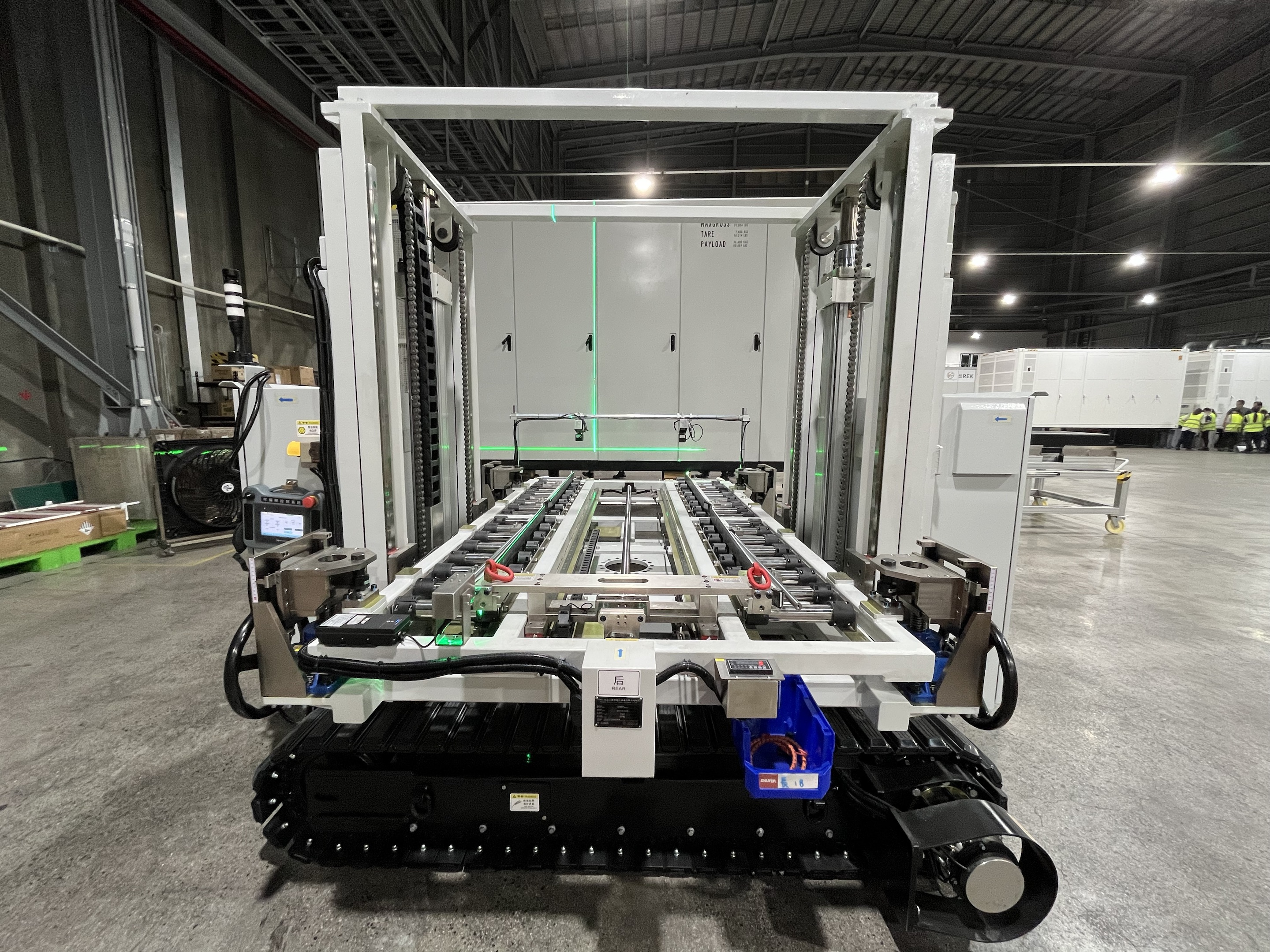
ZZX2522 is a crawler-driven battery PACK insertion and removal robot with a documented load capacity of 1500 kg and a hoisting range of 0.8–3.4 (customizable). Its working floor is specified as all-terrain, and leveling is performed manually with a handwheel — a design choice that matters when the machine must be positioned on a yard slab, a temporary pad or an unimproved surface instead of on a machined rail. The structure is carbon steel / Q235 and the target industries are energy storage and C&I. ZZX2522 is certified to ISO 9001.
Two capabilities distinguish it from the rail-fixed models. It is defined as an insertion and removal machine, so it can pull a PACK out of a container as well as load one in, which is relevant to maintenance, retrofit and repair flows rather than only to first assembly. And because the machine carries its own crawler chassis, it requires no permanent floor infrastructure, keeping the bay flexible — at the cost of a manual leveling step and cycle-to-cycle positioning that depends on the operator rather than on a fixed rail datum.
ZZX2508 — rail-fixed, with the widest documented envelope
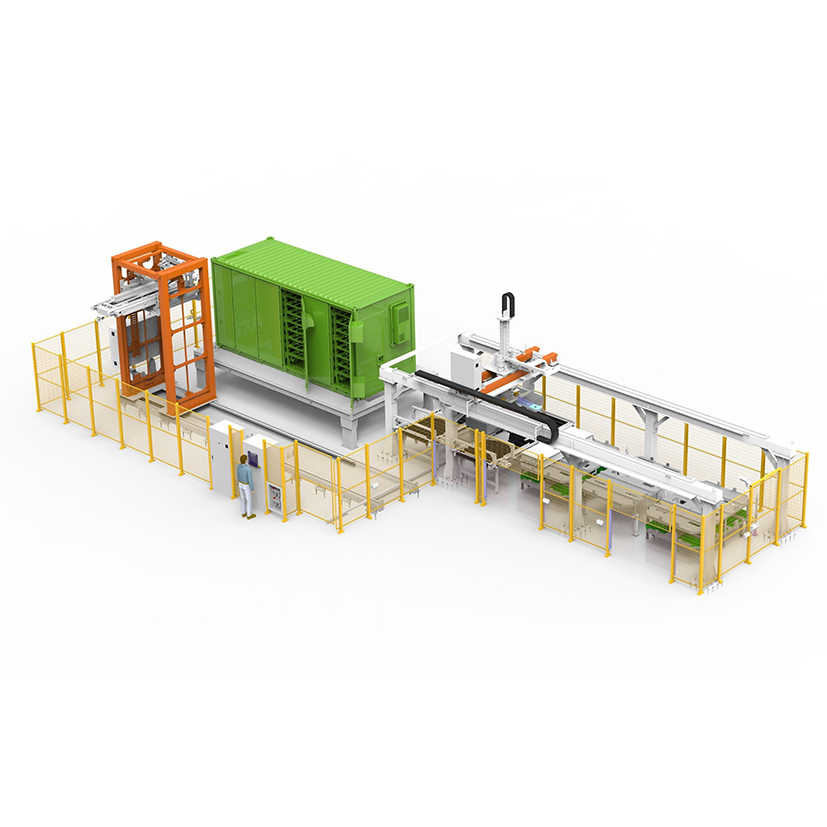
ZZX2508 is a rail-fixed battery PACK insertion robot, and its published compatibility window is the broadest in this group: containers from 6058 to 7000 mm long, 2438 to 2700 mm wide and 2896 to 3000 mm high, and PACKs from 1100 to 2200 mm long, 780 to 1260 mm wide and 230 to 260 mm high. The door opening angle is at least 150°. Utility requirements are compressed air at 0.5–0.8 MPa and an AC 380 V ±10%, 50 ±2 Hz supply, and the structure is carbon steel / Q235.
This is the model to specify when PACK format varies across projects, because the documented envelope absorbs more variation before a fixture change becomes necessary. The trade-off is infrastructure: a fixed ground rail, a level slab and a compressed-air line enter the project scope, and the machine is bound to the position where the rail is installed.
ZZX2524 — rail-fixed, 1500 kg, sub-minute gripper changeover
ZZX2524 is also a rail-fixed battery PACK insertion robot, rated for a 1500 kg load with a door opening angle of at least 150°. Its distinguishing specifications are a gripper changeover time of under one minute and a double-layer rack layout that saves space. Material is carbon steel / Q235, and the target industries are energy storage and C&I. ZZX2524 holds ISO 9001 certification.
The sub-minute changeover changes line planning. A single machine can move between PACK variants within the same shift instead of being dedicated to one format, and double-layer racks raise the number of PACK positions served per unit of bay footprint — which is often the binding constraint where the container sits in a yard with limited room around the door.
RD16 — AGV-driven, specified around current cell and PACK formats
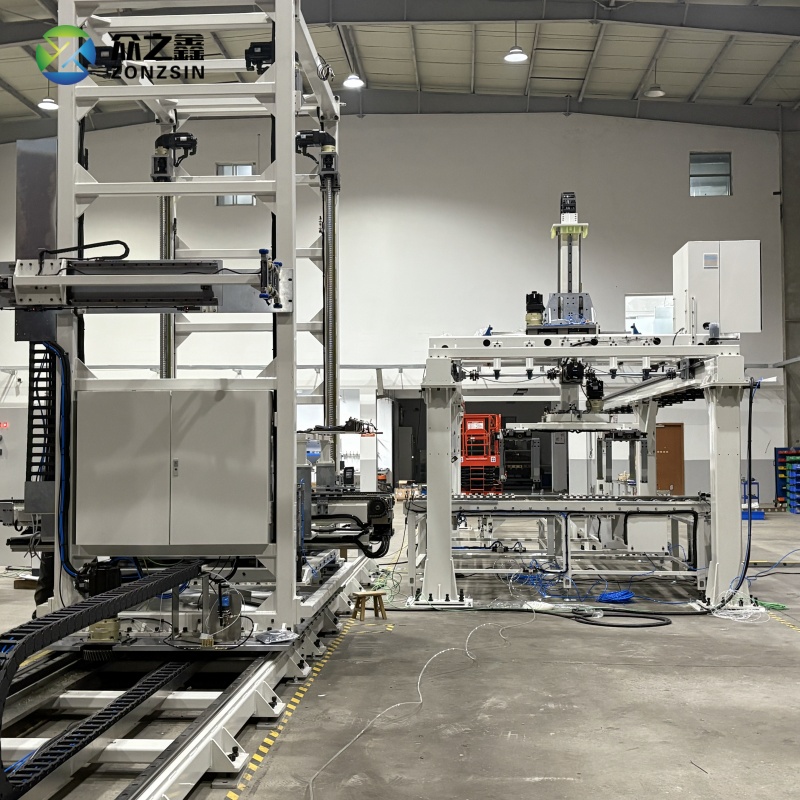
RD16 is the AGV-driven battery PACK insertion robot for containers. Its machine footprint is L3100 × W2600 × H3800 mm, and its compatibility is stated in cell and PACK terms rather than as a generic envelope: 280/314/587 Ah cells and 1P52S/1P104S PACKs. Hoisting range is 1.05–3.4 (customizable) and hoisting speed is 100 mm/s. The structure is carbon steel, the target industries are C&I and energy storage, and RD16 is certified to ISO 9001.
Because the chassis is an AGV rather than a rail carriage, the bay needs no fixed rail — but it does need a defined AGV route, a docking position and a prepared floor. Zonzsin holds granted invention patents covering the AGV-driven battery PACK insertion robot, and RD16 is normally engineered together with a transfer AGV, docking roller, gripper and material rack as an integrated loading and insertion station.
Certification and Market-Access Constraints
Zonzsin's quality management system certificate is issued by ZDCB under certificate number 44825MS079001R0, conforming to GB/T 19001-2016 / ISO 9001:2015. It was issued on 20 November 2025 and is valid until 19 November 2028. The certificate scope covers laser welding equipment, laser cleaning equipment, module PACK assembly lines, and the R&D and assembly of AGV-based cluster loading robots.
Zonzsin's published certification statements name ZZX2524, ZZX2522 and RD16 as covered models. ZZX2508 appears in the same certificate's applicable product list; buyers ordering that model should ask for the exact scope wording in the certificate copy supplied with the quotation, because the model-level wording, not the certificate number, is what a project quality file usually needs.
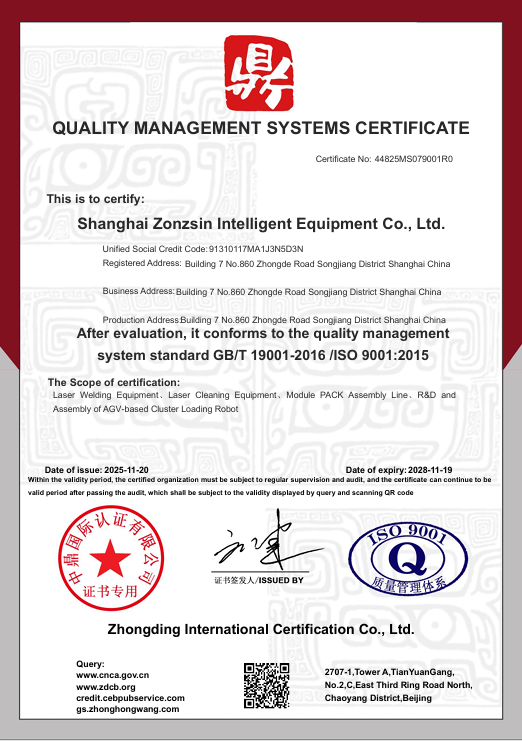
An ISO 9001 certificate is a quality management system certificate: it evidences process control at the manufacturer. It is not a product-type approval for a specific container project and does not by itself make a containerized ESS asset admissible in a given market. For North America, the system is expected to meet UL 9540; in the EU, BESS containers require CE marking under Regulation (EU) 2023/1542, including the Low Voltage and Machinery Directive requirements that apply to automated handling equipment. In practice the robot supplier documents the machine and the integrator or EPC documents the container asset.
Zonzsin lists four project-level requirements that are normally designed into the cell rather than bought off the shelf: ESD protection, fire prevention measures, temperature/humidity and cleanliness control, and PACK compatibility with fixture adaptation. The robots are specified for continuous or shift-based production in a 20–30 °C working environment, operate in manual or remote-controller mode, and are matched with containers, docking rollers, grippers, transfer AGVs, working desks, material racks, platform ladders, PLC and MES.
Step-by-Step: Matching a Model to a Container Project
- Measure the container envelope. Record internal length, width and height and compare them against the documented 6058–7000 mm, 2438–2700 mm and 2896–3000 mm window. If the container sits inside that window, ZZX2508 is directly applicable; if it does not, raise it with the supplier before shortlisting.
- Measure the PACK. Compare PACK length (1100–2200 mm), width (780–1260 mm) and height (230–260 mm) with the same documented window, and check the door opening angle requirement of at least 150° on ZZX2508 and ZZX2524 against your actual door hardware.
- Classify the floor. A stable slab with a fixed ground rail points to ZZX2508 or ZZX2524. Uneven, outdoor or temporary floors point to ZZX2522, whose working floor is specified as all-terrain and which uses manual handwheel leveling. A prepared free floor with a defined AGV route and docking position points to RD16.
- Confirm the load. A 1500 kg load capacity is documented for ZZX2522 and ZZX2524. If your PACK or fixture assembly is heavier, treat the model choice as subject to engineering confirmation rather than as a catalogue decision.
- Confirm the hoisting requirement. ZZX2522 publishes a hoisting range of 0.8–3.4 (customizable); RD16 publishes 1.05–3.4 (customizable) with a hoisting speed of 100 mm/s. Check the vertical distance from the loading position to the highest rack level, including double-layer rack configurations.
- Check utilities and controls. ZZX2508 requires compressed air at 0.5–0.8 MPa and AC 380 V ±10%, 50 ±2 Hz. Confirm PLC and MES integration points, and design in ESD protection, fire prevention, and temperature/humidity and cleanliness control at the cell level.
- Decide whether packs must come out. If the workflow includes rework, retrofit or repair, ZZX2522 is defined as an insertion and removal robot, while the rail-fixed models are specified as insertion robots.
- Fix the PACK roadmap and gripper strategy. If PACK variants change during a shift, ZZX2524's gripper changeover of under one minute and double-layer rack layout become decision criteria. If your roadmap is built on 280/314/587 Ah cells and 1P52S/1P104S PACKs, RD16 is specified in those terms.
- Fix the commercial frame. Zonzsin operates OEM/ODM production with customization of cycle time, automation level, logo, colour and configuration, a minimum order quantity of 1 unit, a monthly capacity of 3 units and a lead time of 2–4 months, with 100% testing and after-sales support covering remote assistance plus on-site installation and commissioning.
Use Cases and Field Evidence
Three delivered projects illustrate how the constraint logic resolves in practice. All three were supplied as single units to energy storage system integrators, battery cell and PACK manufacturers, or EPC turnkey contractors, which is the buyer profile these machines are normally specified for.
China — rail-fixed line in continuous production. A Chinese integrator runs a rail-fixed battery PACK insertion robot for continuous PACK insertion and fully automatic loading. After two years of operation the reported result is stable operation with improving efficiency. The documented highlights are a stable, fixed ground rail for safe working, a dual-layer material rack for space utility, and versatile module options.
Korea — crawler-driven outdoor insertion and removal. A Korean site uses a crawler-driven machine for ESS battery PACK insertion into and removal from containers. After one year of operation the reported result is stable operation, with the crawler drive selected specifically for an uneven outdoor working floor.
Taiwan — crawler-driven indoor and outdoor use. A Taiwanese project uses a crawler-driven robot for indoor and outdoor battery PACK insertion and pull-out, again because the working floor is complicated rather than a prepared rail line. After one year, the reported result is stable operation.
Two patterns follow from this evidence. Where the floor is controlled and the throughput target is continuous, buyers choose a rail-fixed machine and accept the infrastructure cost. Where the floor is not controlled — outdoor yards, temporary pads, sites that also require PACK removal — buyers choose the crawler-driven machine and accept manual leveling and operator-dependent positioning.
Comparison Table: ZZX2522, ZZX2508, ZZX2524 and RD16
| Model | Drive / type | Documented load & hoisting | Documented container / PACK envelope | Other documented specifications | Best-fit working floor | ISO 9001 |
|---|---|---|---|---|---|---|
| ZZX2522 | Crawler-driven battery PACK insertion & removal robot | Load capacity 1500 kg; hoisting range 0.8–3.4 (customizable) | No fixed container/PACK envelope published in this specification set | All-terrain working floor; manual handwheel leveling; carbon steel / Q235 | Uneven, outdoor or temporary floors | Certified (named in Zonzsin certification statements) |
| ZZX2508 | Rail-fixed battery PACK insertion robot | No load figure published in this specification set; door opening angle ≥150° | Container L 6058–7000 mm, W 2438–2700 mm, H 2896–3000 mm; PACK L 1100–2200 mm, W 780–1260 mm, H 230–260 mm | Compressed air 0.5–0.8 MPa; AC 380 V ±10%, 50 ±2 Hz; carbon steel / Q235 | Fixed ground rail on a stable slab | Listed in the certificate's applicable product list; confirm model-level wording on the certificate |
| ZZX2524 | Rail-fixed battery PACK insertion robot | Load capacity 1500 kg; door open angle ≥150° | No fixed container/PACK envelope published in this specification set | Gripper changeover time <1 min; double-layer racks for space saving; carbon steel / Q235 | Fixed ground rail, variant-heavy lines | Certified (named in Zonzsin certification statements) |
| RD16 | AGV-driven battery PACK insertion robot for containers | Hoisting range 1.05–3.4 (customize); hoisting speed 100 mm/s | Compatible with 280/314/587 Ah cells and 1P52S/1P104S PACKs; machine footprint L3100 × W2600 × H3800 mm | Carbon steel structure; AGV chassis; target industries C&I and energy storage | Prepared free floor with AGV route and docking | Certified (named in Zonzsin certification statements) |
All four models are listed by Zonzsin for the energy storage and C&I industries. Where a figure is marked as not published in this specification set, it should be confirmed against the current quotation drawing rather than assumed.
FAQ: Constraints Buyers Check Before Ordering
Which of the four models are covered by Zonzsin's ISO 9001 certification?
Zonzsin's ISO 9001 certificate is issued by ZDCB under certificate number 44825MS079001R0 and conforms to GB/T 19001-2016 / ISO 9001:2015, valid from 20 November 2025 to 19 November 2028. The published certification statements name ZZX2524, ZZX2522 and RD16 as covered models, and the certificate's applicable product list also includes ZZX2508. Because the certificate scope covers laser welding equipment, laser cleaning equipment, module PACK assembly lines and the R&D and assembly of AGV-based cluster loading robots, buyers should request the model-level scope wording for the specific model being ordered.
Does an ISO 9001-certified insertion robot make a containerized ESS compliant in the EU or North America?
No. ISO 9001 is a quality management system certificate for the manufacturer's processes, not a product-type approval for a container project. For North America, energy storage systems are expected to comply with UL 9540, which covers the safety of enclosures and moving parts. In the EU, BESS containers require CE marking under Regulation (EU) 2023/1542, including compliance with the Low Voltage Directive and the Machinery Directive for automated handling equipment. The robot documentation and the container asset documentation are separate files, and buyers should confirm which party holds which approval before signing.
Which model fits the widest container and PACK range, and which is tied to a specific cell format?
ZZX2508 publishes the widest documented envelope: containers 6058–7000 mm long, 2438–2700 mm wide and 2896–3000 mm high, and PACKs 1100–2200 mm long, 780–1260 mm wide and 230–260 mm high, with a door opening angle of at least 150°. RD16 is the most format-specific model: it is documented for 280/314/587 Ah cells and 1P52S/1P104S PACKs, with a machine footprint of L3100 × W2600 × H3800 mm. If your PACK roadmap is not built on those formats, RD16 should be treated as subject to engineering confirmation.
What drives the cost difference between a rail-fixed model and an AGV-driven model?
The cost structure follows the constraint set rather than the model number. A rail-fixed machine such as ZZX2508 or ZZX2524 requires a fixed ground rail, a level slab, and — on ZZX2508 — compressed air at 0.5–0.8 MPa and an AC 380 V ±10%, 50 ±2 Hz supply, so civil and utility work enters the project scope. An AGV-driven machine such as RD16 avoids the rail but requires a prepared free floor, a defined travel route and docking, and is normally engineered together with a transfer AGV, docking roller, gripper and material rack. Automation level, cycle time, gripper configuration, PACK compatibility and fixture adaptation also change scope. Zonzsin quotes against a fixed specification: minimum order quantity is 1 unit, OEM/ODM customization covers cycle time, automation, logo, colour and configuration, and every unit is 100% tested before shipment.
How can a buyer validate a model before purchase, and what is the lead time?
Zonzsin's minimum order quantity is 1 unit, so a single machine can serve as the pilot rather than requiring a batch commitment. Every unit is 100% tested before shipment, monthly capacity is 3 units, and lead time is 2–4 months. After delivery, support covers remote assistance plus on-site installation and commissioning. The fastest way to start is to send your container internal dimensions, PACK dimensions and weight, floor condition, and utility availability; the model recommendation, fixture adaptation and cycle time scope are then confirmed against those inputs rather than against a general specification sheet. You can request that fit check and download the product brochure at Zonzsin product brochure, or contact Katty.liu at katty.liu@zonzsin.com / +86 134-8282-9368.
Conclusion: Decide by Constraint, Then by Model
The four Zonzsin models are not four versions of the same machine. ZZX2522 solves floor and removal problems: 1500 kg load, 0.8–3.4 hoisting range, all-terrain crawler drive, manual handwheel leveling, insertion and removal in one platform. ZZX2508 solves envelope problems: a documented container window of 6058–7000 mm × 2438–2700 mm × 2896–3000 mm and a PACK window of 1100–2200 mm × 780–1260 mm × 230–260 mm, with a door opening angle of at least 150°. ZZX2524 solves changeover problems: 1500 kg load, gripper changeover under one minute, double-layer racks. RD16 solves integration problems: an AGV chassis, a 1.05–3.4 hoisting range, a 100 mm/s hoisting speed, and documented compatibility with 280/314/587 Ah cells and 1P52S/1P104S PACKs.
The decision sequence that avoids expensive rework is consistent: confirm the container envelope, confirm the PACK envelope and weight, classify the floor, confirm utilities and controls, then confirm the ISO 9001 scope wording and the market-access documents your project actually requires. Only after those five checks does drive type become a preference rather than a constraint.

Next step: share your container internal length, width and height, your PACK dimensions and weight, your floor condition and your available power and air supply. Zonzsin will return a model recommendation with the applicable envelope, load, hoisting and certification scope. Download the product brochure, or contact Katty.liu — Email: katty.liu@zonzsin.com, Tel / WhatsApp: +86 134-8282-9368. Website: www.zonzsin.com.
Have Questions or Need More Details?
Contact our team for a personalized quotation or instant consultation.
Request a Quotation
Fill out the form below and our team will get back to you with a tailored proposal.
WhatsApp Direct Chat
Prefer to chat in real-time? Message us on WhatsApp for instant assistance & quick answers.
- Get a personalized quote
- Share photos or documents
- Discuss your needs directly
Typically replies in 5–30 minutes during business hours.