
New-Build vs Retrofit: Matching the Right ESS Battery PACK Insertion Robot
New-Build vs Retrofit ESS Container Projects: How to Match a Battery PACK Insertion Robot
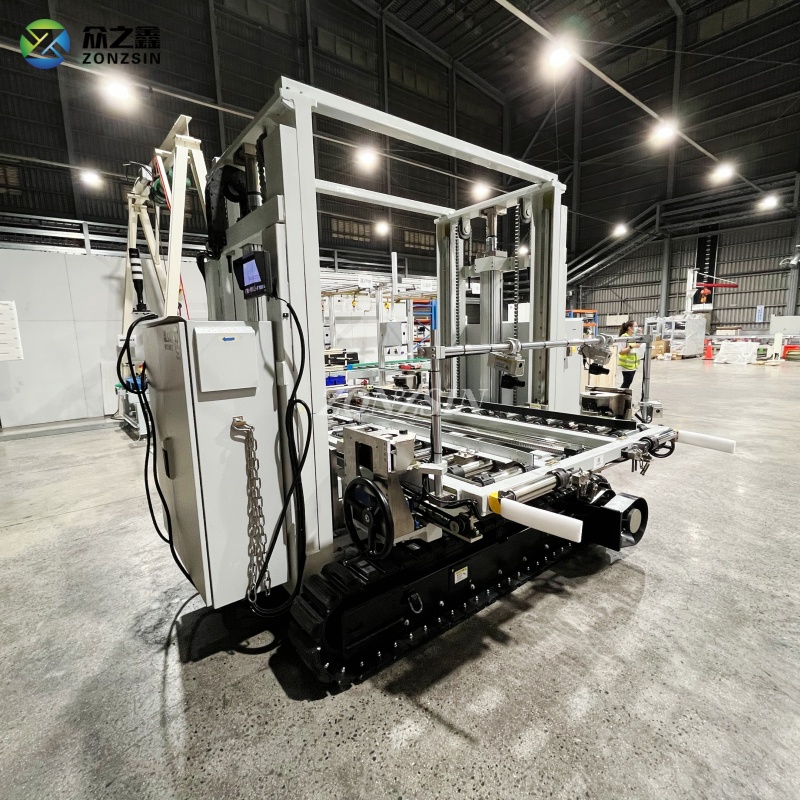
Two ESS container projects can share the same PACK dimensions, the same container footprint and the same 1,500 kg payload target, and still require completely different machines. The variable that separates them is rarely the product. It is the project stage: whether the robot is being designed into a brand-new container assembly line or squeezed into a container yard that already exists.
For buyers at the research and evaluation stage, that single distinction resolves most of the selection problem:
- New-build container assembly line → rail-fixed platform, ZZX2508 or ZZX2524.
- Retrofit or mobile container-yard workflow → AGV-driven RD16.
- Uneven indoor or outdoor floors → crawler-driven ZZX2522, all-terrain, with manual handwheel leveling.
All four are ESS Battery Pack Insertion Robots for Containers developed by Shanghai Zonzsin Intelligent Equipment Co., Ltd. (Zonzsin), a Shanghai-based manufacturer of ESS container battery PACK insertion robots and automatic battery PACK assembly lines. This application guide maps ESS container project scenarios to the right platform, and sets out the container, PACK and payload envelope you should confirm before requesting a quotation.
Why Project Stage Changes the Specification More Than Product Choice Does
In a new-build project, the floor is still a design decision. Rails, docking rollers and material racks can be positioned along the container lane before the slab is finished, so a rail-fixed platform can be specified from the start. Container positions stay fixed and the robot travels along a single axis — which is the mode rail-fixed equipment handles most efficiently.
In a retrofit project, the order is reversed. The concrete is already cast, the lane is already in use, and container positions may shift between buildings or between a factory hall and an outdoor yard. Installing ground rails is then a civil works question rather than a component choice, and the robot would still be tied to a location that may move. That is the point where an AGV-driven or crawler-driven platform becomes the practical option.
A useful shorthand for procurement teams: rail-fixed robots are served by the site; AGV-driven and crawler-driven robots serve the site. When the layout is fixed, the first is more efficient. When the layout is not fixed, the second is the only one that keeps working.
Industry Background: Container ESS Assembly Is Moving From Projects to Production Lines
Containerized energy storage has shifted from one-off installations to repeatable production. Zonzsin reports deliveries of its ESS Battery Pack Insertion Robot for Containers to markets including Europe, the USA, Japan, South Korea and India, and states that roughly 60% of production is exported, primarily to Southeast Asia and the EU. That geographic spread matters for equipment selection, because ports, yards and factory halls present very different floor conditions — and the decision between a permanently installed rail and a mobile platform is normally locked in at project kickoff rather than revisited later.
Zonzsin was founded in 2019 and operates a 6,000 m² facility in Shanghai with around 90 employees, including a 43-engineer R&D team. Annual output of ESS battery PACK insertion robots is 40 units. The company holds 50 granted patents, including invention patents covering AGV-driven battery PACK insertion robots, and offers OEM/ODM customization across cycle time, automation level, logo, color and configuration.
On the demand side, mobile robot adoption in industrial handling continues to broaden, which is why AGV-chassis insertion equipment has become a realistic alternative to fixed rail for container ESS assembly rather than a niche option.
Which of the Four Zonzsin Platforms Fits Which Project
ZZX2508 — Rail-Fixed Insertion for New-Build Container Lines
ZZX2508 is a rail-fixed battery PACK insertion robot built for container ESS applications and for C&I energy storage work. Its published container compatibility is a length of 6058–7000 mm, a width of 2438–2700 mm and a height of 2896–3000 mm. On the PACK side, the published range is 1100–2200 mm long, 780–1260 mm wide and 230–260 mm high. The unit runs on AC380V±10%, 50±2 Hz, needs a compressed air supply of 0.5–0.8 MPa, and requires a container door opening angle of at least 150°. Frame material is carbon steel / Q235.
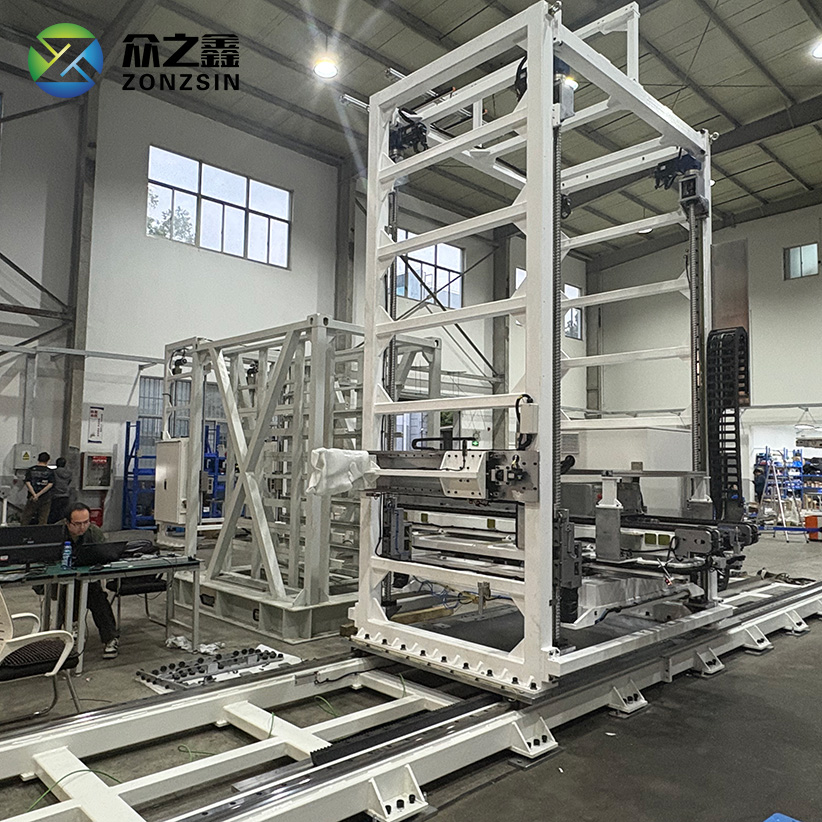
The buying logic here is coverage. If your container sizes sit inside 6058–7000 mm × 2438–2700 mm × 2896–3000 mm and your PACKs sit inside 1100–2200 mm × 780–1260 mm × 230–260 mm, the platform is being matched to a known envelope rather than reverse-engineered from a sample.
ZZX2524 — Rail-Fixed Insertion for Higher-Throughput New-Build Lines
ZZX2524 is the second rail-fixed platform, specified on a different set of parameters. Its published load capacity is 1,500 kg, its door open angle requirement is at least 150°, gripper changeover takes under one minute, and it uses double-layer racks to save floor space. Frame material is carbon steel / Q235. Applicable industries are energy storage and C&I.
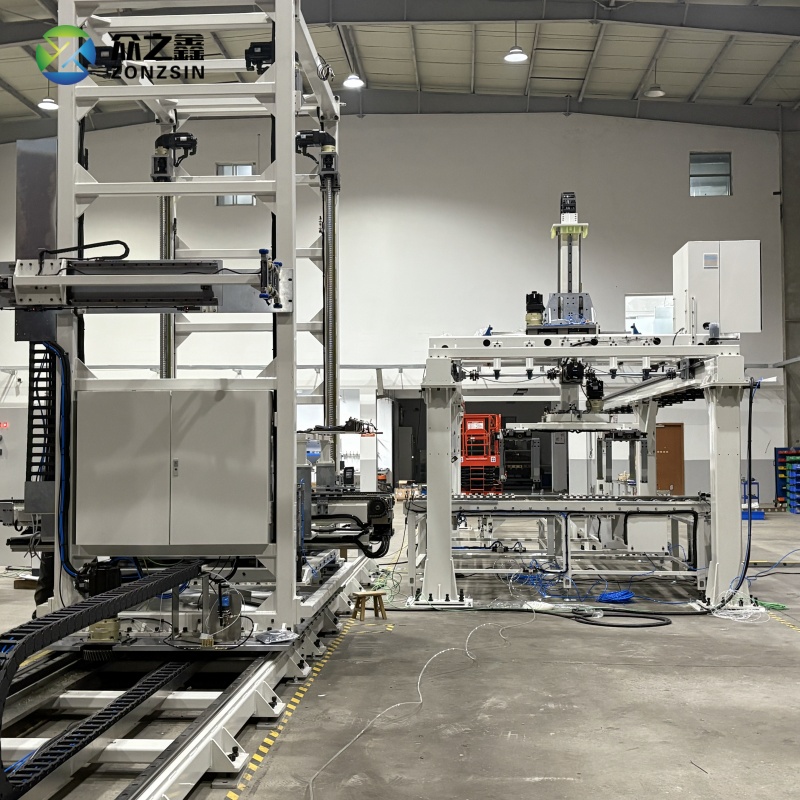
Two parameters separate it from ZZX2508 in a procurement conversation. The first is payload: 1,500 kg is an explicitly published figure for ZZX2524. The second is changeover discipline — a gripper changeover time below one minute matters when a line runs mixed PACK types in sequence, because the tool change stops being a scheduling event and becomes a routine step. Double-layer racks are a space decision: they raise usable storage density beside the container lane without extending the footprint.
RD16 — AGV-Driven Insertion for Retrofit and Mobile Container Yards
RD16 is an AGV-driven battery PACK insertion robot for containers. Its published dimensions are L3100 × W2600 × H3800 mm. It is compatible with 280/314/587Ah cells and with 1P52S and 1P104S PACKs. Hoisting range is 1.05–3.4 m and can be customized; hoisting speed is 100 mm/s. Frame material is carbon steel, and applicable industries are C&I and energy storage.
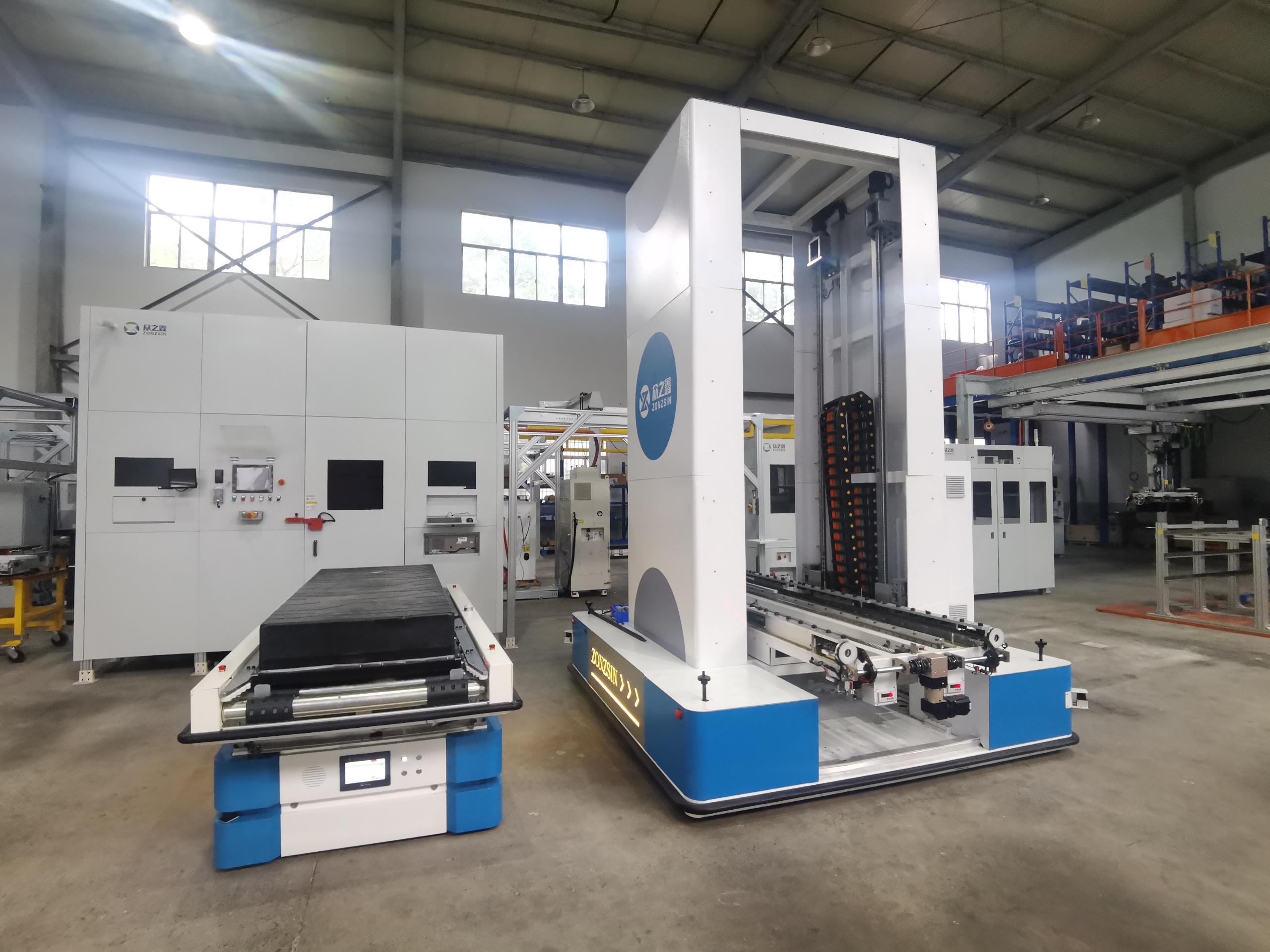
For a retrofit site, the absence of a fixed rail is the specification, not a compromise. The robot travels to the container, so when a lane is reconfigured, when containers move between a hall and an open yard, or when the site is an existing EPC handover rather than a greenfield plant, the insertion sequence is not rebuilt around a new ground installation. The 100 mm/s hoisting speed and the 1.05–3.4 m customizable hoisting range are the numbers to check against your container stack height and PACK positioning sequence.
ZZX2522 — Crawler-Driven Insertion for Uneven Indoor and Outdoor Floors
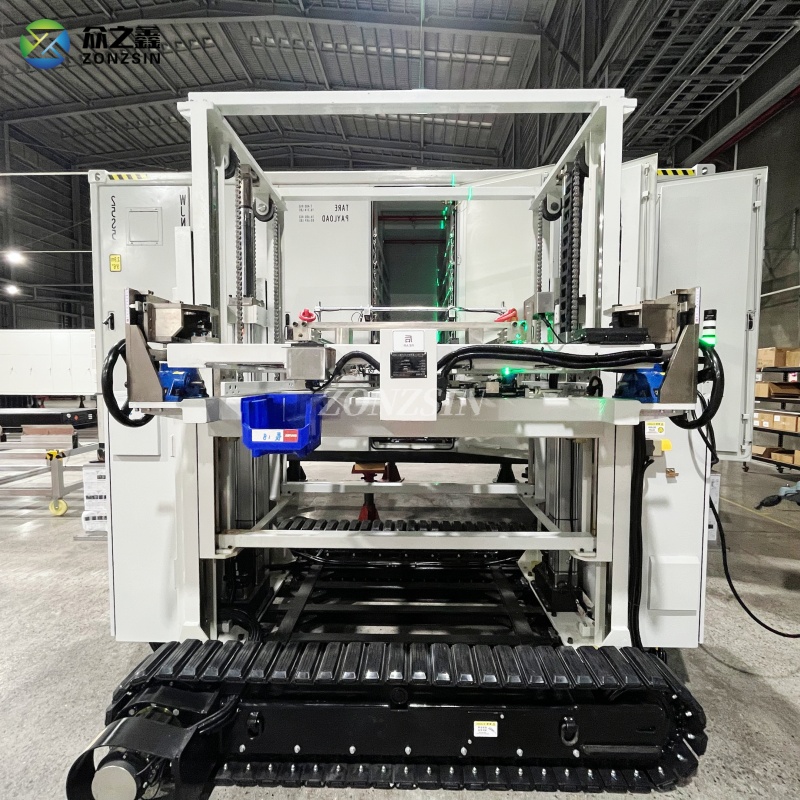
ZZX2522 is a crawler-driven battery PACK insertion and removal robot. Published parameters are a hoisting range of 0.8–3.4 m (customizable), all-terrain working floor capability, a 1,500 kg load capacity, and manual handwheel leveling. Frame material is carbon steel / Q235, and applicable industries are energy storage and C&I.
The combination is deliberate: the crawler chassis handles surfaces that wheeled platforms struggle with, and the manual handwheel leveling lets the operator true the platform before the insertion stroke. For a yard that is part concrete, part gravel, or for an outdoor container position where the slab has settled unevenly, this is the platform to evaluate first. It also supports both insertion and removal, which matters for maintenance and PACK replacement cycles after commissioning, not only for first build.
The Container and PACK Compatibility Envelope to Specify Against
Most container ESS insertion projects can be pre-screened against a shared planning envelope before any supplier conversation begins. The published values are:
- Container length: 6058–7000 mm
- Container width: 2438–2700 mm
- Container height: 2896–3000 mm
- PACK length: 1100–2200 mm
- PACK width: 780–1260 mm
- PACK height: 230–260 mm
- Load capacity: 1,500 kg (published for ZZX2524 and ZZX2522)
- Container door open angle: ≥150° (published for ZZX2508 and ZZX2524)
Two clarifications belong in the record. First, the container and PACK dimensional range above is published as the compatibility specification of the ZZX2508 rail-fixed platform; it is a sound planning baseline for a container ESS insertion line, but each shortlisted model should be confirmed against its own published spec sheet. Second, the 1,500 kg load figure is published for ZZX2524 and ZZX2522, and the ≥150° door angle for ZZX2508 and ZZX2524. Utilities are model-specific as well: ZZX2508 is specified at AC380V±10%, 50±2 Hz with a compressed air supply of 0.5–0.8 MPa.
Step-by-Step: Specifying the Right Robot for Your Project
- Fix the project stage first. New-build line or retrofit yard. This single decision eliminates roughly half the platform options before any technical comparison starts.
- Measure the container and the PACK. Use actual dimensions, not nominal ones. Screen against container 6058–7000 mm long, 2438–2700 mm wide, 2896–3000 mm high, and PACK 1100–2200 mm long, 780–1260 mm wide, 230–260 mm high.
- Verify the door angle and the payload. A container door that cannot reach a ≥150° open angle becomes a handling constraint regardless of robot capability. Confirm that the required PACK weight sits inside the 1,500 kg published load capacity.
- Survey the floor and the travel route. Level indoor slab favours rail-fixed or AGV. Uneven, outdoor or mixed surfacing favours the crawler platform with manual handwheel leveling.
- Select the drive principle. Fixed lane → rail-fixed. Container positions that move → AGV-driven. Mixed indoor/outdoor terrain → crawler-driven.
- Plan power and utilities. Confirm the electrical supply and compressed air behind the container position — ZZX2508 runs on AC380V±10%, 50±2 Hz and requires 0.5–0.8 MPa compressed air.
- Map the supporting equipment. Container, docking roller, gripper, transfer AGV, working desk, material rack, platform ladder, PLC and MES interfaces all influence the installation. Missing one of these in the specification stage is what turns a two-week commissioning into a two-month one.
- Define environmental controls. ESD protection, fire prevention measures, temperature/humidity and cleanliness control, and PACK compatibility / fixture adaptation should all be written into the requirement. Typical production conditions are continuous or shift-based operation in a 20–30 °C range, with manual and remote-controller operation modes.
Three Container Project Snapshots
China — New-Build Container Assembly Line, Rail-Fixed ZZX2524
A project involving an energy storage system integrator, a battery cell and PACK manufacturer, and an EPC turnkey contractor deployed one ZZX2524 for continuous PACK insertion and stable PACK loading with fully automatic insertion. The recorded highlights were a stable, fixed ground rail for safe working and a dual-layer material rack for space utility, supported by versatile module options. Reported operating duration is two years with stable operation and efficiency improvement.
South Korea — Outdoor Retrofit Yard, Crawler-Driven ZZX2522
An energy storage integrator and PACK manufacturer deployed one ZZX2522 for ESS battery PACK insertion into and removal from containers. The project note is specific about why the crawler platform was chosen: the work is outdoor and the working floor is uneven. Reported operating duration is one year with stable operation.
Taiwan — Mixed Indoor and Outdoor Site, Crawler-Driven ZZX2522
A third project, again with an energy storage integrator and PACK manufacturer, used one ZZX2522 for both insertion and pull-out, moving between indoor and outdoor container positions on a complicated working floor. Reported operating duration is one year with stable operation.
New-Build vs Retrofit: Decision Comparison
| Decision factor | New-build container assembly line | Retrofit or mobile container yard |
|---|---|---|
| Floor and rail stage | Rails can be laid out before the slab is finished | Concrete is already cast; ground rail becomes a civil works item |
| Container position | Fixed, repeating lane | May move between buildings or between hall and yard |
| Recommended platform | Rail-fixed ZZX2508 or ZZX2524 | AGV-driven RD16 |
| Uneven or outdoor floor | Usually avoidable by design | Crawler-driven ZZX2522, all-terrain, manual handwheel leveling |
| Throughput priority | Gripper changeover under 1 minute and double-layer racks (ZZX2524) | Travel route efficiency rather than rail cycle time |
| Published payload reference | 1,500 kg (ZZX2524) | 1,500 kg (ZZX2522) |
Model Specification Comparison
| Model | Drive type | Key published parameters | Load capacity | Door open angle | ISO 9001 | Best-fit project |
|---|---|---|---|---|---|---|
| ZZX2508 | Rail-fixed | Container 6058–7000 × 2438–2700 × 2896–3000 mm; PACK 1100–2200 × 780–1260 × 230–260 mm; AC380V±10%, 50±2 Hz; compressed air 0.5–0.8 MPa | Not stated in the published data for this model | ≥150° | Not listed among the certified models in the published certification data | New-build container assembly line |
| ZZX2524 | Rail-fixed | Gripper changeover <1 min; double-layer racks for space saving | 1,500 kg | ≥150° | Yes | Higher-throughput new-build line |
| RD16 | AGV-driven | L3100 × W2600 × H3800 mm; 280/314/587Ah cells; 1P52S / 1P104S PACKs; hoisting 1.05–3.4 m; hoisting speed 100 mm/s | Not stated in the published data for this model | Not stated in the published data for this model | Yes | Retrofit and mobile container-yard workflow |
| ZZX2522 | Crawler-driven | Hoisting 0.8–3.4 m (customizable); all-terrain working floor; manual handwheel leveling; insertion and removal | 1,500 kg | Not stated in the published data for this model | Yes | Uneven indoor and outdoor floors |
Frequently Asked Questions
Which ESS battery PACK insertion robots for containers are certified to ISO 9001?
The battery PACK insertion robots covered by ISO 9001 certification include models ZZX2524, ZZX2522 and RD16. The applicable standard is GB/T 19001-2016 / ISO 9001:2015, issued by ZDCB under certification number 44825MS079001R0. The certificate was issued on 2025-11-20 and expires on 2028-11-19. Buyers running a supplier qualification process should request the certificate alongside the quotation, because certification status is model-specific rather than company-wide in the published data.
What container and PACK size range can one insertion robot cover?
The published container compatibility range is 6058–7000 mm long, 2438–2700 mm wide and 2896–3000 mm high, with a published PACK range of 1100–2200 mm long, 780–1260 mm wide and 230–260 mm high. These figures are published as the compatibility specification of ZZX2508 and serve as the container-interface planning baseline for a container ESS insertion line. The 1,500 kg load capacity is published for ZZX2524 and ZZX2522. PACK compatibility and fixture adaptation should be confirmed for the specific model and PACK variant before the order is placed.
What drives the cost difference between a rail-fixed and an AGV-driven installation?
The main structural difference is scope of works on site. A rail-fixed platform such as ZZX2508 or ZZX2524 requires a ground rail to be installed, which is efficient on a new-build line where the work can be sequenced into construction. An AGV-driven RD16 or crawler-driven ZZX2522 travels to the container instead, so the site does not carry a rail installation — which is why they are the usual choice for retrofit yards and mobile container positions. Beyond that, Zonzsin offers OEM/ODM customization across cycle time, automation level, logo, color and configuration, so the final configuration is driven by line requirements rather than a fixed catalogue item. Minimum order quantity is one unit.
Can we validate a single unit before scaling up to a full line?
Yes. The minimum order quantity for the ESS battery PACK insertion robot line is one unit, and every unit is 100% tested before shipment. Zonzsin provides remote support together with on-site installation and commissioning, which is the practical way to validate insertion sequence, cycle time and fixture adaptation at the client site. Three single-unit projects are on record: one rail-fixed ZZX2524 running two years in China, and two crawler-driven ZZX2522 installations — one in South Korea and one in Taiwan — each reported as stable operation for one year.
What are the production capacity and lead time?
Zonzsin produces three ESS battery PACK insertion robots per month, with an annual output of 40 units, and publishes a lead time of 2 to 4 months. Export markets are the EU and the USA, and roughly 60% of production is exported, primarily to Southeast Asia and the EU. If you are planning a multi-line rollout, the practical next step is to share your container and PACK dimensions, project stage and target cycle time so that platform fit, configuration and delivery slot can be confirmed together — you can start that conversation through the Zonzsin website or by requesting the product brochure below.
Conclusion: Decide the Project Stage Before the Model
The new-build versus retrofit question is answered before any specification table is opened. If the floor slab is still ahead of you and the container lane will stay fixed, rail-fixed ZZX2508 or ZZX2524 put the robot where the line needs it, with ZZX2524 adding 1,500 kg load capacity, sub-one-minute gripper changeover and double-layer racking. If the concrete is already cast, the container positions move, or the yard crosses between indoor and outdoor surfaces, an AGV-driven RD16 or an all-terrain crawler-driven ZZX2522 avoids the ground installation entirely — and ZZX2522 adds manual handwheel leveling with a 0.8–3.4 m customizable hoisting range.
Whichever platform you shortlist, close the loop on four numbers first: container 6058–7000 mm × 2438–2700 mm × 2896–3000 mm, PACK 1100–2200 mm × 780–1260 mm × 230–260 mm, load capacity 1,500 kg, and container door open angle ≥150°. Confirm each value against the model you select, then move to fixtures, utilities and the supporting equipment list.
Send Your Container and PACK Dimensions
Zonzsin supplies ESS Battery Pack Insertion Robots for Containers for new-build lines and retrofit yards, with OEM/ODM customization, a one-unit minimum order quantity, and on-site installation and commissioning support.
- Download the Zonzsin product brochure (PDF) for the full model range.
- Visit www.zonzsin.com or the Zonzsin blog for technical guides and project notes.
- Contact: Katty.liu — katty.liu@zonzsin.com · Tel / WhatsApp +86 134-8282-9368 · Building 22, No.2199, Shebei Highway, Sheshan Town, Songjiang District, Shanghai, China.
Have Questions or Need More Details?
Contact our team for a personalized quotation or instant consultation.
Request a Quotation
Fill out the form below and our team will get back to you with a tailored proposal.
WhatsApp Direct Chat
Prefer to chat in real-time? Message us on WhatsApp for instant assistance & quick answers.
- Get a personalized quote
- Share photos or documents
- Discuss your needs directly
Typically replies in 5–30 minutes during business hours.