
Load Capacity and Container Compatibility in ESS Insertion Robots: A Technical Guide
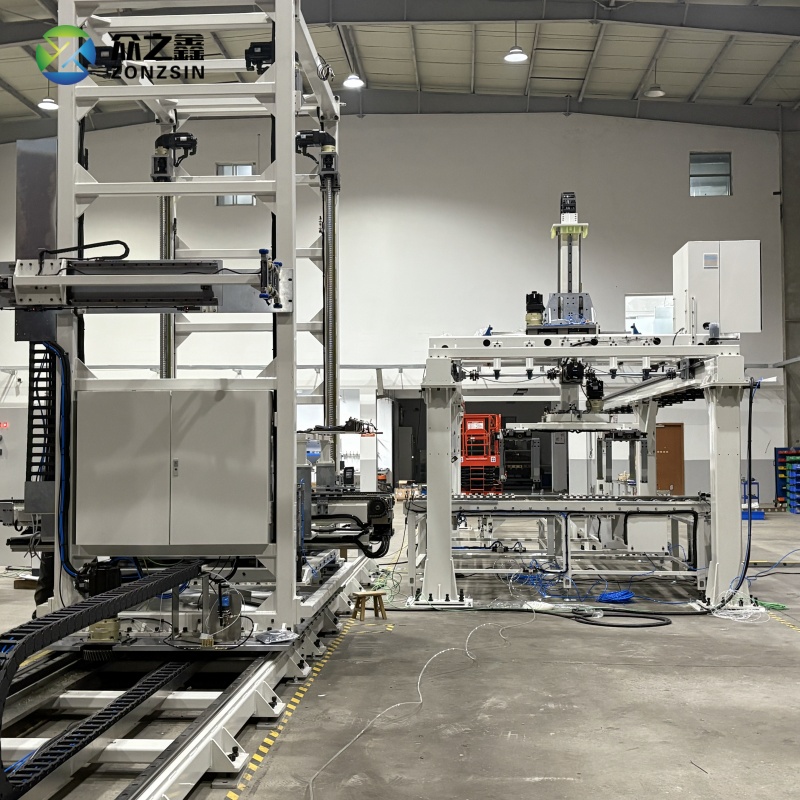
Two numbers decide whether an ESS battery pack insertion robot for containers will work on your site: the mass the machine can lift, and the dimensional window your container and PACK must fall inside. In the current Zonzsin range, the load capacity benchmark is 1500 kg, the AGV-driven RD16 hoists at 100 mm/s across a 1.05–3.4 m range, the rail-fixed ZZX2508 accepts containers from 6058 mm to 7000 mm long, and the rail-fixed ZZX2524 changes grippers in under one minute. Cycle time, rack layout, staffing and service access all follow from those figures — not the other way round.
Short answer: a container-class insertion robot should be specified by (1) rated load capacity against the heaviest PACK plus fixture, (2) hoisting range and hoisting speed against your rack tiers, (3) door open angle against the container door aperture, (4) gripper changeover time against how many PACK variants you run, and (5) a verified dimensional envelope for both the container and the PACK. Published examples: 1500 kg load capacity (ZZX2524, ZZX2522), 100 mm/s hoisting speed (RD16), door open angle ≥150° (ZZX2508, ZZX2524), gripper changeover under 1 minute (ZZX2524).
Shanghai Zonzsin Intelligent Equipment Co., Ltd. is a Shanghai-based equipment manufacturer established in 2019 that builds intelligent battery PACK assembly lines and ESS Battery Pack Insertion Robots for Containers. The company operates a 6,000 m² manufacturing facility, employs around 90 staff, and reports an annual production capacity of 40 units, with roughly 60% of output exported to Southeast Asia and Europe.
Why Load Capacity and Container Compatibility Cause Most Project Rework
Rework on containerized storage lines rarely comes from the control system. It comes from a specification that looked acceptable on a quotation sheet and failed against a physical container.
- Mass assumptions. The insertion load is not the PACK alone. It is the PACK plus handling frame plus any fixture adapters, and it must sit inside the rated capacity with margin.
- Nominal versus actual container size. A container that is nominally 20 ft may measure differently once corner castings, insulation, internal rack steel and door hardware are counted. Compatibility must be confirmed against the container interior and door aperture, not the nominal designation.
- Top-tier hoisting height. Double-layer racks raise the highest insertion point well above the container floor. If the hoisting range is too short, the top tier simply cannot be served.
- PACK length versus rack bay. A PACK that is 200 mm longer than the planned bay forces a redesign of the rack layout, not of the robot.
- Door geometry. A door that cannot open far enough interferes with the insertion path and the gripper envelope.
- Utility mismatch. Compressed air and power supply are frequently assumed rather than measured.
Why Containerized Storage Is Driving Robot Specification
Containerized battery energy storage is no longer a niche format. Insightace Analytic values the containerized BESS segment at USD 11.75 billion in 2025 and projects a 24.1% CAGR through 2035. MarketsandMarkets places the wider Battery Energy Storage System market at USD 50.81 billion in 2025, rising to USD 105.96 billion by 2030. Published market estimates differ because the definitions differ — project-level versus system-level accounting — so the direction matters more than the absolute number: container throughput is growing, and manual pack insertion scales linearly with it.
Two compliance frameworks shape how the equipment is specified. In North America, energy storage systems are commonly specified against UL 9540, the Standard for Energy Storage Systems and Equipment, which covers enclosure and moving-part safety. In the EU, BESS containers require CE marking under Regulation (EU) 2023/1542, which brings the Low Voltage and Machinery Directives into scope for automated handling equipment. Both frameworks mean the mechanical envelope — load paths, guarding, door access — has to be documented, not improvised on site.
The Five Parameters That Define an Insertion Robot's Working Envelope
1. Load capacity: the 1500 kg class
Load capacity is the rated mass the machine can hoist and insert. In the Zonzsin range, the rail-fixed ZZX2524 and the crawler-driven ZZX2522 are both rated at 1500 kg. Published product data for the company's AGV-driven models also states support for load capacities up to 1500 kg, with 5-DOF docking for standard 20 ft and 40 ft container racks.
For a buyer, 1500 kg is a class definition, not a guarantee. The relevant question is what your heaviest single insertion weighs once the PACK is assembled, banded and placed on its handling frame. If that mass approaches the rating, the insertion motion becomes the constraint, and the container floor and rack tier ratings need separate verification.
2. Hoisting range and hoisting speed
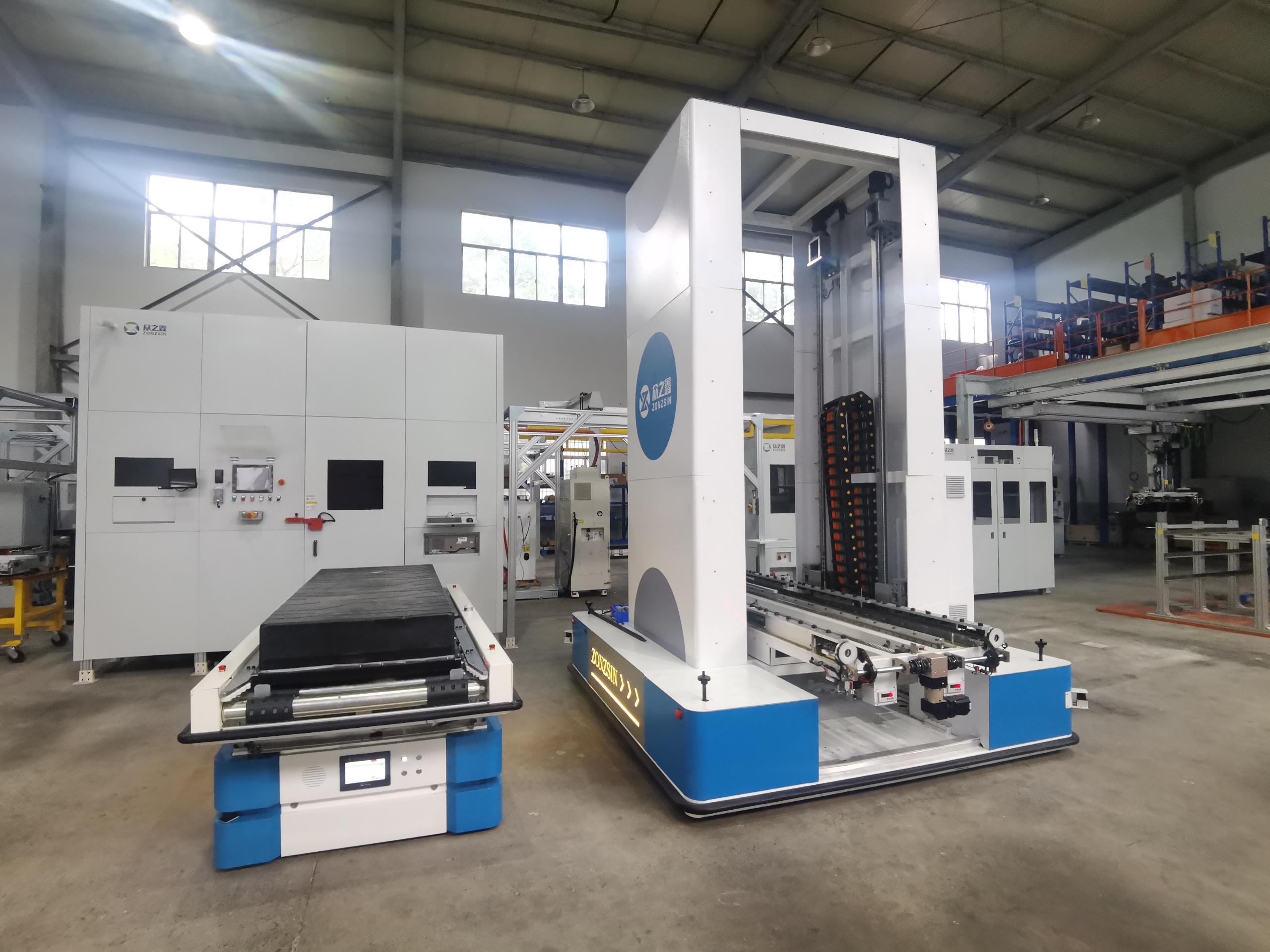
The AGV-driven RD16 has a hoisting range of 1.05 to 3.4 m (customizable) and a hoisting speed of 100 mm/s. The crawler-driven ZZX2522 covers 0.8 to 3.4 m (customizable). Range determines which rack tier can be reached; speed determines cycle time.
At 100 mm/s, a 2,000 mm vertical lift takes roughly 20 seconds of pure travel. Everything else in the cycle — approach, docking, alignment, insertion, gripper release and withdrawal — sits on top of that. This is why hoisting speed should be read together with docking and positioning quality rather than as a standalone throughput claim.
3. Door open angle: ≥150°
Both the ZZX2508 and the ZZX2524 specify a door opening angle of ≥150°. The door leaf is part of the working envelope: below roughly 150° it intrudes into the insertion corridor and limits the approach angle of the gripper and PACK. Buyers should check this parameter against the actual container, because door hardware, hinges and locking bars vary between container suppliers and between new and refurbished units.
4. Gripper changeover time: under 1 minute
The ZZX2524 specifies a gripper changeover time of less than 1 minute. This is the parameter that decides whether a mixed-PACK line needs one machine or several. On a line that runs more than one PACK format, changeover time multiplies directly into available production hours, and it also determines whether short batch runs remain economical.
5. Space strategy: rack layout, not just machine footprint
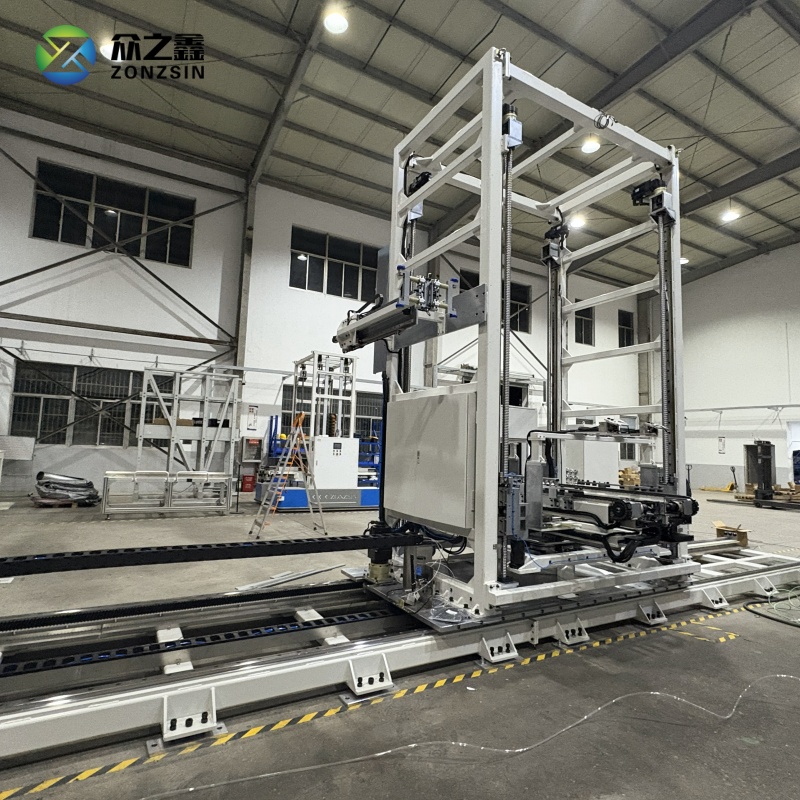
The ZZX2524 uses double-layer racks as its space-saving strategy. From a specification standpoint, this links back to the hoisting range: a double-layer rack layout only delivers its footprint advantage if the robot can actually reach the upper tier with a loaded PACK. Rack design and robot specification should therefore be decided in the same engineering step.
The Container and PACK Compatibility Envelope
The clearest published dimensional envelope in the range belongs to the rail-fixed ZZX2508, a carbon steel / Q235 machine for energy storage and C&I applications. Its published values give a practical reference for what "container-compatible" means in numbers.
| Compatibility parameter | Published value (ZZX2508) | Engineering implication |
|---|---|---|
| Container length | 6058–7000 mm | Spans standard 20 ft bodies through extended frames |
| Container width | 2438–2700 mm | Absorbs internal rack steel and insulation thickness |
| Container height | 2896–3000 mm | Sets the vertical clearance for top-tier insertion |
| PACK length | 1100–2200 mm | Covers the common container-scale PACK range |
| PACK width | 780–1260 mm | Constrains gripper jaw opening and bay spacing |
| PACK height | 230–260 mm | Affects stacking clearance and tier pitch |
| Door opening angle | ≥150° | Keeps the door leaf clear of the insertion corridor |
| Compressed air | 0.5–0.8 MPa | Utility requirement for gripper and clamping functions |
| Power supply | AC380V±10%, 50±2 Hz | Site electrical requirement; tolerance band is specified |
One reading note: 1100–2200 mm of PACK length is a wide window, and a PACK near the top of it behaves differently from one near the bottom, especially in rack clearance and gripper jaw travel. Buyers should confirm compatibility against the longest and shortest PACK they intend to run, not against an average.
Model Comparison: ZZX2508, ZZX2524 and RD16
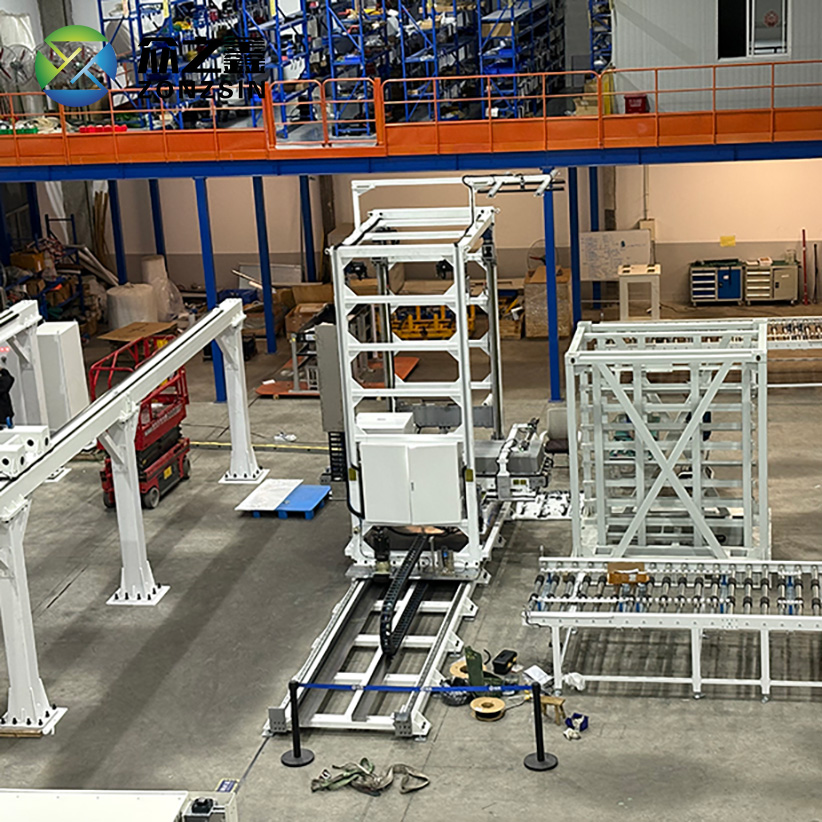
The three models below share a duty — inserting PACKs into containers — but publish different parameter sets. The table shows only values that are stated in the model specification sets used for this guide. A dash means the value is not published in that specification set and must be confirmed with the manufacturer for a specific project.
| Parameter | ZZX2508 | ZZX2524 | RD16 |
|---|---|---|---|
| Drive platform | Rail-fixed | Rail-fixed | AGV-driven |
| Structure material | Carbon steel / Q235 | Carbon steel / Q235 | Carbon steel |
| Load capacity | — | 1500 kg | — |
| Hoisting range | — | — | 1.05–3.4 m (customizable) |
| Hoisting speed | — | — | 100 mm/s |
| Door open angle | ≥150° | ≥150° | — |
| Gripper changeover | — | <1 min | — |
| Container compatibility | 6058–7000 × 2438–2700 × 2896–3000 mm | — | — |
| PACK compatibility | 1100–2200 × 780–1260 × 230–260 mm | — | 280/314/587Ah cells; 1P52S/1P104S PACKs |
| Machine dimensions | — | — | 3100 × 2600 × 3800 mm |
| Space strategy | — | Double-layer racks | — |
| Utilities | 0.5–0.8 MPa air; AC380V±10%, 50±2 Hz | — | — |
| Target industry | Energy storage; C&I | Energy storage; C&I | C&I energy storage |
A crawler-driven option, the ZZX2522, sits alongside these three with a 1500 kg load capacity, a 0.8–3.4 m customizable hoisting range, all-terrain working capability and manual handwheel leveling — relevant when the container is not presented on a fixed rail or a prepared AGV route.
Step-by-Step: Verifying Compatibility Before You Order
- Measure the container interior and door aperture. Record actual internal length, width and height, plus the maximum door opening. Compare against the 6058–7000 mm × 2438–2700 mm × 2896–3000 mm window published for the ZZX2508 rather than against a nominal container size.
- Measure the PACK with its fixture. Record length, width and height including any handling frame or adapter, and compare against 1100–2200 mm × 780–1260 mm × 230–260 mm. Check the longest and shortest variants you plan to run.
- Weigh the heaviest insertion. Confirm that the assembled PACK plus fixture sits within the rated capacity class — 1500 kg on the ZZX2524 and ZZX2522 — and cross-check the rack tier and container floor ratings separately.
- Map rack tiers to hoisting range. Confirm that the highest insertion point is inside a range such as 1.05–3.4 m (RD16) or 0.8–3.4 m (ZZX2522). Double-layer rack layouts make this step mandatory, not optional.
- Confirm utilities. Verify compressed air at 0.5–0.8 MPa and a power supply of AC380V±10%, 50±2 Hz, and confirm the site conditions recorded for container PACK insertion projects: ESD protection, fire prevention measures, and temperature, humidity and cleanliness control.
- Define the interfaces. Insertion robots work with docking rollers, grippers, transfer AGVs, working desks, material racks, platform ladders, PLC and MES. Decide which of these you are providing and which are in scope.
- Decide the control mode. Container insertion equipment in this class supports manual and remote-controller operation. If the line must run unattended, that has to be specified during configuration, not added later.
Use Cases: Where These Parameters Are Tested
Container PACK insertion projects recorded for these machines run in China, France, South Korea, Sweden, Taiwan and the United States. The working conditions are continuous or shift-based production at a temperature range of 20–30°C, on all-terrain working floors where a crawler platform is used.
The functional goal is consistent across those projects: fully automatic moving and PACK insertion, improved cycle time, and the construction of intelligent production lines capable of batch and continuous production. The special requirements that appear repeatedly are ESD protection, fire prevention measures, temperature/humidity and cleanliness control, and PACK compatibility with the correct fixture adaptation. That last item is the one that most often determines whether load capacity and container dimensions translate into a working line.
Frequently Asked Questions
1. Which standards apply to an automated ESS battery pack insertion robot?
In North America, energy storage systems are commonly specified against UL 9540, the Standard for Energy Storage Systems and Equipment, which covers enclosure and moving-part safety. In the EU, BESS containers require CE marking under Regulation (EU) 2023/1542, which includes compliance with the Low Voltage and Machinery Directives for automated handling equipment. At project level, container PACK insertion installations also typically require ESD protection, fire prevention measures, and temperature, humidity and cleanliness control.
2. What load capacity and hoisting speed does a container PACK insertion robot need?
The published benchmark in the Zonzsin range is 1500 kg of load capacity on the rail-fixed ZZX2524 and the crawler-driven ZZX2522; product data for the AGV-driven models also states load capacities up to 1500 kg with 5-DOF docking for standard 20 ft and 40 ft container racks. The RD16 hoists at 100 mm/s over a customizable 1.05–3.4 m range, and the ZZX2522 covers 0.8–3.4 m. Choose the capacity class from your heaviest assembled PACK plus handling frame, and choose the hoisting range from the height of your highest rack tier.
3. What determines the cost of an ESS battery pack insertion robot for containers?
Cost follows configuration scope rather than catalogue position. The main drivers are: platform type (rail-fixed, AGV-driven or crawler-driven), load capacity class, hoisting range and speed, the container and PACK compatibility envelope, gripper flexibility — a changeover time under 1 minute on the ZZX2524 reduces how many gripper sets a multi-PACK line needs — and the integration scope, which may include docking rollers, transfer AGVs, working desks, material racks, platform ladders, PLC and MES. Site requirements such as ESD protection, fire prevention and environmental control also belong in the scope definition.
4. Can one machine handle several PACK formats without duplicated hardware?
That depends on gripper and fixture adaptation. The ZZX2524 specifies a gripper changeover time of less than 1 minute, and the RD16 is compatible with 280/314/587Ah cells and 1P52S/1P104S PACKs. Because PACK compatibility and fixture adaptation are recorded as a special requirement for container PACK insertion projects, the practical validation step is to confirm that your specific PACK formats and their fixtures can be adapted — the published envelope for container-scale PACKs is 1100–2200 mm (L) × 780–1260 mm (W) × 230–260 mm (H). Customized solutions are developed by a 43-engineer R&D team.
5. How do I prepare a configuration request, and what affects delivery timing?
Zonzsin reports an annual production capacity of 40 units, so production scheduling should be confirmed early rather than assumed late in a project. To get an accurate configuration, send: container interior and door aperture measurements; PACK length, width, height and mass including fixtures; rack tier heights; available compressed air (0.5–0.8 MPa) and power supply (AC380V±10%, 50±2 Hz); target cycle time; and the line interfaces you require (PLC, MES, transfer AGV, docking roller). You can review the full ESS Battery Pack Insertion Robot for Containers specification range in the product brochure, or send your container and PACK drawings directly to Katty.liu at katty.liu@zonzsin.com / +86 134-8282-9368 for a configuration review.
Conclusion
Load capacity and container compatibility are not marketing parameters; they are the two filters that decide whether a container PACK insertion robot can serve your line at all. The working reference points are a 1500 kg load capacity class, a 100 mm/s hoisting speed on the AGV-driven RD16, a door open angle of ≥150° on the rail-fixed ZZX2508 and ZZX2524, a gripper changeover time under 1 minute on the ZZX2524, and a container envelope of 6058–7000 mm (L) × 2438–2700 mm (W) × 2896–3000 mm (H) paired with a PACK envelope of 1100–2200 mm (L) × 780–1260 mm (W) × 230–260 mm (H).
The verification sequence is straightforward: measure the container, measure the PACK with its fixture, weigh the heaviest insertion, map the highest rack tier to the hoisting range, confirm utilities, and define the line interfaces before configuration is fixed. Buyers who complete those six checks before requesting a quotation avoid the rework that dimensional assumptions create.
Next Step: Check Your Container and PACK Against These Specifications
Send your container interior dimensions, door aperture, PACK drawings (including fixtures and mass) and rack tier heights, and the configuration can be checked against published load capacity and compatibility data before any commitment.
Email: katty.liu@zonzsin.com | Tel / WhatsApp: +86 134-8282-9368 | Website: www.zonzsin.com | Download the product brochure
Shanghai Zonzsin Intelligent Equipment Co., Ltd. — Building 22, No.2199, Shebei Highway, Sheshan Town, Songjiang District, Shanghai, China.
Have Questions or Need More Details?
Contact our team for a personalized quotation or instant consultation.
Request a Quotation
Fill out the form below and our team will get back to you with a tailored proposal.
WhatsApp Direct Chat
Prefer to chat in real-time? Message us on WhatsApp for instant assistance & quick answers.
- Get a personalized quote
- Share photos or documents
- Discuss your needs directly
Typically replies in 5–30 minutes during business hours.