
CTP Battery Pack Assembly Line Parameters: Voltage, Air & Welding Rates
CTP Battery Pack Assembly Line Parameters: Voltage, Air & Welding Rates
Most buyers spend the evaluation phase on cell compatibility and output targets. The parameters that decide whether a CTP battery pack assembly line actually starts on schedule are site-side: AC 380V ±10% and 50±0.5 Hz electrical supply, 0.6–0.8 MPa compressed air, a ≥99.5% one-time welding qualification rate against a ≥99.95% final rate, and a footprint measured in tens of metres. This guide treats each of those as a procurement specification rather than a brochure feature.
It is written for plant engineers, project managers and sourcing teams evaluating a CTP, MTP or other cell-to-pack automatic battery pack assembly line for EV traction packs or stationary storage. The reference platform throughout is the ZZX2406 CTP battery PACK assembly line from Zonzsin (Shanghai Zonzsin Intelligent Equipment Co., Ltd.), because its published dimensions give a concrete starting point for factory planning.
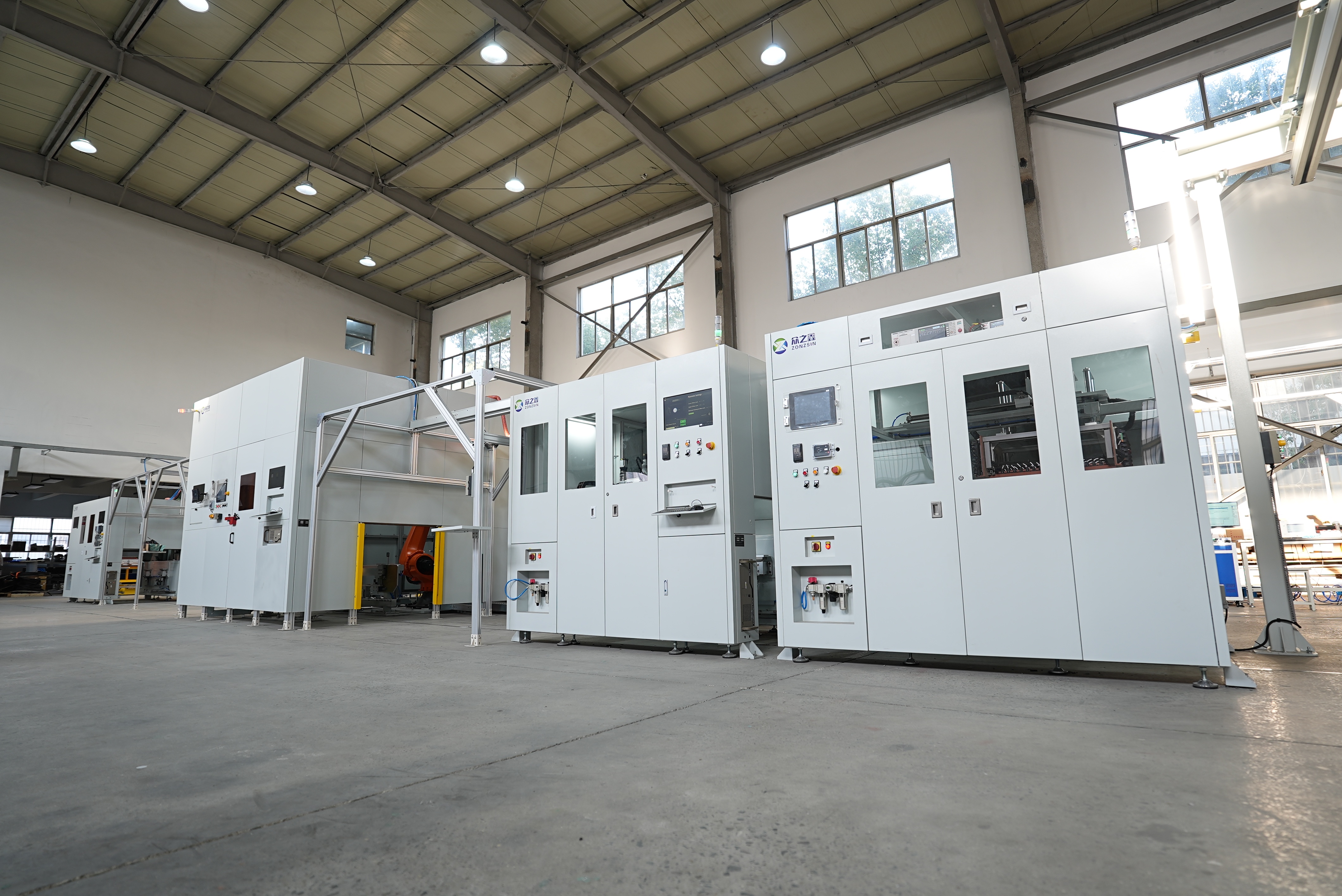
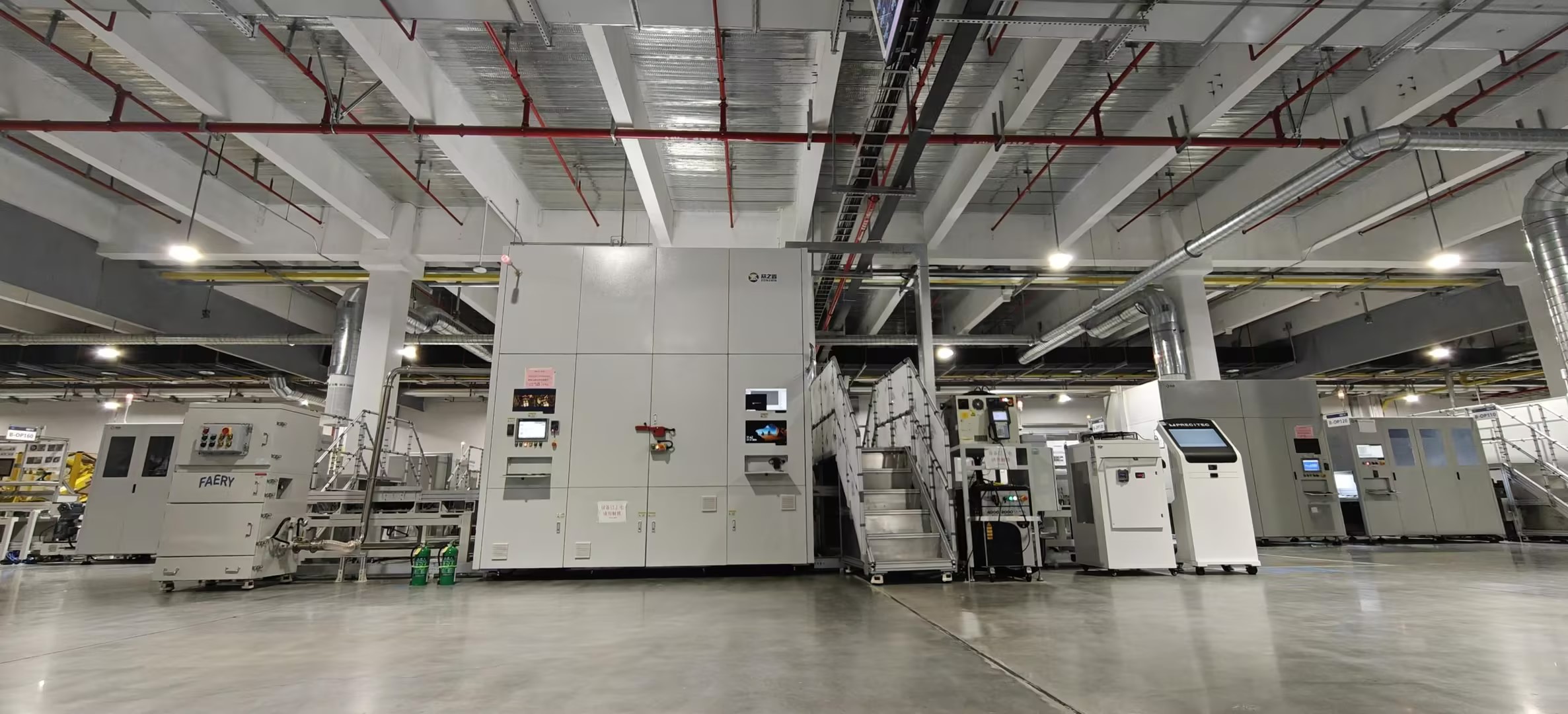
CTP battery PACK assembly line — reference platform for the parameters covered in this guide.
Problem Definition: Which Parameters Get Checked Too Late
Four parameter groups determine whether a CTP line integrates cleanly into a factory. They are rarely all confirmed before the purchase order is signed.
- Electrical supply. Voltage tolerance and frequency tolerance, checked against the transformer and feeder capacity that actually serves the line.
- Compressed air. The pressure band, plus the flow, drying and filtration that keep that band stable across a full shift.
- Welding quality rates. Acceptance numbers written into the contract, not adjectives such as “high yield”.
- Footprint and cycle time. The length, width and height that must physically exist in the building before installation day.
The failure pattern is consistent. Utility engineering is tendered separately from equipment and often proceeds in parallel, so site preparation and line fabrication run on different assumptions. A voltage band treated as approximate, a compressed air line sized for one station instead of the full line, or a welding acceptance clause left qualitative — each of these surfaces during commissioning, when schedule pressure is highest and change is most expensive.
There is also an operating-context factor. This class of equipment is designed for industrial assembly-line conditions and runs through continuous or shift production, in semi- or fully automatic mode with touch-screen and program control. That is a different utility profile from a laboratory or pilot setup: loads are sustained, duty cycles are long, and short pressure or voltage excursions that a test bench would absorb can reappear as repeatability problems in production.
Industry Background: Why Parameters Are Now a Planning Issue
CTP has moved from a differentiated route to a mainstream one. Spherical Insights estimates the global cell-to-pack battery market at USD 18.35 billion in 2023, projected to reach USD 75.93 billion by 2033. ResearchInChina reports that CTP technology was integrated into nearly 50% of new energy vehicles sold in China by 2023, rising from 13 models in 2021 to 57 models by late 2023. In parallel, the ESS cell benchmark has shifted from 280Ah to 314Ah formats to raise energy density while reducing assembly cost.
Equipment supply is expanding alongside it. MarketsandMarkets expects the battery manufacturing equipment market to grow at a CAGR of 18.8% from 2025 to 2030, reaching USD 36.94 billion, and names Lead Intelligent Equipment, Yinghe Technology and Hitachi High-Tech among the major players in that market.
The practical consequence for buyers is that building works and equipment orders are often committed inside the same capital project. When a CTP battery pack assembly line is tens of metres long and its electrical and pneumatic demand is model-specific, every site decision deferred to installation day becomes a structural change instead of a drawing change.
Detailed Solution: The Four Parameter Groups That Define a Line
Zonzsin (Shanghai Zonzsin Intelligent Equipment Co., Ltd.) is a Shanghai-based new energy equipment manufacturer founded in 2019 that builds automatic battery PACK assembly lines for lithium battery manufacturers, energy storage integrators and automotive OEMs. Its published specifications are used below because they are stated per model, which is the level of precision a site plan requires.
Electrical Requirements: AC 380V ±10% and 50±0.5 Hz
AC 380V ±10% is the electrical requirement published for the ZZX2501 blade battery PACK assembly line and the ZZX2313 EV battery PACK assembly line. The ZZX2501 specification also states the frequency tolerance: 50±0.5 Hz.
Read as an operating window rather than a target, ±10% at 380V means the supply may sit anywhere between 342V and 418V, and 50±0.5 Hz spans 49.5 to 50.5 Hz. Transformer and feeder capacity should be sized for the aggregated load of the whole line — welding and inspection stations, servo axes, vision systems and control cabinets — not for a single machine nameplate. Put the window into the site specification and require logged supply quality as part of acceptance evidence.
Compressed Air: 0.6–0.8 MPa, Confirmed Per Model
Compressed air specifications across this product range are not identical, and that difference matters. The ZZX2501 requires 0.6–0.8 MPa. The ZZX2313 is specified at 0.5–0.8 MPa. The ZZX2406, the CTP machine whose public parameters are used in this guide, does not list a compressed air range among its published values.
Welding Quality: Three Numbers That Can Be Enforced
Welding performance should be defined by rates, not by the word “reliable”. The ZZX2313 specification lists three figures that translate directly into acceptance criteria and contract terms:
- Single machine operation rate ≥95% — how much of planned production time the equipment is genuinely available.
- One-time welding qualification rate ≥99.5% — the share of assemblies that pass the welding station without rework.
- Final welding qualification rate ≥99.95% — the share of finished packs that pass after any rework or re-inspection.
Read together, these three numbers reveal something a single figure cannot. The gap between the one-time rate and the final rate is the rework burden: at ≥99.5% one-time and ≥99.95% final, a small and bounded proportion of packs enters rework while almost all output ships conforming. The operation rate is independent of welding quality — a line with excellent qualification rates but a low running rate still misses its output target. All three belong in the purchase specification, measured by an agreed method.
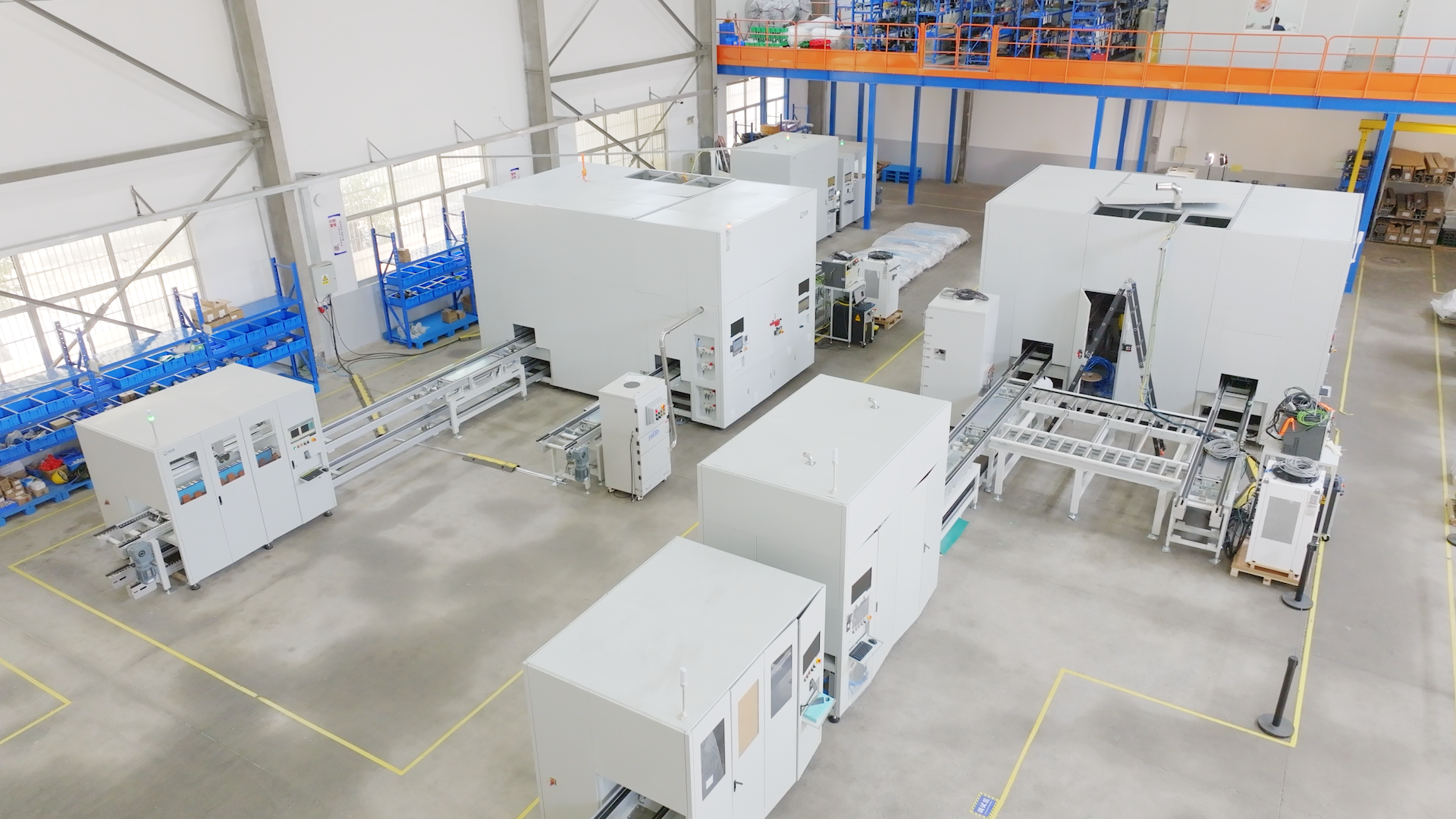
ZZX2313 EV battery PACK assembly line — source of the ≥95% operation rate and ≥99.5% / ≥99.95% welding qualification benchmarks.
Footprint and Cycle Time: ZZX2406 as the Factory Planning Baseline
A CTP line's dimensions are a building requirement, not a shipping detail. The ZZX2406 is specified at L58000 × W11000 × H3800 mm — roughly 58 m along the line, 11 m across it, and a 3.8 m height requirement. The model uses CTP technology, runs semi-automatically, accepts 314Ah and 587Ah cells, produces 1P96S battery packs at a 4 PPM cycle time, and is built on a carbon steel / Q235 structure for energy storage plus EV and C&I applications.
For capacity planning comparison, the ZZX2501 blade battery PACK assembly line is listed at 6 PPM with a 30 min/PACK cycle time, also on a carbon steel / Q235 structure, serving the EV and energy storage industries. Neither line is a drop-in: clear height, bay width and logistics flow all have to be fixed before civil work begins.
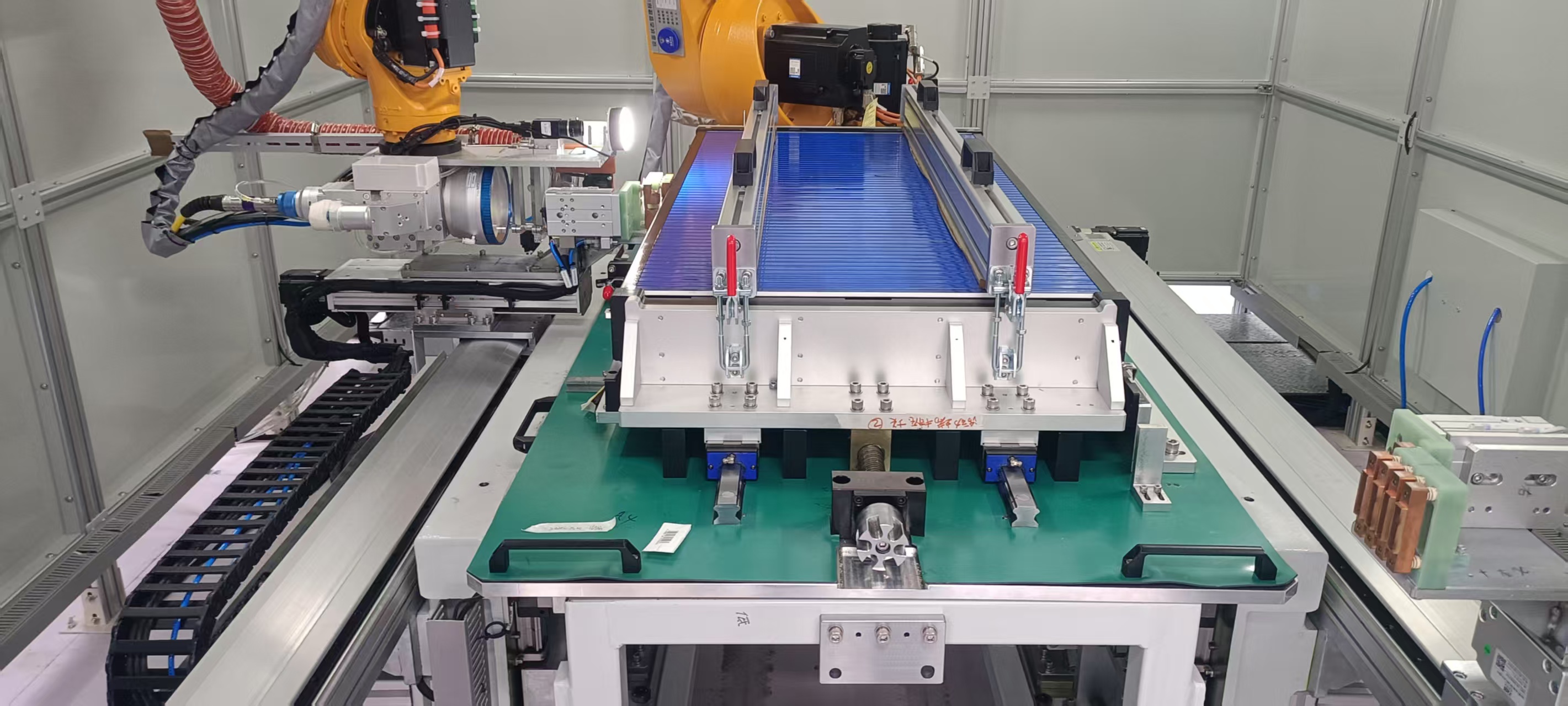
Production-scale PACK assembly line layout — footprint and cycle time drive the building plan, not the reverse.
Step-by-Step Breakdown: Matching Parameters to a Site in Eight Steps
- Work backwards from the project. Define the cell chemistry, cell format and target throughput before comparing machines. For a stationary storage container project that may mean 314Ah or 587Ah cells in a 1P96S pack configuration — the combination the ZZX2406 is specified for.
- Write the electrical requirement as a site specification. Use AC 380V ±10% as the operating window, add 50±0.5 Hz where applicable, then verify transformer and feeder capacity against the full line load rather than one machine.
- Confirm compressed air by model. The ZZX2501 is specified at 0.6–0.8 MPa and the ZZX2313 at 0.5–0.8 MPa. Choose the machine first, then size flow, drying and filtration for continuous operation.
- Plan the building from the dimensional drawing. The ZZX2406 occupies 58000 × 11000 mm at a 3800 mm height requirement. Add maintenance access, material infeed and finished-pack buffering — a 58 m line does not compress into a bay drawn for 40 m.
- Lock product compatibility and tooling. Cell format and pack configuration must match the line, and fixture design decides changeover time. Zonzsin lists cycle time, automation level, logo, colour and configuration as customizable items, so these are concept-stage decisions rather than installation-stage ones.
- Specify environmental control. Application data for this equipment class lists ESD protection, fire prevention measures, temperature and humidity control, cleanliness control, and pack compatibility with fixture adaptation — all of which must be coordinated with the building's ventilation, fire and cleanliness design.
- Put the welding metrics into the acceptance file. A single machine operation rate ≥95%, a one-time welding qualification rate ≥99.5% and a final welding qualification rate ≥99.95% are acceptance criteria, not aspirations.
- Plan the path from factory test to ramp-up. Quality control is described as 100% test before shipment, followed by remote support plus on-site installation and commissioning, then trial production where the operation rate is verified at real cycle time.
Use Cases: How the Parameters Change the Decision
Use Case 1 — Stationary Storage Packs at 314Ah and 587Ah
An energy storage integrator planning a stationary storage pack assembly line is usually constrained by the building before it is constrained by cell supply. The ZZX2406 supports 314Ah and 587Ah cells and produces 1P96S packs at 4 PPM, with CTP technology and semi-automatic operation, in a footprint of 58000 × 11000 mm. Those numbers have to reach the building design earlier than the equipment order: 58 m of line length sets the bay allocation, and the 3800 mm height requirement affects cable tray routing and lighting layout.
Use Case 2 — EV Traction Packs
An EV-focused automatic battery pack assembly line raises the welding bar. Within the Zonzsin range, the ZZX2313 EV battery PACK assembly line is the model where welding data is most explicit: single machine operation rate ≥95%, one-time welding qualification rate ≥99.5%, and final welding qualification rate ≥99.95%. For an EV programme ramping toward volume, those three figures — not the name of the welding process — decide whether equipment acceptance passes. The line runs on AC 380V ±10% with 0.5–0.8 MPa compressed air and a carbon steel / Q235 structure.
Use Case 3 — A Space-Constrained Plant in India
Zonzsin delivered a CTP battery PACK assembly line to a plant in India, where the client profile spanned automotive OEM, energy storage system integrator, battery cell and PACK manufacturer, and EPC turnkey contractor. A single unit was installed and has operated stably for one year; the highlighted advantages were a space-saving U-shape layout and a user-friendly interface. For plants where bay width is the binding constraint, that is the more useful reference point than a raw footprint number — line geometry can solve a space problem that a smaller machine cannot.
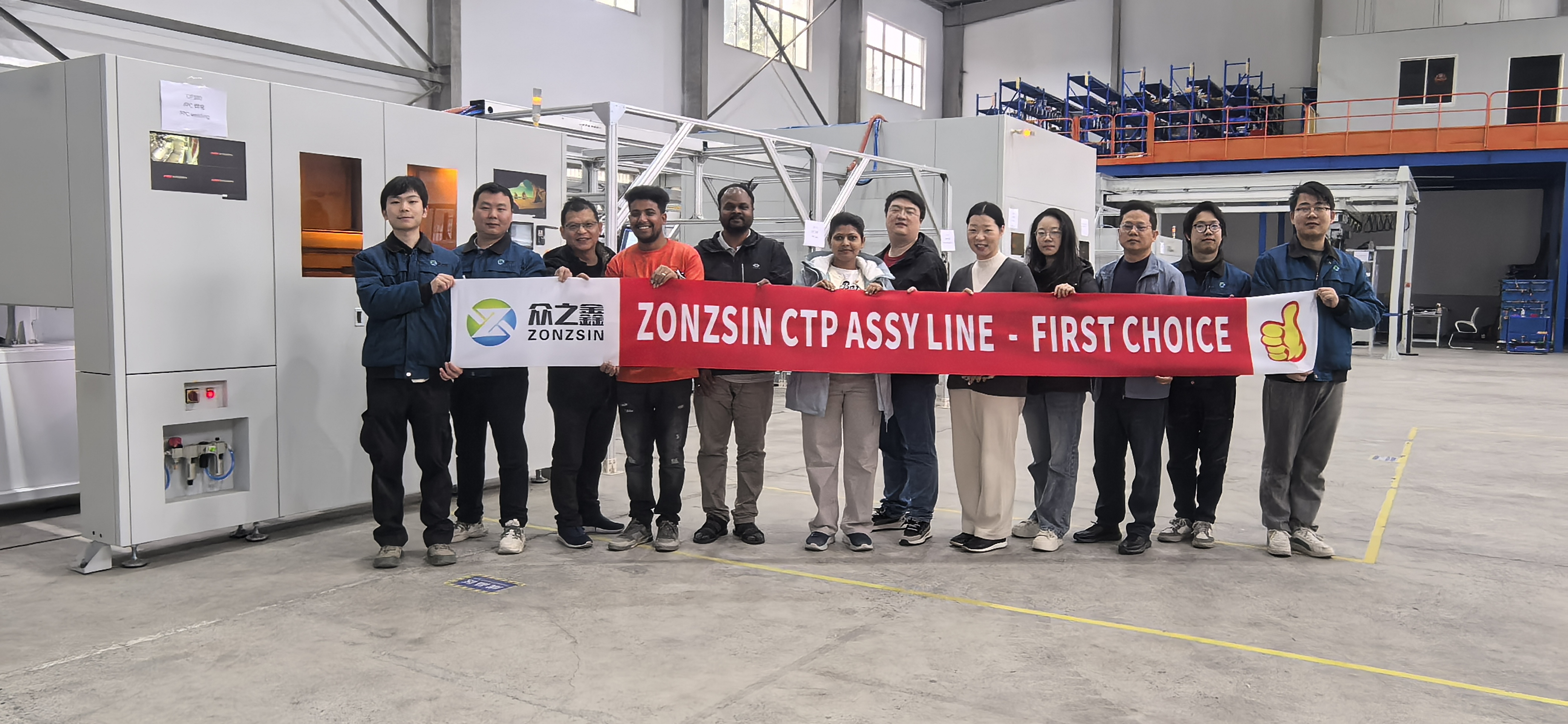
CTP battery PACK assembly line delivered to an Indian plant, arranged in a space-saving U-shape layout.
Comparison Table: Three Zonzsin Platforms Side by Side
Where the table reads “Not specified”, the parameter is not part of the published specification for that model. Treat those cells as open items to confirm with the supplier rather than as planning assumptions.
| Parameter | ZZX2406 | ZZX2501 | ZZX2313 |
|---|---|---|---|
| Line type | CTP battery PACK assembly line | Blade battery PACK assembly line | EV battery PACK assembly line |
| Battery cell | 314Ah & 587Ah | Not specified | Not specified |
| Battery PACK | 1P96S | Not specified | Not specified |
| Cycle time | 4 PPM | 6 PPM, 30 min/PACK | Not specified |
| Automation | Semi-automatic | Not specified | Not specified |
| Electrical requirement | Not specified | AC 380V ±10%, 50±0.5 Hz | AC 380V ±10% |
| Compressed air | Not specified | 0.6–0.8 MPa | 0.5–0.8 MPa |
| Single machine operation rate | Not specified | Not specified | ≥95% |
| One-time welding qualification rate | Not specified | Not specified | ≥99.5% |
| Final welding qualification rate | Not specified | Not specified | ≥99.95% |
| Dimension | L58000 × W11000 × H3800 mm | Not specified | Not specified |
| Structure material | Carbon steel / Q235 | Carbon steel / Q235 | Carbon steel / Q235 |
| Applicable industry | Energy storage; EV and C&I | EV industry; energy storage | EV industry; energy storage; automotive OEMs |
FAQ
What electrical and compressed air conditions does a CTP battery pack assembly line installation require?
In Zonzsin's published specifications, AC 380V ±10% is the stated electrical requirement for the ZZX2501 blade battery PACK assembly line and the ZZX2313 EV battery PACK assembly line, with 50±0.5 Hz additionally stated for the ZZX2501. For compressed air, the ZZX2501 requires 0.6–0.8 MPa and the ZZX2313 requires 0.5–0.8 MPa. Because pressure bands differ between models and the ZZX2406 does not list a compressed air range among its published parameters, air supply planning should be confirmed against the specific model being purchased rather than against a single site-wide figure.
Which battery cells and pack configurations does the ZZX2406 support?
The ZZX2406 is a CTP battery PACK assembly line compatible with 314Ah and 587Ah battery cells and configured for 1P96S battery packs. It runs at a 4 PPM cycle time with semi-automatic operation, occupies L58000 × W11000 × H3800 mm, uses a carbon steel / Q235 structure, and is applied in energy storage as well as EV and C&I industries.
How should welding quality metrics be written into acceptance criteria?
Use the three ZZX2313 figures as separate, enforceable clauses: single machine operation rate ≥95%, one-time welding qualification rate ≥99.5%, and final welding qualification rate ≥99.95%. They are independent — a line with high qualification rates but a weak running rate still misses its output target. Agree the measurement method, sample basis and record format before acceptance testing, so the numbers can be verified on the buyer's own site.
What lead time and after-sales arrangement applies to a CTP battery pack assembly line?
Zonzsin's published capability data lists a monthly capacity of 3 units, a minimum order quantity of 1 unit, and a lead time of 3–5 months. After-sales support consists of remote support plus on-site installation and commissioning, with quality control described as 100% test. Customization options cover cycle time, automation level, logo, colour and configuration.
How can a buyer validate site fit before committing to parameters?
The reliable sequence is: confirm the electrical and compressed air values for the exact model, then test the model's dimensions and height requirement against the building bay and clear height, and finally confirm cell and pack compatibility together with fixture design. The Zonzsin product brochure carries the parameter tables for the ZZX2406, ZZX2501 and ZZX2313 and can be checked directly against your plant conditions; for a project-specific configuration match, contact the team at katty.liu@zonzsin.com or request a quotation through www.zonzsin.com.
Conclusion: Take the Parameter List to the Site
A CTP battery pack assembly line specification is a project constraint, not a marketing claim. AC 380V ±10% with 50±0.5 Hz, compressed air at 0.6–0.8 MPa for the ZZX2501 and 0.5–0.8 MPa for the ZZX2313, a ≥95% single machine operation rate, ≥99.5% one-time and ≥99.95% final welding qualification rates, and a 58000 × 11000 × 3800 mm footprint for the ZZX2406 are the numbers that connect a purchase decision to a working plant. Confirm them per model, write them into the site specification and the acceptance clause, and the commissioning schedule stops being the point where surprises appear.
Next Step: Check These Numbers Against Your Building
Bring the parameter list — voltage window, air pressure band, operation rate, welding qualification rates and footprint — into your next site review, and settle them before the equipment order is placed.
Download the Zonzsin product brochure: Product brochure (PDF)
Contact: Katty Liu · katty.liu@zonzsin.com · +86 134-8282-9368 · www.zonzsin.com
Have Questions or Need More Details?
Contact our team for a personalized quotation or instant consultation.
Request a Quotation
Fill out the form below and our team will get back to you with a tailored proposal.
WhatsApp Direct Chat
Prefer to chat in real-time? Message us on WhatsApp for instant assistance & quick answers.
- Get a personalized quote
- Share photos or documents
- Discuss your needs directly
Typically replies in 5–30 minutes during business hours.