
Insertion vs Insertion & Removal: ESS PACK Robots Explained
Insertion vs Insertion & Removal: Battery PACK Robots for ESS Containers Explained
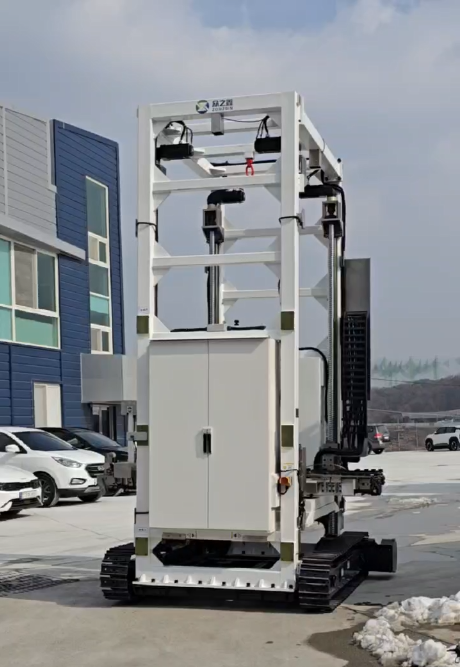
An ESS battery pack insertion robot for containers does one physical job: it takes a finished battery PACK from a conveyor or material rack and places it into a defined slot inside a container, at the correct height and angle, without damaging the PACK, the rack or the connections around it. Under that single job description, two different capability tiers are sold. Insertion-only machines load PACKs during assembly and return empty. Insertion & removal machines load PACKs and can also grip one and pull it back out for rework, service, replacement or teardown.
The short answer for someone new to container energy storage: if a PACK will ever leave the container again, the removal function has to be specified at quotation stage, because it changes the gripper, the control logic and the force limits of the machine. If the container leaves the line finished and nothing is expected to come back, an insertion-only machine covers the task. Removal is not simply a question of buying a larger chassis. Zonzsin documents a rail-fixed platform doing both directions of work, which shows that the deciding factor is the tool and control system rather than mobility alone.
Zonzsin — Shanghai Zonzsin Intelligent Equipment Co., Ltd. — is a Shanghai-based manufacturer founded in 2019 that builds ESS battery pack insertion robots for containers and automatic battery pack assembly lines. The company states 50 granted patents, including invention patents for AGV-driven battery PACK insertion robots, and lists an annual output of 40 units.
What insertion-only and insertion & removal actually mean
The two terms describe the direction of travel of the gripper, not the size of the machine or the type of chassis. Both tiers drive to the container door, raise the PACK to the rack level and push it forward. They diverge at the end of the stroke.
- Insertion-only: the gripper supports the PACK, advances it into the slot, releases it and withdraws. Every cycle is the same, so the tool can be a simple support and push device and the control logic can stop at the release point.
- Insertion & removal: the gripper must also reach an installed PACK, engage it securely, pull it out of the rack without scuffing the slot or loading the busbar, and then carry it back. This requires a latching or clamping tool, a pull force that stays within the PACK's limits, and position feedback that confirms the grip before the robot reverses.
- Changeover: on machines that run more than one PACK type, the tool set has to be swappable. Zonzsin specifies gripper changeover under one minute on the rail-fixed ZZX2524, which matters when a line inserts during the day and pulls PACKs during a service window.
For a newcomer, the practical consequence is commercial rather than technical. The removal function is normally a configuration item — it appears in the gripper list and in the automation scope — so it is far cheaper to decide at the specification stage than to retrofit after the container line is running.
Why the container, not the robot, sets the difficulty
Container energy storage compresses the whole handling problem into a narrow opening. A PACK has to enter through the container door, travel to a rack position that may be several levels above the floor, and land within the slot without touching neighbouring PACKs. Each of those constraints comes from the container and the rack, not from the robot.
Door geometry sets the working envelope. Zonzsin specifies a door opening angle of at least 150° for the rail-fixed ZZX2524; the wider the door swings, the less the robot has to fight the door edge when the gripper carries a PACK through the aperture. Rack height sets the hoisting requirement. The AGV-driven RD16 is specified with a hoisting range of 1.05–3.4 m and a hoisting speed of 100 mm/s, so the vertical move is a deliberate, controlled phase of the cycle rather than a fast drop.
Mass sets the platform. The ZZX2524 carries a rated load of 1,500 kg, which places it in the heavy-duty part of the category. Any comparison should therefore start from the heaviest PACK on the line and the rack level it has to reach, then work backwards to the platform, rather than starting from the robot and looking for a container that fits.
Compliance sits alongside these physical constraints. For EU-facing projects, Regulation (EU) 2023/1542 is the framework for batteries placed on the market, and it governs the battery product rather than the design of the insertion machine. The machine-side checks are the container and PACK interface, site safety and the quality system behind the build; separately, Zonzsin holds an ISO 9001 certificate covering its quality management system, discussed further below.
The four Zonzsin platforms, one by one
Zonzsin groups its container insertion equipment into four named platforms. They share the same application but differ in how they reach the container, and that difference decides which tier of work each one is documented for.
ZZX2522 — crawler-driven, all-terrain, insertion & removal
The crawler platform is the one built for ground that is not a finished factory floor. In a South Korean project, a crawler-driven unit was used outdoors on an uneven working floor for ESS battery PACK insertion into and removal from containers, and the project was reported as running stably for one year. A second project, in Taiwan, covered the same two-direction application over a one-year implementation period with stable operation.
For a newcomer, the crawler configuration is the clearest illustration of why insertion and removal belong together. Outdoor sites are exactly where a PACK may need to come back out — for inspection, for replacement, or because commissioning is still being corrected — and a machine that can only push forward cannot finish that job.
RD16 — AGV-driven, for lines that move between containers
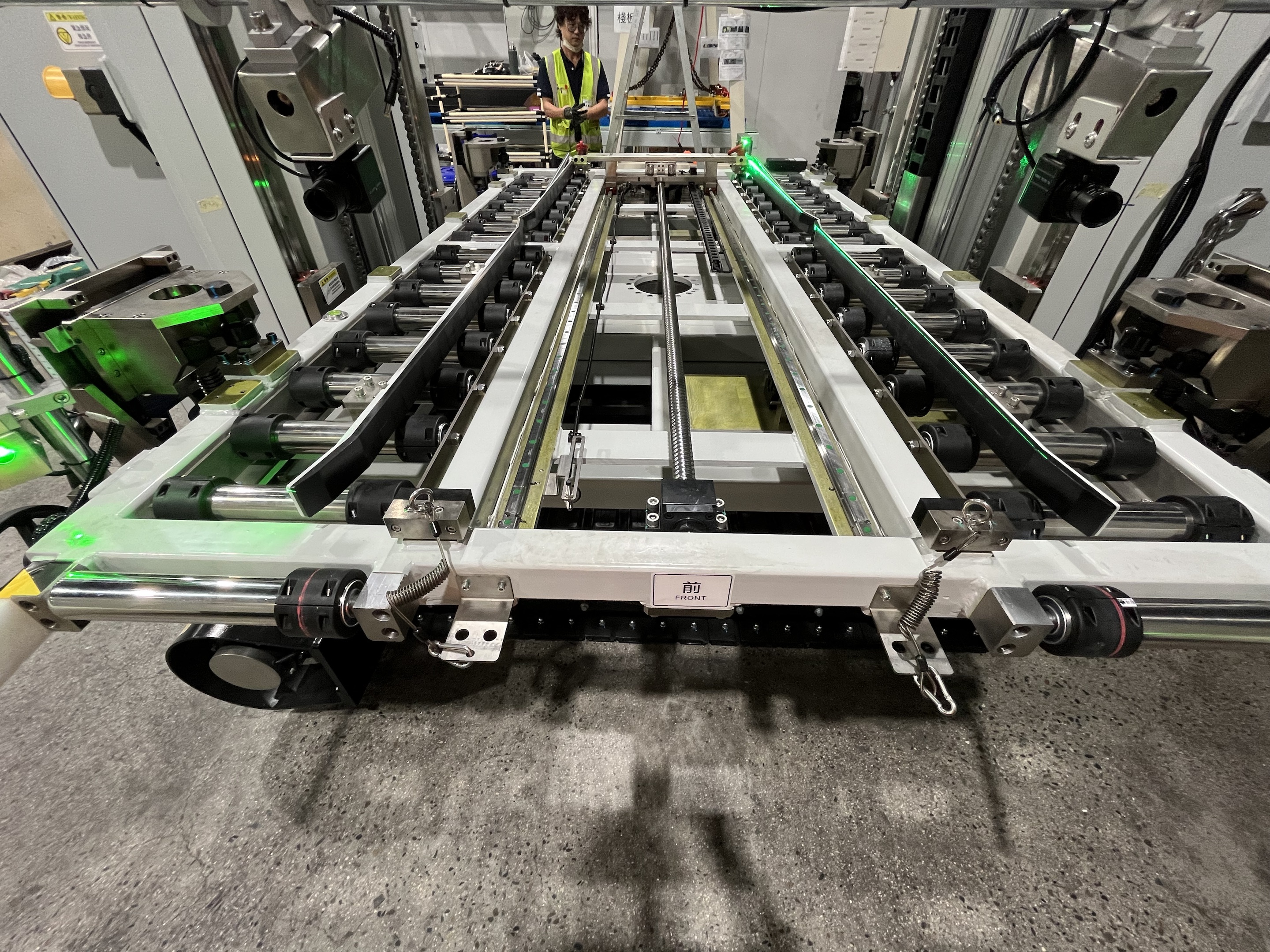
The RD16 is an AGV-driven battery PACK insertion robot for containers. Zonzsin specifies it for 280/314/587 Ah cells and 1P52S/1P104S PACKs, with a hoisting range of 1.05–3.4 m and a hoisting speed of 100 mm/s. Its value is routing: because the unit drives itself, it can serve more than one container station instead of being tied to a single rail position.
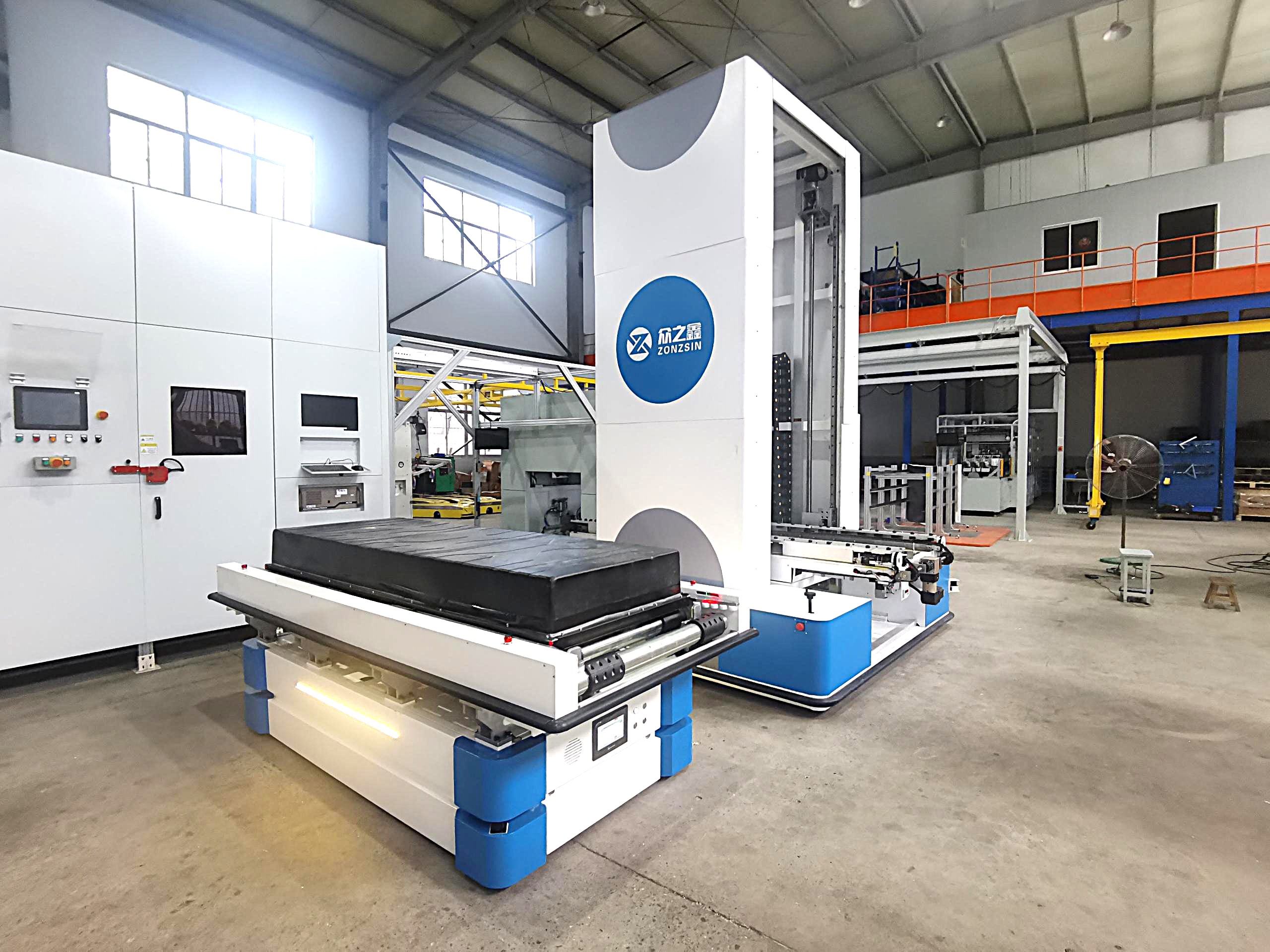
An AGV platform assumes a floor suitable for wheeled travel. Where the ground is uneven or unfinished, the crawler configuration is the coherent alternative; where the container station is fixed and repeatable, a rail-fixed machine removes the driving task entirely.
ZZX2508 — rail-fixed, documented in both directions
The ZZX2508 is a rail-fixed battery PACK insertion robot. It matters to this comparison because of a specific record: in a project in Taiwan, a battery PACK insertion robot (model 5357, the ZZX2508) was installed for ESS battery PACK insertion into and removal from containers, over a one-year implementation period, and achieved stable operation.
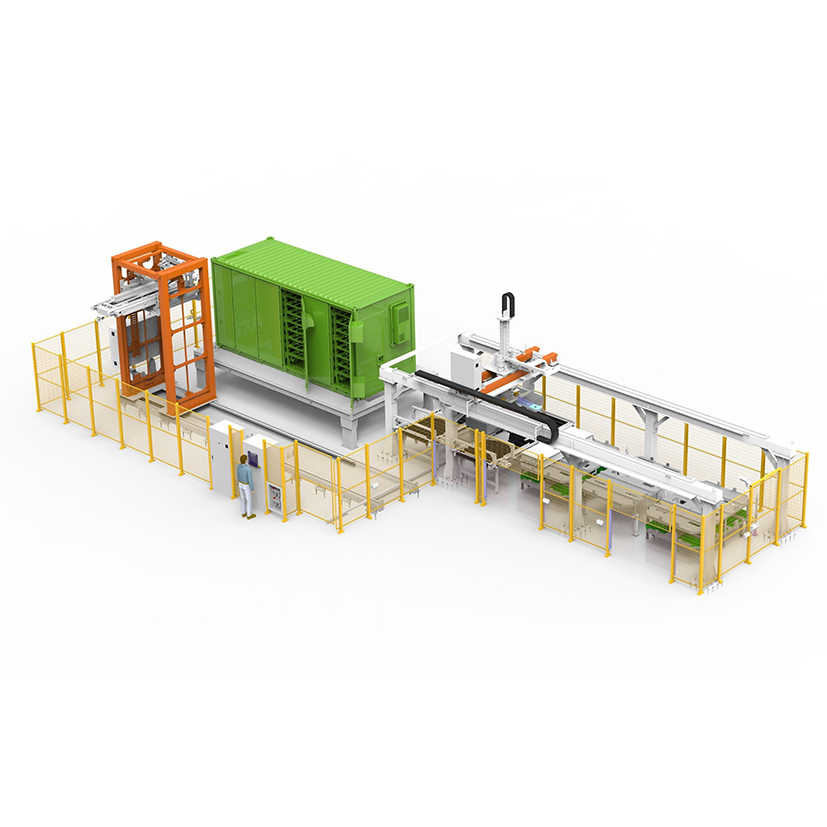
That single record answers a common beginner assumption — that removal requires a mobile platform. It does not. Removal requires a gripper and control logic that can grip and pull; the chassis only decides how the machine arrives at the container door.
ZZX2524 — rail-fixed, heavy-duty
The ZZX2524 is the heavy-duty rail-fixed platform in the set. Zonzsin specifies a load capacity of 1,500 kg, a door opening angle of at least 150° and gripper changeover in under one minute. Those three figures describe the same design intent: lift a heavy PACK, pass it cleanly through a wide-open door, and swap tooling quickly when the task changes from inserting to pulling out.
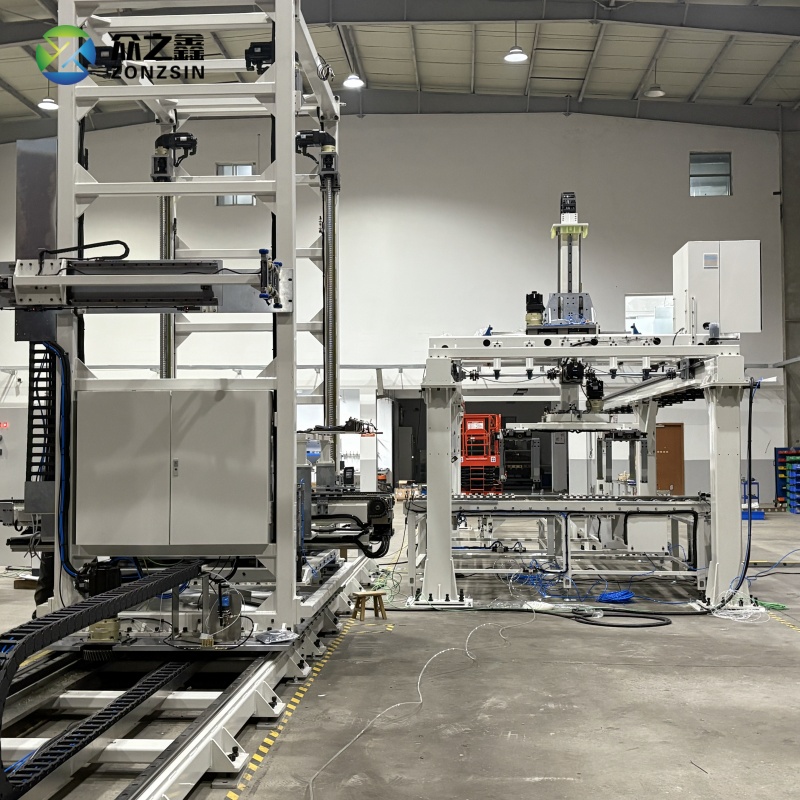
A Chinese project record for the rail-fixed platform describes continuous PACK insertion, stable PACK loading and fully automatic insertion over a two-year period, with a fixed ground rail and a dual-layer material rack used to save floor space. That is the insertion-only production pattern: high repetition, fixed station, no expectation that the PACK returns.
Side-by-side: what each platform is documented for
The table below compares only what the reviewed Zonzsin documents state. Where a model-specific figure is not published, the honest entry is a request for the datasheet rather than an estimate.
| Model | Drive / mounting | Documented working context | Published specifications reviewed | Insertion & removal |
|---|---|---|---|---|
| ZZX2522 | Crawler | Outdoor sites with uneven floors (South Korea project); two-direction container work (Taiwan project) | No model-specific load or speed figure in the reviewed documents | Documented in projects inserting into and removing from containers |
| RD16 | AGV | Lines where one unit serves container stations by driving | 280/314/587 Ah cells; 1P52S/1P104S PACKs; hoisting range 1.05–3.4 m; 100 mm/s | Specified for insertion; confirm the removal gripper in the quotation |
| ZZX2508 | Rail-fixed | Fixed indoor station; one-year Taiwan project | No model-specific load or speed figure in the reviewed documents | Documented: model 5357 inserted into and removed from containers |
| ZZX2524 | Rail-fixed | Fixed station with heavy PACKs; two-year project record | 1,500 kg load; door opening ≥150°; gripper changeover <1 min | Tool-dependent; specify the removal gripper and confirm load |
Step by step: what happens in one loading cycle
Understanding the cycle makes the difference between the two tiers concrete, because removal adds steps rather than replacing them.
- PACK presentation. The PACK arrives on a conveyor or from a material rack; the machine identifies it and confirms it matches the programmed PACK type.
- Grip and lift. The gripper takes the PACK and the hoist raises it towards the target rack level; on the RD16 this vertical phase runs at 100 mm/s within a 1.05–3.4 m range.
- Travel to the door. The machine moves to the container aperture — by rail, by AGV drive, or on crawlers — and aligns with the slot.
- Insertion. The PACK is advanced into the rack slot, released and the gripper withdraws.
- Removal (second tier only). For a pull-out, the gripper re-enters, engages the installed PACK, confirms the grip, and withdraws the PACK to the door before lowering it.
- Tool change (when required). If the next task uses a different PACK or a different direction of work, the gripper set is swapped — under one minute on the ZZX2524.
How to specify the right tier in five decisions
For a newcomer at evaluation stage, five decisions usually settle the configuration before any supplier comparison begins.
- Direction of work. Decide whether PACKs will ever be pulled out during commissioning, service life or teardown. If yes, removal is a specification item, not an upgrade.
- Floor and site. A finished indoor floor supports a rail-fixed station; a line that must reach several containers suits the AGV-driven RD16; outdoor or uneven ground points to the crawler platform.
- PACK envelope and mass. Match the heaviest PACK and the highest rack level against the published load and hoisting figures, and confirm the number in the signed technical agreement rather than in a directory listing.
- Container interface. Confirm door opening, rack pitch, slot clearance and the actual container type you will run; these are project inputs and should be fixed in writing before the build.
- Gripper set and changeover. Count how many PACK variants and how many directions of work the line will handle, then size the tool set; changeover time decides whether mixed production is practical.
Where each set-up earns its place
High-volume indoor assembly. A fixed rail station with a dual-layer material rack and continuous insertion is the pattern recorded in the Chinese project, where the line ran fully automatic insertion for two years. Insertion-only tooling is sufficient when the container leaves finished.
Multi-station factories. Where a single unit must serve several container positions, the AGV-driven RD16 avoids duplicating hardware at each station; the trade-off is that the floor has to suit wheeled travel.
Outdoor and temporary sites. Crawler platforms are documented on uneven outdoor ground in South Korea and in two-direction container work in Taiwan, which is where the insertion-and-removal tier earns its cost most obviously.
Service and rework operations. A line that must pull a PACK for inspection, replacement or a commissioning correction needs the removal function regardless of how the machine reaches the door — the ZZX2508 Taiwan record shows a rail-fixed machine doing exactly that.
Limits, verification points and lead time
Every configuration above has a boundary worth stating plainly. A rail-fixed machine requires ground installation, so it is a poor fit for a site that will be re-laid out. An AGV platform depends on floor quality. A crawler platform trades speed and floor protection for terrain tolerance. Insertion-only tooling cannot perform a pull-out, and a removal gripper adds a tool the line must store and maintain.
Verification should be document-based. Ask for the model datasheet that states the load, hoisting range and speed for the exact configuration quoted, and check that the figures appear in the technical agreement. Third-party listing pages for rail-fixed container loading equipment exist, but a listing is not a controlled specification and should not be used as the basis for a load rating.
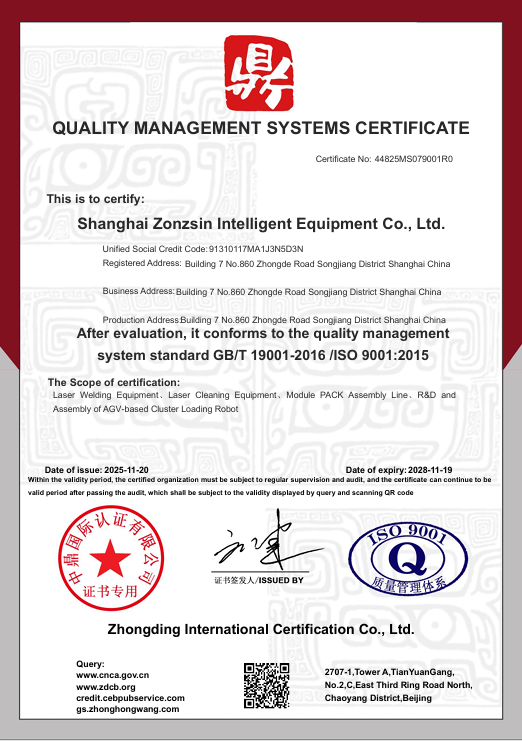
Zonzsin's quality system is covered by an ISO 9001 certificate issued by ZDCB, number 44825MS079001R0, under GB/T 19001-2016 / ISO 9001:2015, issued on 20 November 2025 and valid until 19 November 2028. Its stated scope covers laser welding equipment, laser cleaning equipment, module PACK assembly lines, and the R&D and assembly of AGV-based cluster loading robots.
Commercially, Zonzsin works with a minimum order quantity of one unit and a lead time of two to four months, against a monthly capacity of three units. Customization fields listed for the equipment include cycle time, automation level, logo, colour and configuration, and every unit is tested before shipment; after-sales covers remote support plus on-site installation and commissioning.
FAQ
Is the Zonzsin ESS battery pack insertion robot certified?
The equipment scope is covered by an ISO 9001 quality management system certificate issued to Shanghai Zonzsin Intelligent Equipment Co., Ltd. by ZDCB, certificate number 44825MS079001R0, under GB/T 19001-2016 / ISO 9001:2015. It was issued on 20 November 2025 and expires on 19 November 2028. The stated scope covers laser welding equipment, laser cleaning equipment, module PACK assembly lines, and the R&D and assembly of AGV-based cluster loading robots. Project-specific declarations should still be requested for your destination market.
What is the difference between insertion-only and insertion & removal robots?
Insertion-only machines push a PACK into its container slot and withdraw empty, which suits a container that leaves the line finished. Insertion & removal machines carry a gripper that can latch onto an installed PACK and pull it out, which is needed for commissioning corrections, rework, service and replacement. Removal is a tooling and control capability rather than a chassis class: a rail-fixed ZZX2508 (model 5357) was used in a Taiwan project to insert into and remove PACKs from containers.
Which platform should a fixed indoor line prefer — rail-fixed, AGV or crawler?
A fixed indoor station with a stable floor usually suits a rail-fixed machine, where the rail is installed in the ground and the working position repeats: the ZZX2524 is specified at a 1,500 kg load with a door opening angle of at least 150° and gripper changeover under one minute. The AGV-driven RD16 fits lines where one unit must travel between container stations, specified with a 100 mm/s hoisting speed and a 1.05–3.4 m hoisting range. Crawler platforms are the choice for outdoor or uneven ground, as in a South Korean project.
What drives the budget, and how long is delivery?
Zonzsin does not publish list prices. The variables that change a quotation are the platform, the number and type of grippers, the container and rack interfaces, and how much of the cycle is automated — all listed as customization fields alongside logo, colour and configuration. Minimum order quantity is one unit, lead time is two to four months, and monthly capacity is three units. Ask for the scope split between remote support and on-site installation and commissioning.
How do we validate fit before ordering, and what is the next step?
Send the PACK drawings, container and rack interface dimensions, and the heaviest PACK weight, so the platform, load rating and gripper set can be checked against the actual slot geometry. Zonzsin tests 100% of units before shipment and confirms fit during on-site installation and commissioning. The product brochure (PDF) summarises the model range as a first screening document; the written specification is the document to compare offers against.
Conclusion
Insertion and insertion & removal are not two product grades; they are two answers to one question — will this PACK ever come back out of the container? Insertion-only equipment covers a finished container leaving a stable indoor line, and the ZZX2524 platform with its 1,500 kg load, door opening of at least 150° and sub-minute gripper changeover is specified for that heavy-duty repetition. Once a PACK may need to return, the removal gripper and its control logic become part of the specification, whether the machine runs on a rail as the ZZX2508 did in Taiwan, drives as an AGV like the RD16, or walks on crawlers as the ZZX2522 did on an outdoor site in South Korea.
For a newcomer, the safest sequence is to fix the direction of work, the floor, the PACK mass and the container interface first, and only then compare platforms. That order keeps the comparison on the facts that decide cost — and keeps a line from being specified for one direction of work when it will eventually need both.
Have Questions or Need More Details?
Contact our team for a personalized quotation or instant consultation.
Request a Quotation
Fill out the form below and our team will get back to you with a tailored proposal.
WhatsApp Direct Chat
Prefer to chat in real-time? Message us on WhatsApp for instant assistance & quick answers.
- Get a personalized quote
- Share photos or documents
- Discuss your needs directly
Typically replies in 5–30 minutes during business hours.