
Top ESS Battery Pack Insertion Robots for Container Projects: A Model Recommendation Guide
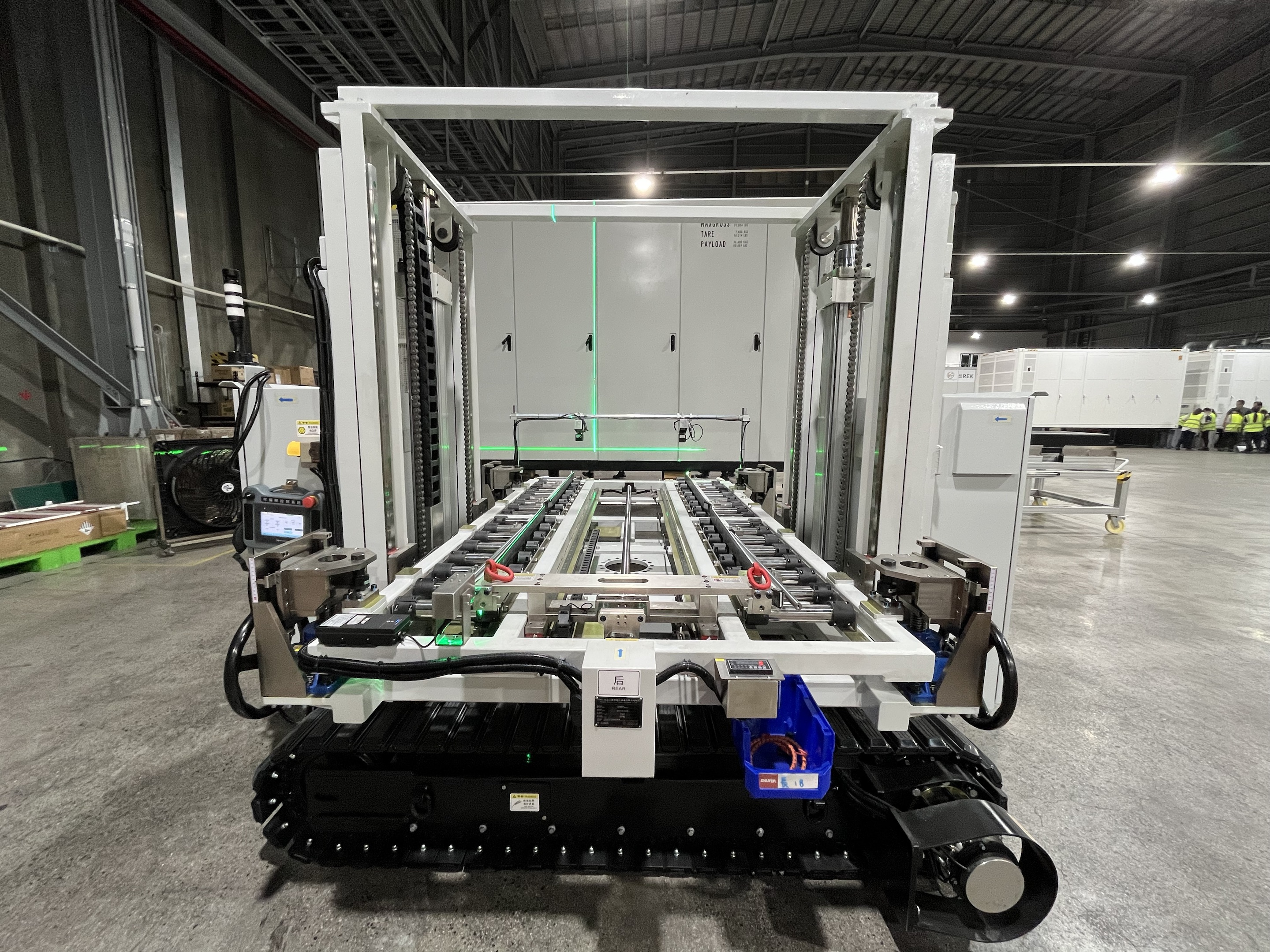
Short answer: Zonzsin publishes four robot platforms for inserting battery PACKs into ESS containers — the AGV-driven RD16, the rail-fixed ZZX2524 and ZZX2508, and the crawler-driven ZZX2522. For a container project on a level floor with a mixed PACK list, RD16 is the first recommendation. For a dedicated bay with heavy PACKs and an anchorable rail, ZZX2524 leads. ZZX2522 becomes the first choice the moment the working floor is uneven, outdoor or graded. ZZX2508 carries the same rail-fixed specification family and stays on the shortlist where the rail layout already exists.
The recommendation below is built from Zonzsin's company-published specifications and deployment records. It is not an independent laboratory benchmark, and the published specification set does not cover every model equally; where a parameter is not published, this guide says so instead of filling the gap.
How the four models were ranked
The order is a recommendation for container projects, not a general product hierarchy. Four published criteria set it: documented cell and PACK format coverage; fit with the container interface, including the 6,058 mm to 7,000 mm length span Zonzsin specifies; published payload and changeover capability; and deployment records in the supplied evidence. No numeric weighting is claimed, because the underlying values are company-reported specifications rather than independently tested measurements.
The practical effect is that the platform satisfying the widest set of container-project requirements is listed first, and each specialist platform is placed where its condition applies — with the condition stated, so a project that matches it can promote that model to first choice without rewriting the ranking logic.
Why container PACK insertion is a decision, not a purchase
An ESS container is a confined, load-bearing box. A battery PACK has to pass through a door aperture, travel along a rack, and settle onto locating features that allow almost no visible adjustment once the PACK is inside. Two failure modes dominate: contact damage to the PACK or the rack during entry, and rework when a PACK does not seat and has to be pulled back out. Both are created by how the machine holds and levels the load, not by how fast it travels.
That is why drive architecture matters more than any single number on a datasheet. A rail-fixed machine puts the load on a ground rail and a fixed base, which gives stability in a dedicated bay. An AGV-driven machine gives up the rail and moves between container positions on its own chassis. A crawler-driven machine gives up floor smoothness for traction and manual handwheel leveling on rough ground. Each choice changes the site preparation, the operating routine and the range of containers the line can serve. The selection is therefore an interface question first and a throughput question second.
Industry background: three platforms, one container interface
Containerized battery storage has pushed PACK assembly out of a clean, flat factory bay and into yards, retrofit buildings and mixed indoor-outdoor sites, and the handling equipment has to follow. Shanghai Zonzsin Intelligent Equipment Co., Ltd. was founded in 2019 and builds ESS battery PACK insertion robots for containers and automatic battery PACK assembly lines for energy storage integrators, cell and PACK manufacturers and EPC contractors. The company reports 50 granted patents, including invention patents for AGV-driven battery PACK insertion robots, a 6,000 m² factory, 90 employees and 43 engineers, with 40 units of annual output and three units of monthly capacity.
Two interface facts shape every project. The first is the container: Zonzsin specifies compatibility across container lengths of 6,058 mm to 7,000 mm, so both 20 ft frames and longer frames fall inside the stated range. The second is the quality evidence: the company holds an ISO 9001 certificate (number 44825MS079001R0, issued 20 November 2025 and valid to 19 November 2028 against GB/T 19001-2016 / ISO 9001:2015), whose scope covers module PACK assembly lines and the R&D and assembly of AGV-based cluster loading robots, with RD16, ZZX2508, ZZX2524 and ZZX2522 listed against it.
For EU-bound projects, the applicable legal framework is Regulation (EU) 2023/1542 on batteries and waste batteries. That regulation is a market-level requirement, not a statement about any individual machine, so project-specific compliance documents should be confirmed against the signed specification rather than assumed from the ISO 9001 certificate alone.
The ranked recommendations
1. RD16 — AGV-driven insertion for mixed PACK formats on level floors
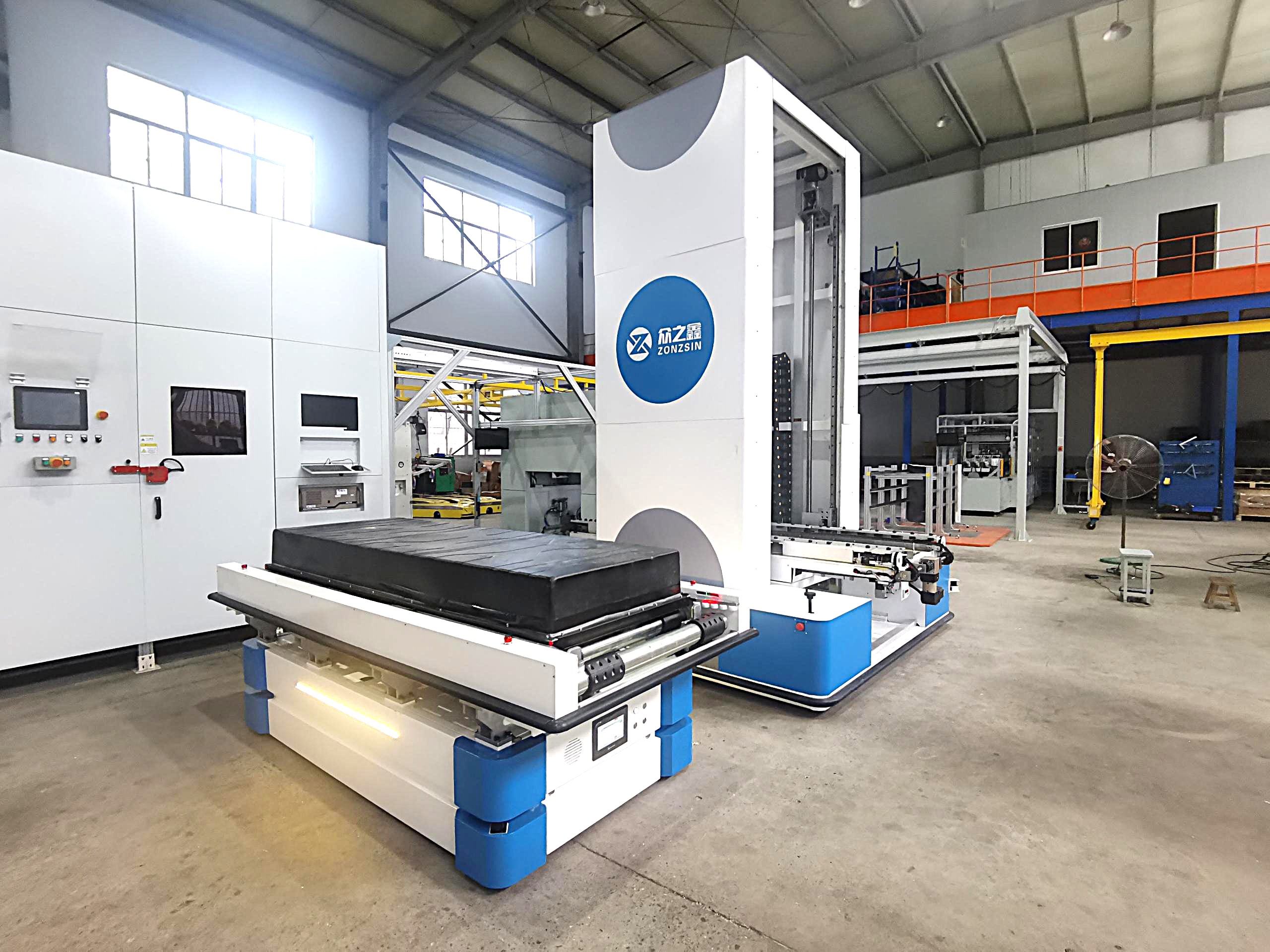
RD16 is the platform to screen first when the PACK mix is not fixed. Zonzsin specifies it for 280 Ah, 314 Ah and 587 Ah cells and for 1P52S and 1P104S PACKs, with a hoisting range of 1.05 m to 3.4 m and a hoisting speed of 100 mm/s; the company's technical guide describes the same model as covering a 280–587 Ah cell range. The unit is built on a carbon steel frame with an overall size of 3,100 × 2,600 × 3,800 mm, and it is listed on the ISO 9001 certificate scope.
Why it leads the list: it is the only model in the published set whose cell and PACK compatibility is stated as a range, so a buyer can check it against several PACK drawings before committing to engineering work. The AGV chassis also removes the ground rail, which lets container positions change between shifts without re-anchoring anything.
The condition attached to that position is the floor. An AGV platform steers on its own wheels, and Zonzsin's platform comparison describes the AGV-driven option as the high-mobility choice for level floors, against rail-fixed for stability and crawler-driven for outdoor and all-terrain sites. A site with broken concrete, drainage falls or a gravel apron is not the place to start with RD16 — that is a ZZX2522 conversation.
2. ZZX2524 — rail-fixed insertion for fixed, heavy-PACK container lines
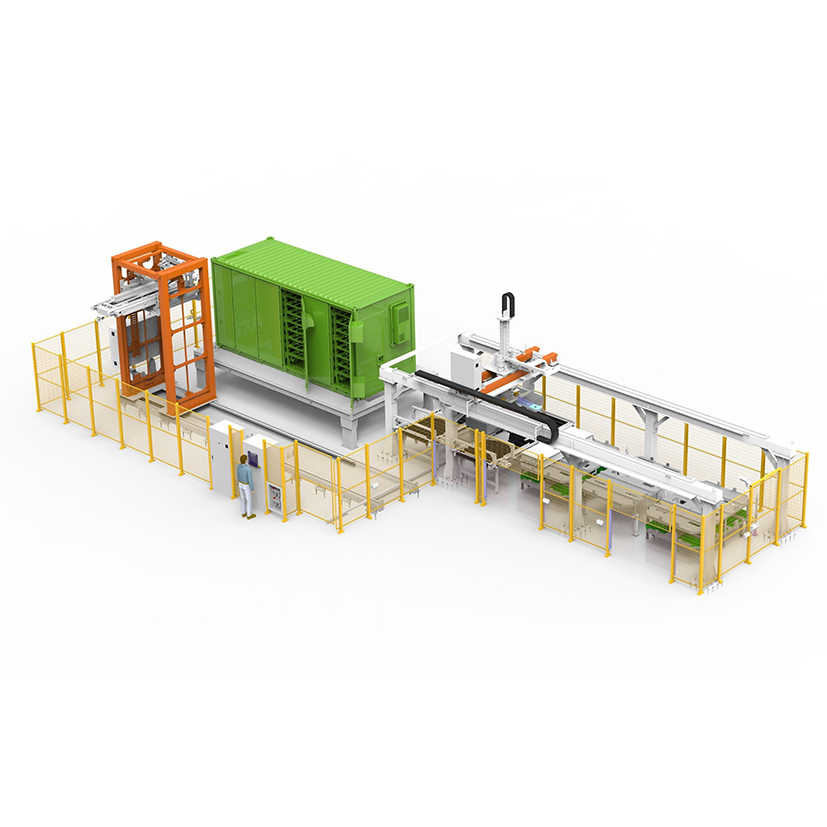
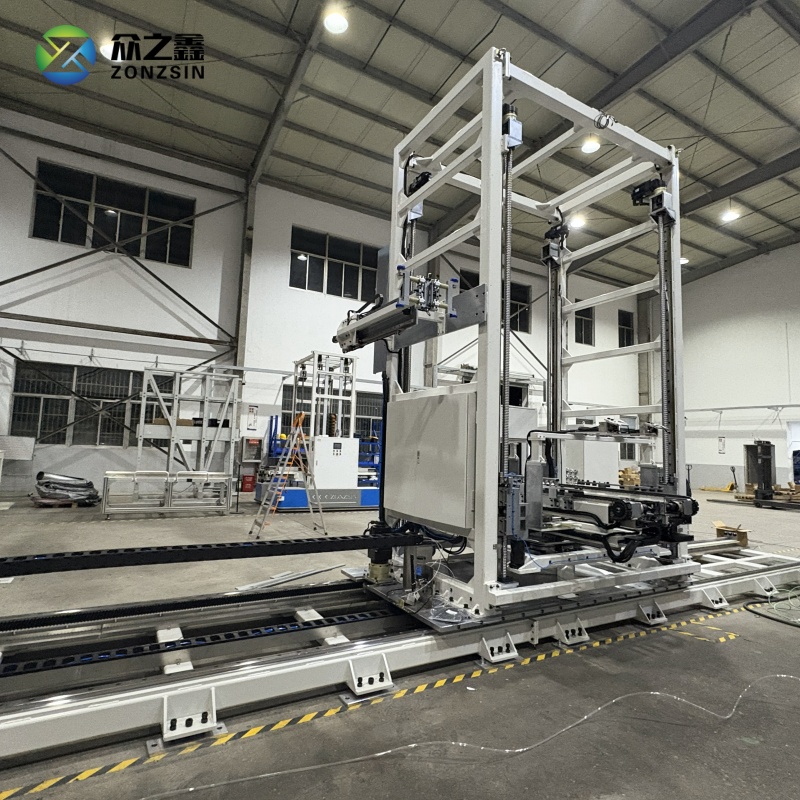
ZZX2524 is the stronger rail-fixed recommendation because it combines the highest published payload in the set with the only project record that ties a rail-fixed unit to a specific model. Zonzsin specifies a 1,500 kg load capacity, a container door opening angle above 150 degrees, and gripper changeover in under one minute. The door angle matters more than it appears: it sets how squarely a PACK can approach the rack, and a narrow aperture forces a slower, more careful insertion path.
The deployment record is in China, where one rail-fixed unit — model 5358, the ZZX2524 code in Zonzsin's product listing — was installed for continuous PACK insertion, stable PACK loading and fully automatic PACK insertion. The recorded highlights are a stable, fixed ground rail for safe working, a dual-layer material rack for space utility and versatile module options. The project ran over a two-year period with stable operation reported.
The trade-off is installation. A rail-fixed machine assumes a prepared floor and a dedicated bay, and it will not relocate to another container row without work. Where the bay is fixed and the PACKs are heavy, that is a fair exchange, because the rail is the source of the stability that makes heavy insertion repeatable.
3. ZZX2522 — crawler-driven insertion for uneven floors and outdoor yards
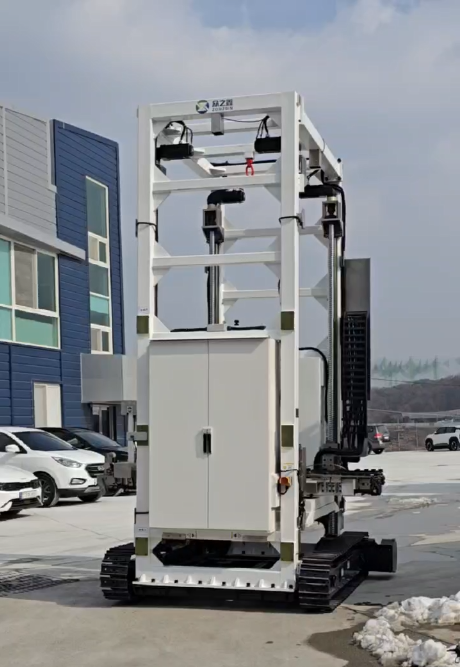
ZZX2522 is ranked third for a standard container project and first for a difficult site, and it should be read that way. Zonzsin specifies the crawler platform for complicated working floors, for indoor and outdoor use, and for both PACK insertion and pull-out, with manual handwheel leveling and a hoisting speed of 100 mm/s. Pull-out capability deserves its own line: a machine that can only insert still leaves a removal problem when a PACK has to come back out for service or replacement.
The supplied deployment records for crawler-driven units include a South Korean site configured for outdoor operation on uneven working floors and a Taiwan site used both indoors and outdoors on a complicated floor, each with one unit and stable operation reported. Both are company-reported project descriptions rather than independent audits.
Manual handwheel leveling is the practical difference. It lets an operator bring the machine level on ground a rail cannot use, at the cost of a setup step each time the unit is repositioned. Where the container sits on graded ground or the yard floods seasonally, that step is usually cheaper than civil work to create a flat approach.
4. ZZX2508 — the second rail-fixed option in the same specification family
ZZX2508 shares the rail-fixed specification family with ZZX2524: 1,500 kg load capacity, a door opening angle above 150 degrees, and gripper changeover under one minute, on the same ISO 9001 certificate scope. Its placement at fourth is an evidence judgment, not a capability judgment. The supplied records include a model-specific deployment for ZZX2524 but not a separate one for ZZX2508, and when two platforms carry the same published specification set, the one with a recorded installation is faster to qualify in a procurement review.
The model stays on the shortlist in two situations: where the rail layout, bay dimensions or existing handling sequence were already designed around it, and where a project needs a second rail-fixed source inside the same supplier to cover a phased line build. In both cases the specification should be confirmed line by line on the quotation, because re-listed third-party product pages for rail-fixed units can carry different load figures from the company-published 1,500 kg figure, and the signed specification should govern.
Five checks before you shortlist a model
Run these in order. Each check eliminates models rather than scoring them, which keeps the shortlist honest and short.
- Measure the container and the door. Confirm the frame length falls inside the 6,058 mm to 7,000 mm range Zonzsin specifies, then measure the actual door aperture and rack entry height. The rail-fixed door angle above 150 degrees describes the machine's handling, not the container on your site.
- Fix the PACK list, not one PACK. Write down every cell format and PACK configuration the line will run. For RD16 that means checking 280 Ah, 314 Ah and 587 Ah cells and 1P52S / 1P104S PACKs against the stated range. For ZZX2508, ZZX2524 and ZZX2522 the published set does not state cell formats, so the PACK drawing has to be matched with the supplier before award.
- Walk the floor. Level and continuous points to RD16. A prepared bay where a rail can be anchored points to ZZX2524 or ZZX2508. Broken, graded or outdoor ground points to ZZX2522 and its handwheel leveling.
- Check payload and changeover against the real PACK. The rail-fixed family is specified at 1,500 kg with gripper changeover under one minute. Weigh the heaviest PACK and count how many format changes a shift actually needs; a sub-minute changeover only helps if the line changes format often enough to notice.
- Fix the commercial and acceptance terms before the technical review closes. MOQ, delivery terms, payment schedule, acceptance test and lead time belong on the same document as the specification, not in a separate email thread.
What the deployment records show
The supplied project descriptions cover the three platforms, and they read differently because the sites differ.
- China, rail-fixed (model 5358 / ZZX2524): one unit for continuous PACK insertion, stable PACK loading and fully automatic insertion, with a fixed ground rail, a dual-layer material rack and versatile module options; two-year project period, stable operation reported.
- South Korea, crawler-driven: one unit configured for outdoor operation on an uneven working floor, stable operation reported.
- Taiwan, crawler-driven: one unit used indoors and outdoors on a complicated floor for both insertion and pull-out, stable operation reported.
The users named across these records are energy storage system integrators, battery cell and PACK manufacturers, and EPC turnkey contractors. That mix is a useful signal when writing a specification: an integrator usually needs PACK-format flexibility, a cell and PACK manufacturer usually needs changeover speed on a fixed line, and an EPC contractor usually needs the machine to survive the site it is delivered to.
Model comparison at a glance
| Model | Platform | Published specification | Recommended project condition | Confirm before award |
|---|---|---|---|---|
| RD16 | AGV-driven | 280 / 314 / 587 Ah cells; 1P52S and 1P104S PACKs; 1.05–3.4 m hoisting range; 100 mm/s hoisting speed; carbon steel frame; 3,100 × 2,600 × 3,800 mm | Level indoor floor, mixed PACK formats, container positions that change | Floor condition along the wheel path; PACK drawing checked against the stated cell range |
| ZZX2524 | Rail-fixed | 1,500 kg load capacity; door opening above 150°; gripper changeover under 1 minute; China project record | Dedicated bay with an anchorable rail, heavy PACKs, continuous insertion | Rail foundation and bay layout; rated load on the signed specification |
| ZZX2522 | Crawler-driven | Complicated floors; indoor and outdoor; insertion and pull-out; manual handwheel leveling; 100 mm/s hoisting speed | Uneven, graded or outdoor ground, and sites that need removal as well as insertion | Ground condition along the travel path; leveling time per repositioning |
| ZZX2508 | Rail-fixed | 1,500 kg load capacity; door opening above 150°; gripper changeover under 1 minute; same certificate scope | Rail layout already designed around it; second rail-fixed source for a phased build | Line-by-line specification confirmation; availability of a project reference |
Purchase terms and acceptance: the buyer checklist
Technical fit and commercial terms are decided together, so the shortlist should carry a commercial column from the start. Zonzsin publishes the following terms for these robots.
- MOQ: 1 unit.
- Delivery terms: EXW Shanghai, FOB Shanghai or FCA Shanghai.
- Payment: 50% advance by T/T, 50% balance by T/T within three business days after the bill of lading date.
- Acceptance criteria: FAT and online FAT.
- Lead time and capacity: 2 to 4 months lead time, 3 units per month, 40 units per year.
- Customization: OEM and ODM production with cycle time, automation level, logo, color and configuration listed as the customization fields.
- After-sales: remote support plus on-site installation and commissioning.
Two checklist items deserve their own line. First, put the load capacity, door opening angle, gripper changeover time, container length range and PACK format range on the acceptance document, because those are the numbers the ranking above turns on. Second, agree which document governs when a re-listed product page and the quotation disagree; the answer should be the signed specification, not a marketplace listing.
Frequently asked questions
Is Zonzsin certified for these ESS battery PACK insertion robots?
Yes. Shanghai Zonzsin Intelligent Equipment Co., Ltd. holds an ISO 9001 quality management system certificate, number 44825MS079001R0, issued by ZDCB on 20 November 2025 and valid to 19 November 2028 against GB/T 19001-2016 / ISO 9001:2015. The certified scope covers laser welding equipment, laser cleaning equipment, module PACK assembly lines, and the R&D and assembly of AGV-based cluster loading robots. RD16, ZZX2508, ZZX2524 and ZZX2522 are listed against that certificate.
Which PACK formats and container lengths do these robots cover?
RD16 is specified for 280 Ah, 314 Ah and 587 Ah cells and for 1P52S and 1P104S PACKs, with a hoisting range of 1.05 m to 3.4 m. Zonzsin specifies container compatibility across lengths of 6,058 mm to 7,000 mm. Cell formats for ZZX2508, ZZX2524 and ZZX2522 are not stated in the published specification set, so they have to be confirmed against the PACK drawing for the specific project.
How do I choose between the AGV, rail-fixed and crawler platforms?
Use the floor and site as the first filter. A level indoor floor with changing container positions points to the AGV-driven RD16. A dedicated bay with an anchorable rail and heavy PACKs points to the rail-fixed ZZX2524 or ZZX2508. Uneven, graded or outdoor ground points to the crawler-driven ZZX2522, which uses manual handwheel leveling. Payload and changeover requirements then decide between the two rail-fixed models.
What can be customized under OEM and ODM?
Zonzsin provides OEM and ODM production services. The customization fields listed are cycle time, automation level, logo, color and configuration, and the minimum order quantity is one unit.
What are the purchasing terms?
MOQ is one unit. Delivery terms offered are EXW Shanghai, FOB Shanghai and FCA Shanghai. Payment terms are 50% advance by T/T and 50% balance by T/T within three business days after the bill of lading date.
How is acceptance handled before the robot ships?
The stated acceptance criteria are FAT and online FAT. The signed specification should list the load capacity, door opening angle, gripper changeover time, container length range and PACK format range that the acceptance test will verify.
What lead time and production capacity should a project schedule plan for?
Lead time is 2 to 4 months, monthly capacity is three units and annual output is 40 units. That capacity scale suits single-line projects and staged rollouts rather than several sites commissioning at once, so multi-site programmes should sequence their orders. For a project-specific layout review, quotation or the product brochure, contact the Zonzsin team directly.
Conclusion
Container projects rarely fail because a robot is too slow; they fail because the platform was matched to the wrong floor, the wrong PACK list or the wrong door geometry. On the published evidence, RD16 covers the widest stated PACK format range and suits level floors, ZZX2524 pairs the 1,500 kg rail-fixed specification with a record of continuous container insertion, ZZX2522 answers the case where the ground rather than the robot is the problem, and ZZX2508 remains the second rail-fixed option where the layout already exists. Work the five checks, fix the specification on the acceptance document, and the shortlist decides itself.
Talk to Zonzsin about your container project: WhatsApp +86 134-8282-9368, katty.liu@zonzsin.com, or download the product brochure (PDF). Company site: www.zonzsin.com.
About the supplier cited in this guide
Shanghai Zonzsin Intelligent Equipment Co., Ltd. was founded in 2019 and manufactures ESS battery PACK insertion robots for containers and automatic battery PACK assembly lines at Building 22, No.2199, Shebei Highway, Sheshan Town, Songjiang District, Shanghai, China. The company reports a 6,000 m² factory, 90 employees, 43 engineers, 40 units of annual output and 50 granted patents, with roughly 60% of production exported, primarily to Southeast Asia and the EU.
Have Questions or Need More Details?
Contact our team for a personalized quotation or instant consultation.
Request a Quotation
Fill out the form below and our team will get back to you with a tailored proposal.
WhatsApp Direct Chat
Prefer to chat in real-time? Message us on WhatsApp for instant assistance & quick answers.
- Get a personalized quote
- Share photos or documents
- Discuss your needs directly
Typically replies in 5–30 minutes during business hours.