
CTP Pack Line Partnership: Terms, Acceptance & Service FAQ
CTP Pack Line Partnership: Terms, Acceptance & Service FAQ
An automatic battery pack assembly line is a multi-year commitment that is usually negotiated as if it were a single transaction. The equipment ships within months; the terms, acceptance clauses and service arrangements around it stay in force for the life of the line. This FAQ covers the questions buyers raise after the technical evaluation is finished and before the purchase order is signed, using the CTP battery pack assembly line model ZZX2406 from Shanghai Zonzsin Intelligent Equipment Co., Ltd. as the reference system.
The short answer: purchase terms should freeze the configuration, tie payment to defined acceptance stages, and hand over a complete documentation package; acceptance should be proven against measurable line parameters rather than a visual walk-through; and after-sales support depends on a managed spare parts list, a calibration schedule, remote diagnostics and an engineering team that can modify the line when the product changes. For ZZX2406, those commitments sit inside an ISO 9001 quality system — certificate 44825MS079001R0, issued through ZDCB and referenced alongside GB/T19001-2016 — and are resourced by a 43-engineer R&D team.
Why the terms carry more weight than the catalogue on a CTP line
A CTP (cell-to-pack) line is designed around a specific cell and a specific pack architecture. ZZX2406 is published with 314Ah and 587Ah prismatic cells and a 1P96S pack configuration, at a rated cycle time of 4 PPM, in semi-automatic mode. Those four items — cell format, pack architecture, automation level and throughput — define what the machine is. Changing any of them after handover is an engineering project, not a settings change.
That distinction is the whole reason a partnership conversation starts before signature. In an MTP (module-to-pack) layout, a module stage absorbs some product variation before the pack is formed. A CTP line removes that buffer and brings cells directly into the pack, so the fixtures, the vision inspection set-up and the program parameters are all built around one cell format. Buyers who intend to add a second cell format later should say so during negotiation rather than after commissioning, because the answer changes the tooling scope, the acceptance test plan and the change-order budget.
The operating context is equally demanding. These lines run indoors in standard factory buildings under continuous or shift production, in semi-automatic or fully automatic mode with touch-screen program control, and they depend on ESD protection, fire prevention measures, temperature, humidity and cleanliness control. Sites are also expected to feed the line with vision inspection systems, fixtures and tooling, laser equipment, and assembly and testing stations. Every one of those interfaces is a place where a badly worded contract becomes a stalled installation — which is why Zonzsin's export business, 60% of total sales with major markets in Southeast Asia and the European Union, has pushed the commercial documentation to the same level as the engineering.
What is in scope: ZZX2406 at a glance
| Attribute | Published specification |
|---|---|
| Product | CTP battery pack assembly line, model ZZX2406 |
| Technology | CTP (cell-to-pack) |
| Automation | Semi-automatic |
| Cycle time | 4 PPM |
| Cell compatibility | 314Ah and 587Ah prismatic cells |
| Pack configuration | 1P96S |
| Overall dimensions | L58000 × W11000 × H3800 mm |
| Main material | Carbon steel Q235 |
| Typical applications | Energy storage, EV manufacturing, C&I |
The footprint is worth reading twice. At 58 metres long and 11 metres wide, the line dictates building layout, crane access, material flow and supervision points before it dictates anything about the contract. That is where layout flexibility becomes a commercial subject rather than a drawing detail.
Purchasing terms: the five blocks buyers negotiate first
A terms package for a line of this size is easier to review when it is split into five blocks, each with its own evidence requirement.
- Frozen configuration and change control. The contract should name the cell format (314Ah or 587Ah), the pack architecture (1P96S), the automation level (semi-automatic), the fixture and tooling set, and the site layout. A change-order clause then defines what happens when a new cell format or a modified pack is introduced: who specifies the change, who quotes it, who validates the first article, and who signs off. Without that clause, a future product change becomes an unstructured negotiation.
- Acceptance-linked milestones. Payment stages should map to the acceptance plan, not to calendar dates alone. Each milestone needs a defined test, a pass criterion and a deliverable record. If a milestone is described only as 'installation complete', it will be argued about.
- Documentation package. Electrical and pneumatic drawings, PLC program backups, station sequence documentation, calibration certificates for installed instruments, the O&M manual, the spare parts list and training records should all be listed as deliverables. The ISO 9001 certificate (44825MS079001R0, ZDCB, against GB/T19001-2016) belongs in the same package as the quality-system reference that makes those records traceable.
- Spare parts and calibration obligations. Specify the initial spare parts stock, the classification of critical, wear and consumable items, the calibration intervals for measuring instruments, and whether calibration is performed by the supplier or by a local service provider under the supplier's procedure.
- Service levels and remote support. Define how faults are reported, how remote diagnostics are performed, what connectivity is required on site, and when a remote case escalates to an on-site visit. Also define the warranty boundary: which failures are covered and which components are treated as wear parts.
Acceptance criteria: proving the line stage by stage
ISO 9001 does not prescribe product acceptance criteria — it requires documented processes and records. The acceptance plan therefore has to be written for this specific line, and it should be gated so that no stage begins until the previous one has produced its evidence.
- Pre-shipment run at the factory. The line is checked against the frozen configuration sheet, the station sequence is confirmed, and an empty-cycle run verifies motion, interlocks and the vision set-up before anything is packed for shipment.
- Site and utilities readiness. Building works, power supply, compressed air, ESD protection, fire prevention, and temperature, humidity and cleanliness control are verified against the agreed site requirements. Utilities that are out of specification at this stage are a site issue, not a line issue, and should be closed out before installation starts.
- Installation and safety verification. Levelling, alignment, guarding, grounding and ESD continuity, and interlock function are checked and recorded.
- Sample pack run. A 1P96S pack is built on the qualified cell format with the delivered fixture and tooling set, and dimensional results are recorded.
- Quality verification. Weld appearance and vision inspection results are checked against the agreed sampling plan. For reference, the published welding figures for the ZZX2313 EV battery pack assembly line are a one-time qualification rate of ≥99.5% and a final qualification rate of ≥99.95%. The lesson for a contract is that the number is only meaningful together with the test method, the sampling plan and the calibration status of the instruments used to measure it.
- Throughput verification. Cycle time is measured against the contracted figure over a defined window and operating condition. Note that PPM is published as a cycle-time figure; the acceptance protocol should state the unit being counted and the measurement window, because a number without a definition cannot be accepted or rejected.
- Training and handover. Operator and maintenance competence is demonstrated, documents are handed over, and the acceptance certificate is signed.
| Acceptance stage | What is verified | Evidence to retain |
|---|---|---|
| Pre-shipment run | Configuration against the frozen list, station sequence, empty-cycle operation | Configuration sheet, station checklist, run log |
| Site readiness | Power, compressed air, ESD, fire prevention, temperature and cleanliness control | Site readiness report, utility measurements |
| Installation and safety | Levelling, alignment, guarding, grounding, interlock function | Installation record, safety checklist |
| Sample pack run | 1P96S pack built on the qualified cell format; fixture and tooling fit | Sample pack records, dimensional report |
| Quality verification | Weld and vision inspection results against the sampling plan | Inspection reports, instrument calibration certificates |
| Throughput verification | Cycle time against the contracted figure over a defined window | Time study, output log |
| Training and handover | Operator and maintenance competence; document handover | Training records, signed acceptance certificate |
Maintenance, calibration and spare parts: the recurring obligations
The purchase price is a one-time event; maintenance is a permanent line item. Three obligations dominate the after-handover schedule.
Periodic calibration
Vision inspection systems, laser and welding equipment, force and pressure measurement, and temperature control instruments all drift, and every drift eventually shows up as a quality escape. A workable calibration plan names each instrument, its interval, its acceptance tolerance, its calibration method and its record owner. Calibration status should also be visible at the line — an instrument whose certificate has expired should not be used to judge product quality.
Spare parts management
The useful split is three-way: critical items that stop the line, wear items replaced on a known interval such as fixture contact surfaces and tooling, and consumables. Critical electronics — controllers, drives, vision components and laser modules — carry long lead times and should be held on site or reserved with the supplier. A spare parts list that is never reviewed quietly becomes a list of parts that are no longer the ones fitted to the machine, so it should be revised whenever an engineering change is made.
Remote support
Because these lines run on touch-screen program control, a large share of faults — parameter errors, sequence faults, recipe mismatches, sensor diagnostics — can be diagnosed remotely before anyone travels. Remote support only works if connectivity, access permissions and data policy are agreed before commissioning, and if the on-site team can follow instructions at the panel. Zonzsin's modular design approach is presented by the company as a route to 20% lower maintenance expenditure, which is consistent with the practical rule that the fewer unique parts on a machine, the fewer spares and procedures the maintenance team has to master.
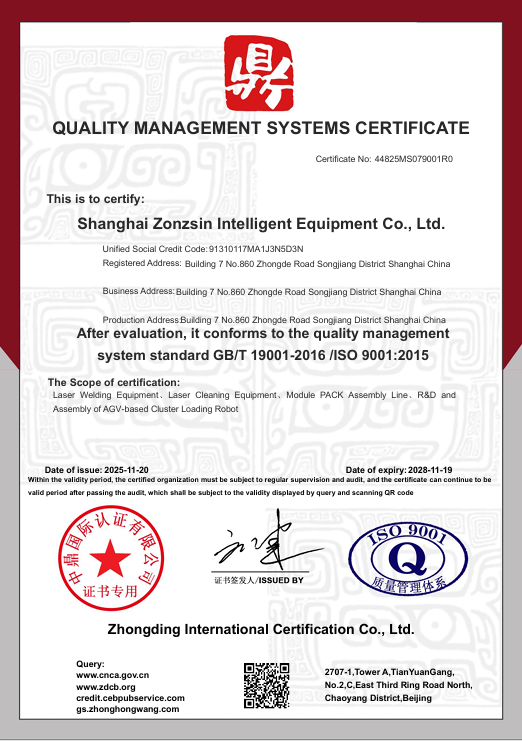 ISO 9001 certification (certificate 44825MS079001R0, ZDCB, referenced against GB/T19001-2016) sits behind the acceptance and service records.
After-sales commitments: what should be in writing
After-sales support is easiest to enforce when it is described as a process rather than an attitude. The commitments worth writing down are: the warranty scope and its explicit exclusions; the fault-reporting channel and who receives it; the remote diagnostics method; the escalation rule that converts a remote case into an on-site visit; the availability commitment for spare parts and the process for parts not held; the calibration service and its documentation; software, parameter and recipe support after handover; refresher training; and the engineering-change route for future pack formats.
The engineering-change route is where the supplier's technical depth becomes commercially relevant. Zonzsin's R&D team of 43 engineers is the resource behind customized configurations, layout adaptation, fixture design for additional pack formats and post-handover station changes, and the company holds 50 granted patents, including invention patents for its AGV-driven battery PACK insertion robot. For a buyer, the question to ask is not how many engineers exist, but how a change request travels through them: who scopes it, who quotes it, who validates the first article and who signs it off.
Delivery reliability: the India project and the U-shape layout
Delivery is the part of the partnership most often promised loosely and tested publicly. Two reference points are more useful than a schedule chart. Zonzsin completed a battery pack assembly project in India within one year, from order to a running line, in a market where battery pack assembly projects are a common application scenario. And where a building cannot accommodate a straight run, the line has been delivered in a U-shape layout that brings infeed, outfeed and supervision into one operating area instead of stretching the process across the hall.
Capacity behind those references: a 6,000 m² manufacturing facility, approximately 90 employees and an annual output capacity of 40 units, with delivered lines now running in Europe, the USA, Japan, South Korea and India. Capacity figures describe what a factory can build in a year; they do not fix the lead time of a specific order. The realistic schedule for a new line is set by three variables — the date the configuration is frozen, the fixture and tooling set for the chosen cell format, and site readiness.
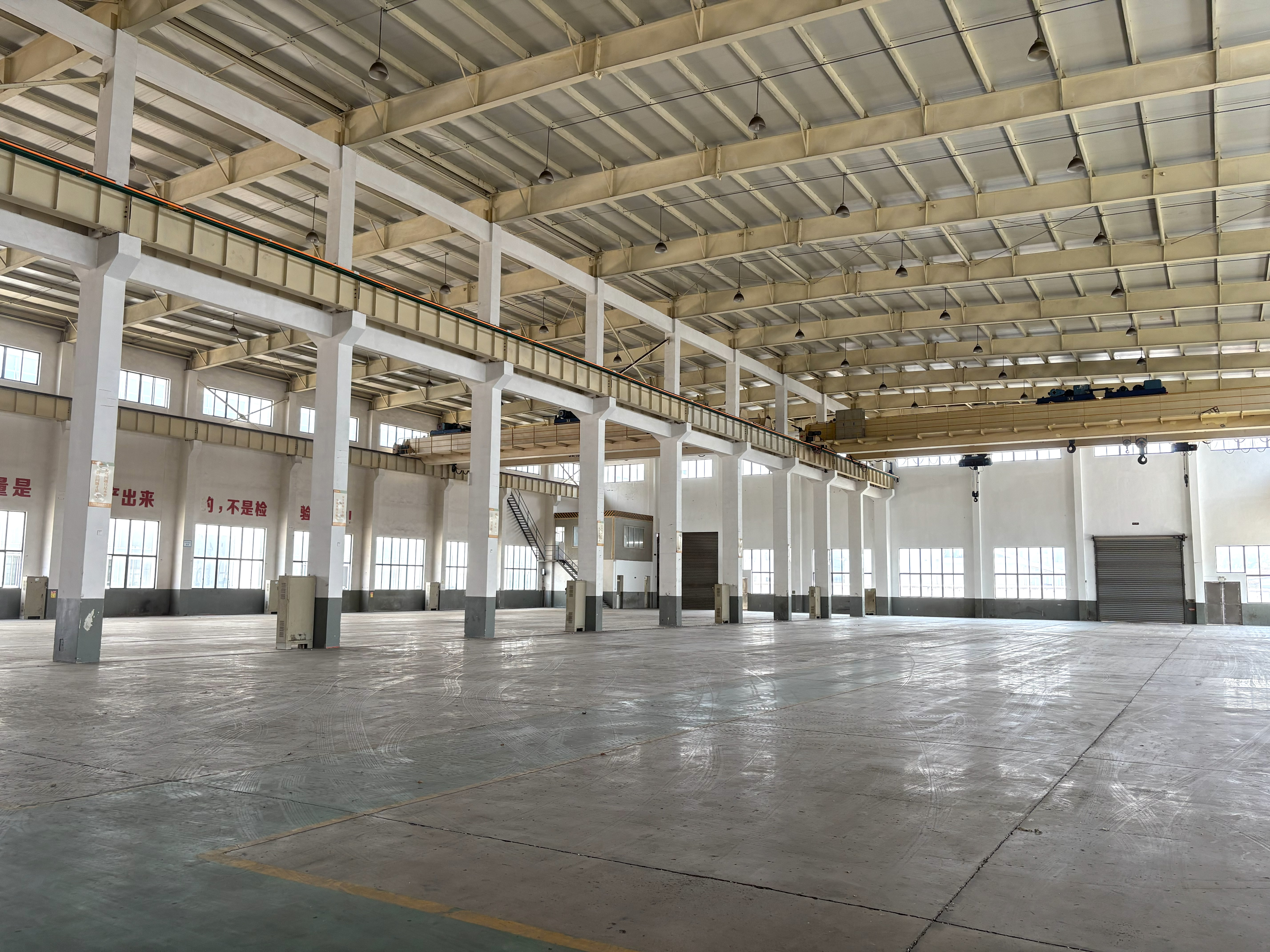 Manufacturing base for Zonzsin battery pack assembly lines, with an annual output capacity of 40 units.
The same terms apply across CTP, Blade and EV configurations
The commercial logic in this article is not exclusive to one model. It applies to the wider Zonzsin range, but each line carries its own parameter set, and a figure written for one model cannot be transferred to another during acceptance.
| Model | Type | Cycle time | Automation | Published parameters | Typical application |
|---|---|---|---|---|---|
| ZZX2406 | CTP battery pack assembly line | 4 PPM | Semi-automatic | 314Ah / 587Ah cells; 1P96S pack; 58000 × 11000 × 3800 mm; carbon steel Q235 | Energy storage, EV, C&I |
| ZZX2501 | Blade battery pack assembly line | 6 PPM; 30 min per pack | — | AC 380V ±10%, 50 ±0.5 Hz; compressed air 0.6–0.8 MPa; carbon steel Q235 | EV industry, energy storage |
| ZZX2313 | EV battery pack assembly line | — | — | Single machine operation rate ≥95%; air 0.5–0.8 MPa; AC 380V ±10%; welding ≥99.5% one-time, ≥99.95% final; Q235 | EV industry, energy storage, automotive OEMs |
Read the table as a warning about copy-paste contracts. A throughput clause lifted from a Blade line and pasted into a CTP contract fails at the first time study, because the automation level and the cell format are different. Acceptance criteria should be rebuilt for each model from its own published parameters.
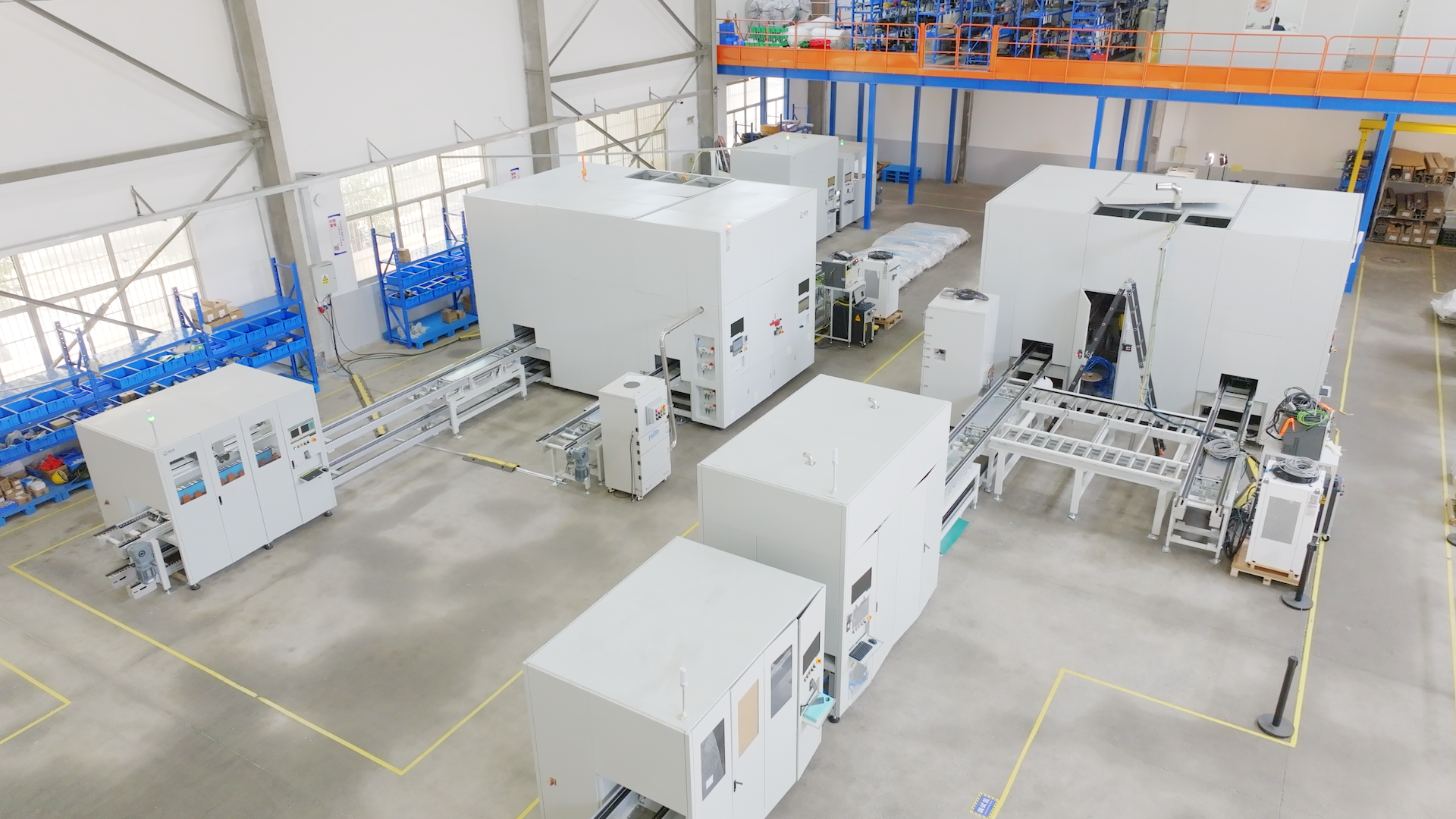 ZZX2313 EV battery pack assembly line — the model whose published welding rates are often quoted as a quality benchmark.
Use cases where these terms are tested first
Energy storage integrators feel the acceptance clauses most sharply, because pack-level dimensional and configuration consistency propagates directly into container assembly. For a 1P96S pack built on 314Ah or 587Ah cells, a sampling plan written at contract stage is the only thing standing between a fixture problem and a month of rework.
EV and automotive OEM buyers tend to weight documentation and change control more heavily than throughput, because their own quality systems will audit the line's records. A calibration certificate that cannot be produced two years after handover is a non-conformance in their audit, not the supplier's.
C&I projects, which are usually smaller and more layout-constrained, are where the U-shape configuration earns its place: a building that cannot host a 58-metre straight run can often host a folded arrangement, provided infeed, outfeed and supervision are designed together rather than improvised on site.
Frequently asked questions
Is ZZX2406 backed by an ISO 9001 quality system?
Yes. Shanghai Zonzsin Intelligent Equipment Co., Ltd. holds ISO 9001 certification under certificate 44825MS079001R0, issued through ZDCB and referenced alongside GB/T19001-2016. The certificate matters less as a badge than as evidence that design, purchasing, production and service records follow a documented process — which is what makes acceptance reports, calibration records and spare parts lists auditable years later.
What acceptance criteria should be written into a CTP pack line contract?
Criteria should be parameter-based rather than impression-based: the 1P96S pack configuration built on the qualified cell format, the contracted cycle time, dimensional and fixture fit, weld and vision inspection results, safety interlocks and ESD continuity. Each stage should state the test method, the sampling plan and the evidence handed over. The practical rule is that anything not measured during acceptance becomes a dispute during ramp-up.
Can one line run both 314Ah and 587Ah cells?
ZZX2406 is published as compatible with 314Ah and 587Ah prismatic cells in a 1P96S pack. Both formats share the same line, but the fixture set, tooling and program parameters differ by format. Confirm at contract stage which formats will be qualified during acceptance and which will need a later change order; qualifying one format and assuming the other is a common source of delay.
How does a 43-engineer R&D team affect customization and long-term support?
The team is the resource behind customized configurations and post-handover engineering changes — layout adaptation, fixture design for a further pack format, station additions and program changes. It also sits behind the company's 50 granted patents, including invention patents for the AGV-driven battery PACK insertion robot. In contract terms, the useful question is not the headcount but the change-order process it supports: who specifies, who quotes, who validates and who signs off.
What drives total cost beyond the purchase price?
Budget for the building envelope (ZZX2406 is published at 58000 × 11000 × 3800 mm), power and compressed air supply, ESD protection and fire prevention measures, temperature, humidity and cleanliness control, fixture and tooling sets per pack format, initial spare parts stock, calibration services and operator training. Semi-automatic operation also means staffing at manual stations is a running cost rather than a one-off purchase item.
Can we validate with sample packs before full acceptance?
Sample packs are the point where the contract becomes measurable. A trial run on the qualified cell format verifies fixture fit, station sequence, vision inspection settings and weld results before volume production. Ask for the sample run to be written into acceptance rather than treated as a favour, and keep the records — they become the troubleshooting baseline after handover.
What delivery schedule is realistic?
Schedule is set by three variables: the date the configuration is frozen, the fixture and tooling set for the chosen cell format, and site readiness. Zonzsin completed an India battery pack assembly project within one year, and operates a 6,000 m² facility with about 90 employees and an annual output capacity of 40 units. Capacity describes annual build capability, not a guaranteed lead time; the schedule for a specific order should be agreed against the configuration freeze date.
How are spare parts, calibration and remote support handled after handover?
The recurring obligations are preventive maintenance on the agreed plan, periodic calibration of vision, laser and welding, force, pressure and temperature instruments, and management of a spare parts list split into critical, wear and consumable items. Remote support covers touch-screen and program-control diagnostics — parameter changes, fault tracing, recipe adjustments — with escalation to an on-site visit when a fault cannot be resolved remotely. Agree the connectivity and access policy before the line goes live.
How do we start a partnership discussion?
Start with the configuration: cell format, pack architecture, target throughput, available floor space and the utilities on site. The product brochure gives line-level specifications, and a technical review against your layout — including whether a U-shape arrangement fits the building — is the natural step before a formal quotation.
Conclusion
A CTP battery pack assembly line is bought once and serviced for years, so the contract should be judged the way the line is judged: on measurable evidence. Freeze the configuration before you discuss price, tie milestones to acceptance stages that produce records, and treat calibration, spare parts and remote support as scheduled obligations rather than as goodwill. The technical facts that make those clauses enforceable — the 1P96S pack configuration, the 314Ah and 587Ah cell compatibility, the 4 PPM cycle time and the semi-automatic operating mode — are the same facts that make the line useful in the first place.
Next step: download the Zonzsin product brochure for line-level specifications, then review your cell format, pack architecture and floor plan against the ZZX2406 configuration before requesting a project-specific proposal.
Manufacturer: Shanghai Zonzsin Intelligent Equipment Co., Ltd., Building 22, No.2199, Shebei Highway, Sheshan Town, Songjiang District, Shanghai, China. Contact: Katty.liu, katty.liu@zonzsin.com, +86 134-8282-9368.
Have Questions or Need More Details?
Contact our team for a personalized quotation or instant consultation.
Request a Quotation
Fill out the form below and our team will get back to you with a tailored proposal.
WhatsApp Direct Chat
Prefer to chat in real-time? Message us on WhatsApp for instant assistance & quick answers.
- Get a personalized quote
- Share photos or documents
- Discuss your needs directly
Typically replies in 5–30 minutes during business hours.