
CTP Battery PACK Assembly Line Compliance: ISO 9001 & GB/T
CTP Battery PACK Assembly Line Compliance: ISO 9001 & GB/T
A CTP battery pack assembly line is compliance-ready when two independent conditions are documented: the equipment supplier's quality management system is certified against ISO 9001, and the line's physical installation inputs match the factory that will host it. For Zonzsin equipment, the first condition is covered by ISO 9001 certification issued through ZDCB under certificate 44825MS079001R0. The second is covered by published model data — AC 380V ±10%, 50±0.5 Hz supply and compressed air at 0.6–0.8 MPa — together with a defined set of indoor factory, ESD, and fire-prevention requirements.
Shanghai Zonzsin Intelligent Equipment Co., Ltd. is a Shanghai-based equipment manufacturer founded in 2019 that builds automatic battery pack assembly lines and ESS battery pack insertion robots for lithium battery manufacturers, energy storage integrators, and automotive OEMs. Its CTP and EV pack line models, ZZX2406 and ZZX2313, are the reference points used throughout this guide.
This article is written for the research stage of a project — the point where a plant team, an EPC contractor, or a procurement manager needs to understand what "compliant" actually means for a pack assembly line before shortlisting suppliers. It separates the certificate question from the installation question, and shows where each one is answered with evidence.
The Compliance Problem: A Certified Supplier Is Not the Same as an Approved Line
Compliance on an automatic battery pack assembly line is usually discussed as a supplier question — "is the manufacturer ISO 9001 certified?" — when in reality it is a two-part question. The certificate proves that a quality management system exists and is audited. It does not prove that the specific line will pass the buyer's installation audit, because installation compliance depends on plant conditions that sit outside the supplier's certificate scope.
In practice, four gaps account for most of the compliance friction on CTP pack projects:
- Scope ambiguity. A certificate number confirms certification, but buyers rarely check which activities it covers — design, manufacturing, sales, or service — or whether the scope matches the equipment being purchased.
- Utility mismatch. Lines specified for AC 380V ±10% and compressed air in the 0.6–0.8 MPa band are sometimes installed into plants with unstable supply or undersized air systems, which then shows up as weld defects rather than as a compliance finding.
- Facility conditions. ESD protection, fire prevention, and temperature, humidity, and cleanliness control are project-side obligations. If they are not assigned in writing before shipment, nobody owns them.
- Handover evidence. Acceptance depends on records: inspection reports, vision inspection data, welding qualification results, and fixture adaptation sign-off.
For a team still in the research phase, the practical consequence is that compliance should be scoped as a project deliverable with two owners — the equipment supplier for the quality system and line data, the buyer for the building and utilities — rather than treated as a single certificate attached to a quotation.
ISO 9001 and GB/T19001-2016: What They Require From Line Builders
GB/T19001-2016 is China's national quality management standard and corresponds to ISO 9001:2015. For an equipment builder, both frameworks ask the same operational questions: is design controlled, are processes validated, are measuring devices calibrated, is nonconforming output identified and handled, and is there a documented record trail that a third party can audit.
What certificate 44825MS079001R0 covers
Zonzsin's quality management system is certified through ZDCB under certificate 44825MS079001R0. What such a certificate establishes is that an independent body has audited the management system behind the design and build of the company's automatic battery pack assembly lines and found it conformant. What it does not do is certify a customer's specific pack design, a specific cell format, or a specific plant layout — those remain project-level validations.
This distinction matters most in cross-border procurement, where a buyer's internal audit team and a customs or project-approval reviewer may ask different questions. The first wants process evidence; the second wants a valid certificate with a clear scope and a current validity period.
The document set to request before signing
- The ISO 9001 certificate with certificate number, issuing body, scope statement, and validity dates.
- A statement of which models the scope covers — for CTP projects, ZZX2406; for EV pack projects, ZZX2313.
- Model datasheets showing utility requirements, dimensions, cycle time, and quality metrics.
- Inspection and test records from factory acceptance testing.
- A written allocation of ESD, fire-prevention, and cleanliness responsibilities between supplier and buyer.
Line-Level Compliance Evidence in ZZX2406 and ZZX2313
Compliance becomes concrete when it is attached to published specifications. The two models most often discussed for CTP and EV pack projects document different things, and understanding which numbers belong to which model prevents specification errors later in procurement.
ZZX2406: a CTP line for 314Ah and 587Ah prismatic cells
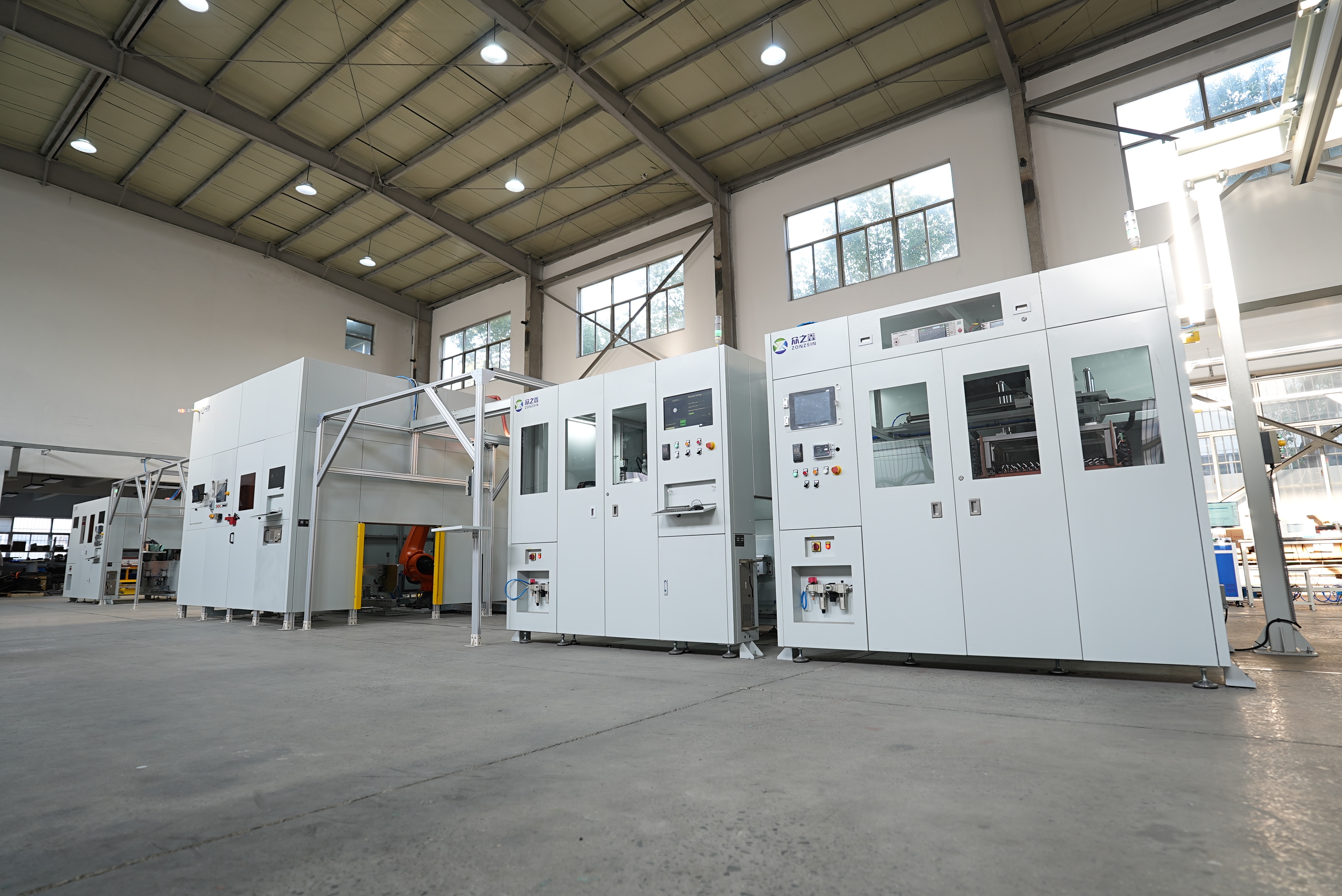
The ZZX2406 is a CTP battery PACK assembly line built from carbon steel Q235, with overall dimensions of L58000 × W11000 × H3800 mm. It runs at a cycle time of 4 PPM in semi-automatic mode, supports both 314Ah and 587Ah cells, and is configured for a 1P96S pack. Typical application scenarios are energy storage, EV, and commercial and industrial (C&I) projects.
Those figures carry compliance implications. A 58-metre line requires a defined indoor footprint and a material flow plan before installation, and the dual cell-format capability means fixture adaptation must be specified at order stage rather than assumed — a point that appears explicitly in the project requirements for pack assembly applications.
ZZX2313: an EV pack line with published welding yields
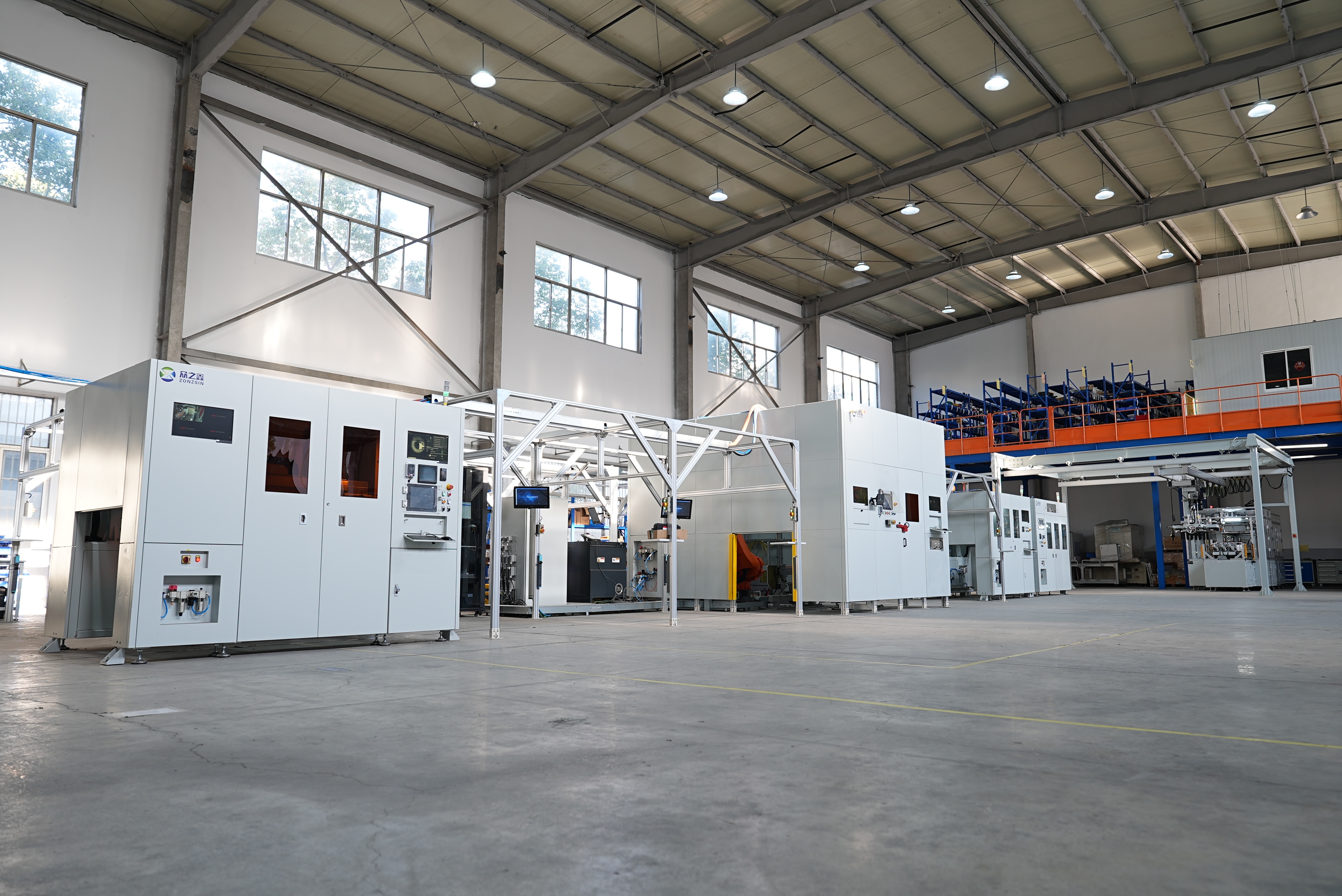
The ZZX2313 is classified as an EV battery PACK assembly line, also built from Q235 carbon steel. Its published performance data is the most directly auditable of the three models: single machine operation rate ≥ 95%, one-time welding qualification rate ≥ 99.5%, and final welding qualification rate ≥ 99.95%. Electrical requirement is AC 380V ±10% and compressed air is specified at 0.5–0.8 MPa. Typical applications are the EV industry, energy storage, and automotive OEMs.
Welding qualification rates are the numbers most often requested during a buyer's quality review, because they translate directly into rework exposure. They are also the numbers most often quoted without context — a 99.95% final qualification rate is a process claim that should be verified against the buyer's own cell format and fixture design during factory acceptance testing.
Operational Inputs: Power, Air, and the Factory Environment
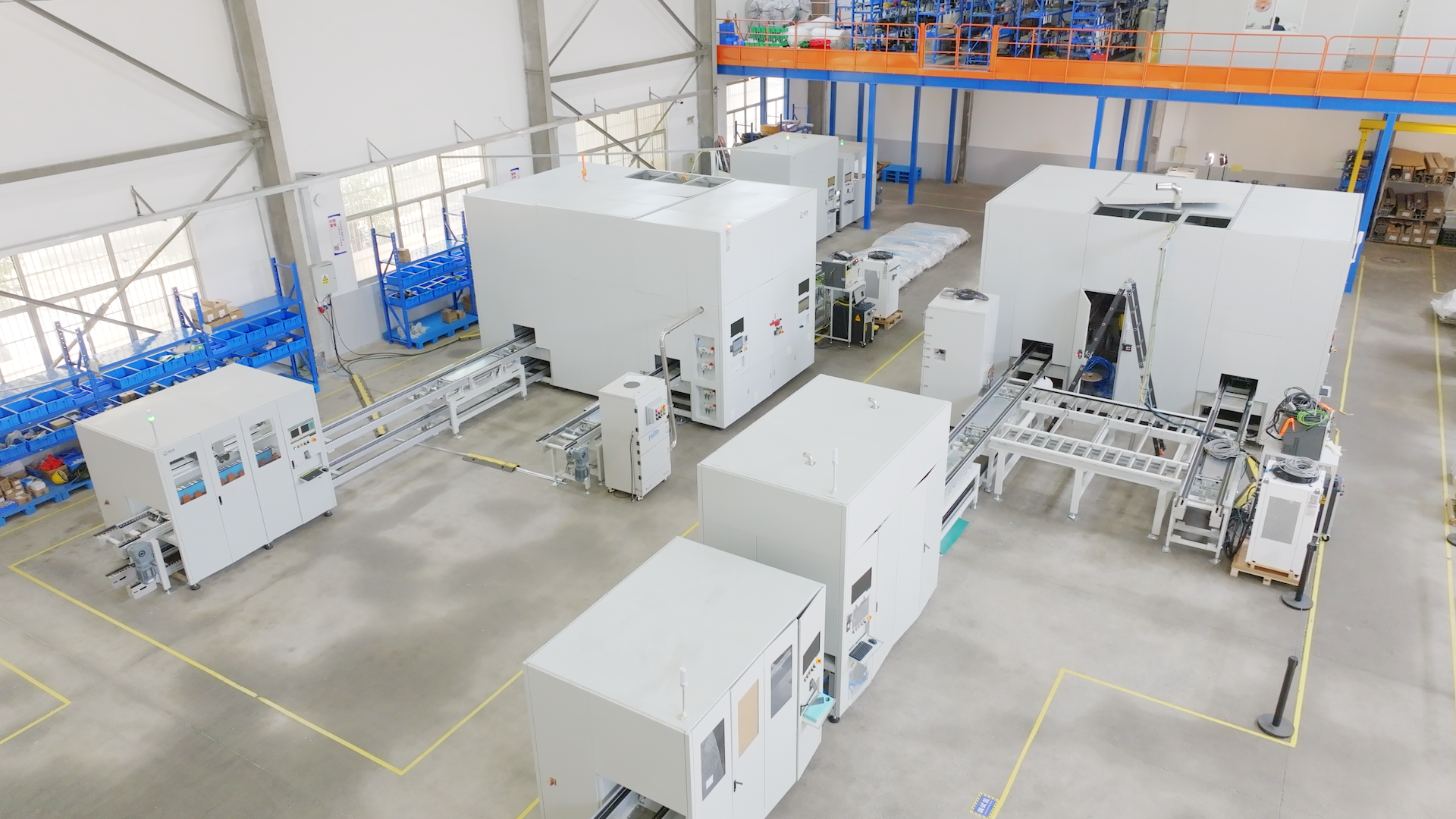
Utility compliance is where most installation surprises originate, because the supplier's specification is a tolerance band and the plant's supply is a measurement. The documented inputs across the line range are:
- Electrical: AC 380V ±10%; the ZZX2501 blade-configuration line additionally specifies 50 ± 0.5 Hz.
- Compressed air: 0.5–0.8 MPa on ZZX2313; 0.6–0.8 MPa on ZZX2501.
- Operating mode: semi-automatic or fully automatic, with touch-screen and program control.
- Working condition: indoor, standard factory, industrial assembly-line conditions, continuous or shift-based production.
Beyond utilities, the project-side conditions that must be in place before commissioning include ESD protection, fire-prevention measures, and temperature, humidity, and cleanliness control. PACK compatibility and fixture adaptation are also listed as special requirements — a reminder that the line is configured around a pack, not the other way around.
Supporting equipment determines whether the compliance evidence is actually generated on the floor. The documented equipment set includes vision inspection systems, fixtures and tooling, laser equipment, and assembly and testing stations. A line without vision inspection can still assemble packs; it cannot produce the inspection records that an audit expects.
Mapping Requirements by Market: India, Southeast Asia, and the EU
Zonzsin delivers intelligent battery PACK assembly lines to domestic and overseas markets, with Southeast Asia and the European Union as major markets and export business accounting for 60% of total sales. Equipment has also been delivered to partners in Europe, the USA, Japan, South Korea, and India. The compliance emphasis differs by destination.
India
India is a common application scenario for Zonzsin pack assembly projects. For Indian projects, the dominant project-side issues are indoor factory conditions and utility stability: the site must deliver AC 380V ±10% reliably across shifts and sustain compressed air within the specified band. ESD protection, fire prevention, and cleanliness control require local engineering and are usually documented as buyer obligations, while the supplier side contributes model data, inspection records, and the ISO 9001 certificate for the buyer's vendor approval process.
Southeast Asia
SEA projects frequently combine EV and stationary storage production in a single facility, which places a premium on configuration clarity. When one building hosts both pack types, the specification must state clearly which model is being installed and which utility band applies — a ZZX2406 CTP line and a ZZX2501 blade line do not share identical published air and frequency inputs.
European Union
EU-bound projects place the heaviest documentation burden on the supplier-buyer interface. The ISO 9001 certificate establishes the management system; what EU project teams typically need in addition is a complete technical file — model drawings, utility data, component documentation, and acceptance test records — assembled before shipment rather than after arrival. Buyers should confirm the exact documentation set at RFQ stage instead of assuming a standard package.
Step-by-Step: Verifying Compliance Before the Line Ships
The sequence below reflects the order in which compliance questions usually surface on a CTP or EV pack project. Running it in this order avoids the common situation where a certificate is verified and then the installation package is discovered to be incomplete.
- Define the compliance scope in writing. State which standard applies (ISO 9001 / GB/T19001-2016), which market the plant serves, and which party owns ESD, fire prevention, cleanliness, and utility quality.
- Verify the certificate, not just its existence. Check certificate 44825MS079001R0 for issuing body (ZDCB), scope, and validity, and confirm the scope covers the equipment being purchased.
- Match the model to the pack. Confirm cell format and pack architecture — for ZZX2406, 314Ah or 587Ah cells in a 1P96S pack — and lock fixture adaptation before order release.
- Run a utility survey against published tolerances. Measure actual supply against AC 380V ±10%, 50 ± 0.5 Hz where applicable, and 0.5–0.8 MPa or 0.6–0.8 MPa compressed air. Record the measurement, not the design intent.
- Confirm the facility envelope. Verify indoor installation space against the line footprint (ZZX2406: L58000 × W11000 × H3800 mm), plus ESD flooring, fire-prevention measures, and temperature, humidity, and cleanliness control.
- Specify the supporting equipment list. Vision inspection systems, fixtures and tooling, laser equipment, and assembly and testing stations should be itemized, since they generate the records used at acceptance.
- Conduct factory acceptance testing against published metrics. For ZZX2313, test against ≥ 95% single machine operation rate, ≥ 99.5% one-time welding qualification, and ≥ 99.95% final welding qualification; for ZZX2406, verify 4 PPM cycle time on the actual pack.
- Close the documentation handover before shipment. Certificates, drawings, inspection reports, and the allocation of buyer-side obligations should be signed off while the equipment is still accessible at the supplier's plant.
Where Compliance-First Lines Fit: Three Project Scenarios
Stationary storage and BESS pack assembly
Storage projects tend to prioritize repeatability and traceability over raw speed. A semi-automatic CTP line at 4 PPM, such as ZZX2406, fits plants that are scaling from pilot to series production and need documented quality records more than maximum throughput.
EV traction pack assembly
EV traction battery pack assembly systems carry the strictest welding expectations, because weld quality drives both safety and warranty exposure. The ZZX2313's published one-time and final welding qualification rates make it the more directly auditable starting point for OEM-facing projects.
Multi-format and C&I plants
Plants serving commercial and industrial storage alongside EV work need flexible automation and clear model separation. Zonzsin's R&D team of 43 engineers supports customized configurations, which is where fixture adaptation and PACK compatibility requirements are resolved — and where the project-specific part of the compliance story is actually written.
Model Comparison: ZZX2406, ZZX2313, and ZZX2501
The table below uses only published model data. ZZX2501 is included because it documents the full utility set — AC 380V ±10%, 50 ± 0.5 Hz, and 0.6–0.8 MPa compressed air — against which CTP projects are often specified. Where a model specification does not list a value, the table says so rather than inferring one.
| Attribute | ZZX2406 | ZZX2313 | ZZX2501 |
|---|---|---|---|
| Line classification | CTP battery PACK assembly line | EV battery PACK assembly line | Blade battery PACK assembly line |
| Cell and pack compatibility | 314Ah and 587Ah cells; 1P96S pack | Not listed in the published specification | Not listed in the published specification |
| Cycle time / production rate | 4 PPM | Not listed in the published specification | 6 PPM; 30 minutes per pack |
| Automation mode | Semi-automatic | Not listed in the published specification | Not listed in the published specification |
| Electrical requirement | Not listed in the published specification | AC 380V ±10% | AC 380V ±10%, 50 ± 0.5 Hz |
| Compressed air | Not listed in the published specification | 0.5–0.8 MPa | 0.6–0.8 MPa |
| Quality metrics | Not listed in the published specification | Single machine operation rate ≥ 95%; one-time welding qualification ≥ 99.5%; final qualification ≥ 99.95% | Not listed in the published specification |
| Footprint / dimensions | L58000 × W11000 × H3800 mm | Not listed in the published specification | Not listed in the published specification |
| Material | Carbon steel Q235 | Carbon steel Q235 | Carbon steel Q235 |
| Typical industries | Energy storage; EV; C&I | EV; energy storage; automotive OEMs | EV; energy storage |
Note: utility and performance values are model-specific. Projects should request a configuration-specific datasheet before finalizing civil, electrical, or compressed-air works.
Frequently Asked Questions
Is the CTP battery PACK assembly line ISO 9001 certified, and what does certificate 44825MS079001R0 cover?
Yes. Zonzsin's quality management system is certified through ZDCB under certificate 44825MS079001R0, which is the certification referenced for the company's automatic battery pack assembly lines, including the ZZX2406 CTP line and the ZZX2313 EV pack line. The certificate covers the management system governing design and manufacturing; it does not certify a customer's specific pack design, cell format, or plant layout. Buyers should request the certificate with its scope statement and validity dates, and should treat the customer-specific elements — fixture adaptation, PACK compatibility, and installation conditions — as project-level validations documented separately.
What utility and facility requirements must be in place before a ZZX2406 or ZZX2313 line is installed?
The lines are designed for indoor, standard factory, industrial assembly-line conditions with continuous or shift production. Published utility inputs across the range are AC 380V ±10% and compressed air at 0.6–0.8 MPa, with 50 ± 0.5 Hz specified on the ZZX2501 model and 0.5–0.8 MPa compressed air on ZZX2313. Beyond utilities, the project must provide ESD protection, fire-prevention measures, and temperature, humidity, and cleanliness control, plus PACK compatibility and fixture adaptation for the specific pack. A ZZX2406 also requires an indoor footprint matching its L58000 × W11000 × H3800 mm dimensions.
What drives the cost of compliance on a CTP pack assembly project?
Compliance cost rarely appears as a single line item. It concentrates in facility works — transformer and distribution capacity to hold AC 380V ±10%, compressed-air capacity within the 0.6–0.8 MPa band, ESD flooring, fire-prevention systems, and environmental control — plus third-party inspection and the engineering time required for fixture adaptation and documentation. For scale context, publicly listed commercial quotations for complete turnkey CTP battery pack production lines have been cited in the US$1,000,000–3,000,000 per set range, but the compliance scope, not the headline equipment price, determines how much of that budget is consumed before commissioning. A configuration-specific quotation is the only reliable basis for budgeting.
Can we validate welding quality and pack fit before shipment?
Yes — validation is structured around factory acceptance testing using the line's supporting equipment: vision inspection systems, fixtures and tooling, laser equipment, and assembly and testing stations. The ZZX2313 publishes measurable targets to test against: single machine operation rate ≥ 95%, one-time welding qualification rate ≥ 99.5%, and final welding qualification rate ≥ 99.95%. For CTP configurations, the equivalent validation is cycle time and pack fit on the actual cell format and pack architecture, which for ZZX2406 means 314Ah or 587Ah cells in a 1P96S pack. Requesting a sample-based validation plan before order release is the recommended approach.
How long does delivery take, and what does compliance add to the schedule?
Zonzsin operates a 6000 m² manufacturing facility with approximately 90 staff and an annual production capacity of 40 units, and roughly 60% of sales are exported. Schedule on a specific project depends on three variables rather than a fixed lead time: when the configuration is frozen (cell format, pack architecture, fixture adaptation), how quickly buyer-side facility works are completed, and how much documentation review the destination market requires. Compliance extends schedules mainly through documentation and inspection steps, not through machine build. To confirm timing and the documentation scope for your market, send your pack specification and destination through www.zonzsin.com or contact the team directly for a configuration review.
Conclusion: Compliance Is a Two-Party Deliverable
The certificate is necessary and insufficient. ISO 9001 certification through ZDCB under certificate 44825MS079001R0 establishes that Zonzsin's quality management system is audited and conformant to ISO 9001 and its Chinese equivalent GB/T19001-2016 — but project approval depends equally on whether the line's published inputs (AC 380V ±10%, 50 ± 0.5 Hz, 0.6–0.8 MPa compressed air), its footprint, and its facility requirements match the plant. Reading the model data for ZZX2406 and ZZX2313 before civil and utility works begin is the single most effective compliance step available at the research stage.
Next Step
If you are preparing a compliance or vendor-approval package for a CTP, EV, or stationary storage pack project, the technical details for the full line range are consolidated in the downloadable product brochure. It covers model specifications, utility inputs, and configuration options in one document that can be shared with your engineering and procurement teams.
Download the product brochure: Zonzsin Product Brochure (PDF)
Contact: Katty.liu — katty.liu@zonzsin.com | Tel / WhatsApp: +86 134-8282-9368 | www.zonzsin.com
Shanghai Zonzsin Intelligent Equipment Co., Ltd. — Building 22, No.2199, Shebei Highway, Sheshan Town, Songjiang District, Shanghai, China.
Have Questions or Need More Details?
Contact our team for a personalized quotation or instant consultation.
Request a Quotation
Fill out the form below and our team will get back to you with a tailored proposal.
WhatsApp Direct Chat
Prefer to chat in real-time? Message us on WhatsApp for instant assistance & quick answers.
- Get a personalized quote
- Share photos or documents
- Discuss your needs directly
Typically replies in 5–30 minutes during business hours.