Manual vs Semi-Automatic vs Fully Automatic Battery Pack Assembly Lines: Cost & Yield Comparison
Manual vs Semi-Automatic vs Fully Automatic Battery Pack Assembly Lines: Cost & Yield Comparison
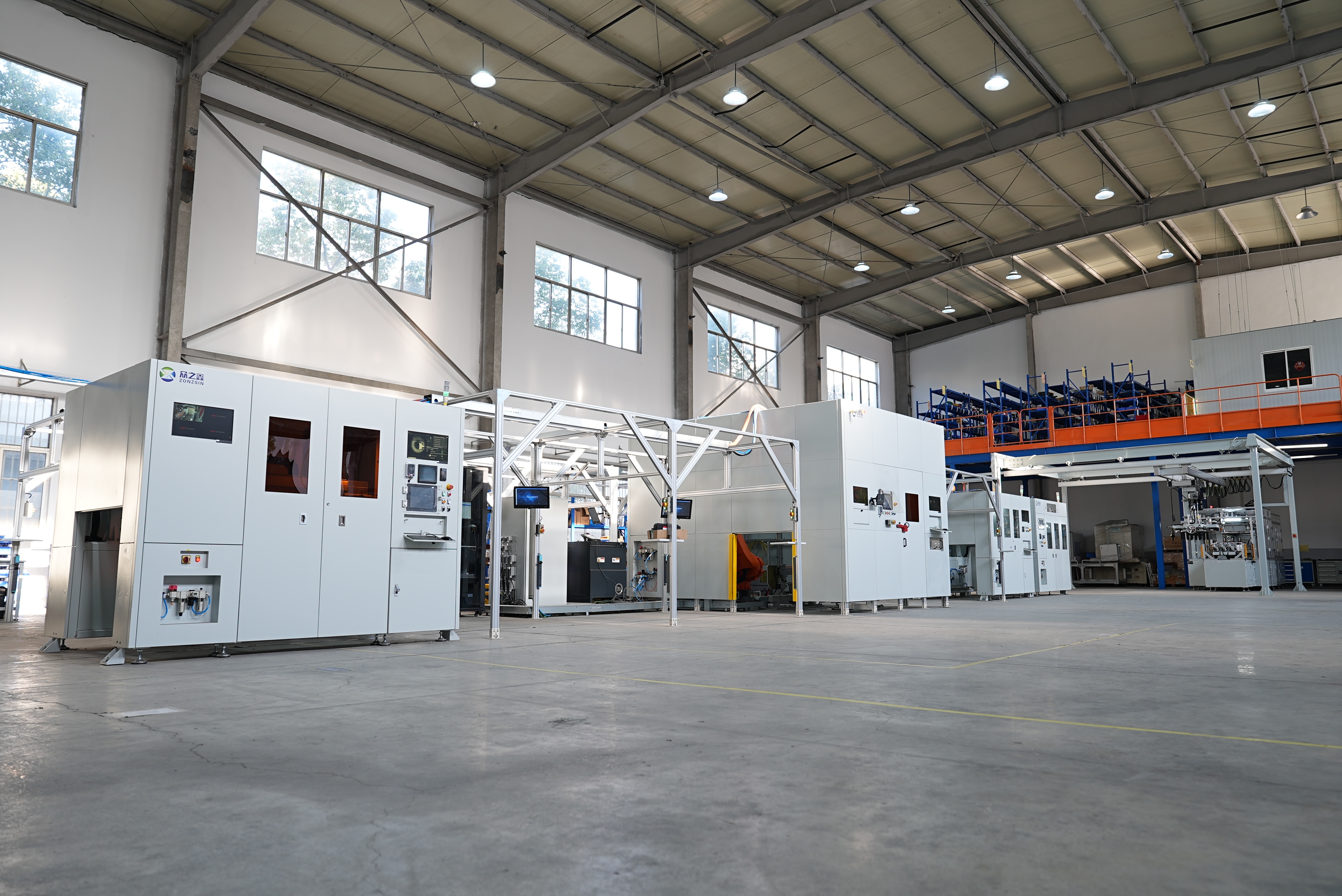
Automation level decides two numbers in a battery pack project: how much capital is committed first, and how much it costs to build every pack afterwards. Manual lines are the cheapest to start and the most expensive to scale. Semi-automatic lines automate the precision stations — welding and end-of-line testing — while operators keep handling cells and packs. Fully automatic lines add automated material flow and reach the lowest per-unit cost at volume, at the highest entry price. This comparison sets out investment, throughput, and yield across all three levels, using published Zonzsin line data and publicly reported market benchmarks.
What Manual, Semi-Automatic, and Fully Automatic Lines Actually Do
The three labels describe one thing: where the human hand leaves the process. That single decision determines throughput, quality consistency, and how many people stand on the line per shift.
Manual battery pack assembly
On a manual line, operators feed cells, position components, run hand tools and semi-manual welding equipment, and move packs between stations by hand or with basic handling aids. Capital expenditure is the lowest of the three levels, and the layout can be rearranged quickly when the product changes.
The cost of that flexibility is repeatability. Cycle time follows operator pace and can vary between shifts, and welding consistency depends on operator skill and attention. For prototype builds, low-volume custom packs, and early market entry, that trade-off is often acceptable. Past a certain daily volume, staffing cost and quality variability start to dominate the calculation.
Semi-automatic battery pack assembly
A semi-automatic line automates the stations where precision matters most — laser welding, end-of-line (EOL) testing, and the program-controlled sequence between them — while operators handle loading, cell feeding, and pack transfer. Zonzsin builds its CTP and EV pack lines in a semi-automatic or fully automatic operating mode, both controlled from a touch screen with program control, so the same platform can be specified at either level.
Output improves over a manual line without the full investment in automated material flow, and the welding process becomes machine-governed rather than operator-governed.
Fully automatic battery pack assembly
A fully automatic line links automated material handling with welding, testing, and inspection, so packs move through the process with minimal operator intervention. At sustained high volume, cost per pack falls furthest here, because direct labor is minimized and process consistency is set by the machine rather than by the shift.
The trade-offs are equally real: the highest initial investment, a longer commissioning period, and less tolerance for product design changes after installation.
Where buyers get stuck: most evaluation spreadsheets compare purchase price first. Yield loss, rework labor, operator skill requirements, and ramp-up time usually move total cost of ownership further than the invoice does.
Why Automation Level Drives Cost Per Pack
Two structural changes in pack design have turned automation level from a preference into a cost calculation.
Cell-to-pack architectures raised handling precision
CTP architectures place cells directly into the pack structure and remove the module stage. That raises pack-level energy density and simultaneously raises the precision required at every station — cell positioning, busbar alignment, and welding. Zonzsin's CTP line, model ZZX2406, is configured for 314Ah and 587Ah prismatic cells in a 1P96S pack. Cell formats at that size and weight make fully manual handling progressively less practical as daily volume rises.
Published industry benchmarks for high-efficiency CTP lines running large prismatic cells list cycle times in the range of 4–8 PPM. Comparison notes in the same dataset contrast a 4 PPM semi-automatic baseline with roughly 12–16 PPM for standard fully automatic lines — a gap that reflects the number of automated stations, not only line speed.
Yield is the largest hidden cost line
Welding quality decides how much production time is consumed by rework and how much material becomes scrap. Zonzsin publishes a one-time welding qualification rate of ≥99.5% and a final welding qualification rate of ≥99.95% for its EV battery pack assembly line, model ZZX2313, alongside a single-machine operation rate of ≥95%.
Those figures are best read as cost controls rather than quality slogans. A one-time qualification rate at or above 99.5% limits how many packs return to rework; a final qualification rate at or above 99.95% limits how many defects reach the finished pack. Applied to annual volume, small differences in these rates translate into measurable differences in labor hours and material loss — a comparison a manual line cannot make, because manual welding consistency is not a fixed machine parameter.
Investment scale is publicly visible
Commercial listings for a complete turnkey CTP battery pack production line typically range from US$1,000,000 to US$3,000,000 per set, depending on automation scope, process coverage, and testing depth. That spread is why the manual-versus-automatic decision is usually settled on payback period rather than on sticker price.
How Zonzsin Configures Semi-Automatic and Fully Automatic Lines
Shanghai Zonzsin Intelligent Equipment Co., Ltd. (Zonzsin) is a Shanghai-based manufacturer founded in 2019 that supplies automatic battery PACK assembly lines and ESS battery pack insertion robots to battery cell and pack manufacturers, energy storage system integrators, automotive OEMs, and EPC turnkey contractors. Because the company builds in OEM and ODM modes, automation level is a configuration field rather than a fixed catalogue entry: buyers can specify cycle time, automation level, logo, color, and configuration.
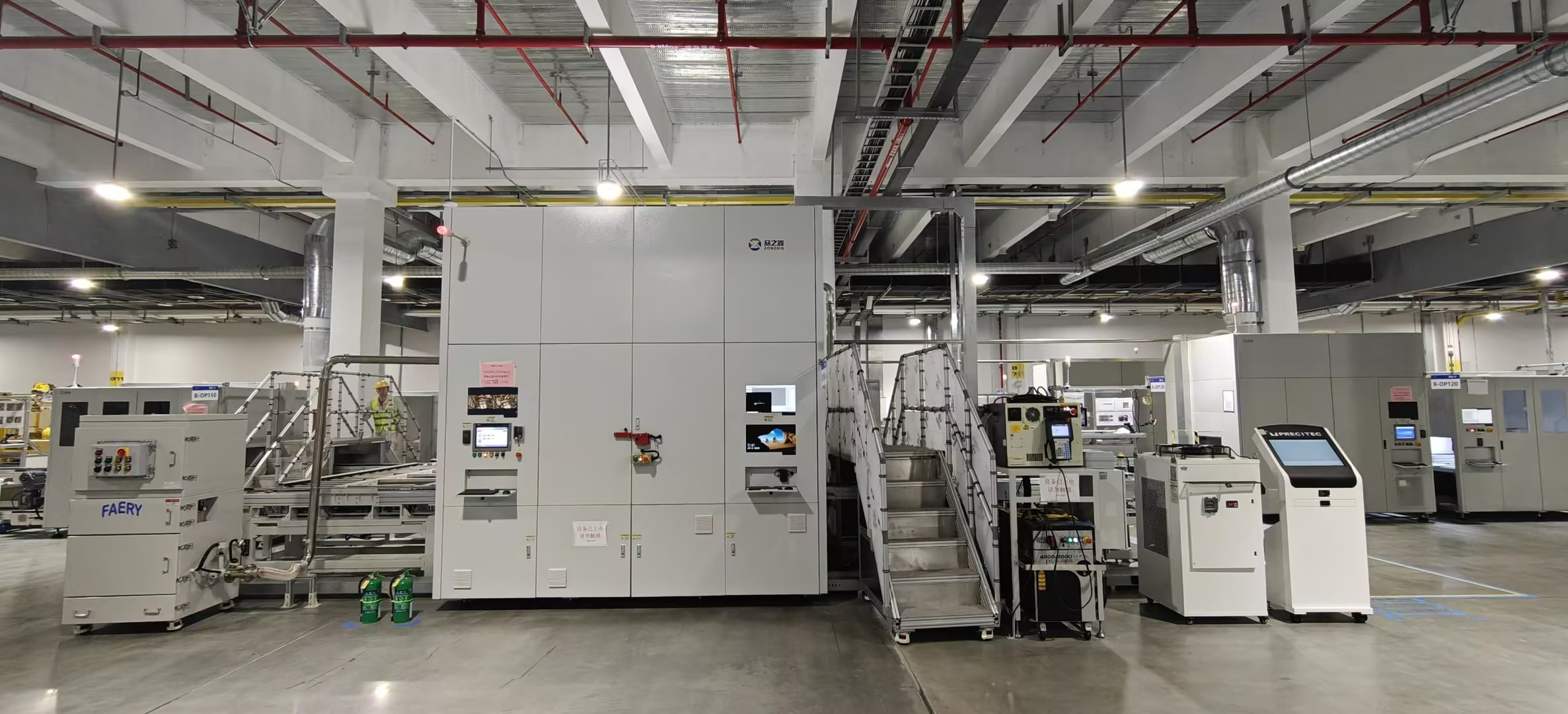
Process coverage across the line family runs from cell feeding and stacking through insulating, wire harness installation, EOL test, and charging/discharging testing. That full scope matters when comparing automation levels, because the test stations included on a manual line and on an automatic line are rarely the same set.
| Published specification | ZZX2406 | ZZX2501 | ZZX2313 |
|---|---|---|---|
| Line type | CTP battery pack assembly line | Blade battery pack assembly line | EV battery pack assembly line |
| Cycle time | 4 PPM | 6 PPM (30 min per pack) | Not stated |
| Automation mode | Semi-automatic | Not stated | Not stated |
| Cell / pack compatibility | 314Ah & 587Ah; 1P96S | Not stated | Not stated |
| Single-machine operation rate | Not stated | Not stated | ≥95% |
| Welding qualification rate | Not stated | Not stated | One-time ≥99.5%; final ≥99.95% |
| Electrical requirement | Not stated | AC 380V ±10%, 50 ±0.5 Hz | AC 380V ±10% |
| Compressed air | Not stated | 0.6–0.8 MPa | 0.5–0.8 MPa |
| Structure material | Carbon steel / Q235 | Not stated | Carbon steel / Q235 |
| Dimensions | L58000 × W11000 × H3800 | Not stated | Not stated |
Three configuration levers carry most of the cost difference:
- Cycle time. ZZX2406 is published at 4 PPM in a semi-automatic CTP configuration, while ZZX2501 is published at 6 PPM, equivalent to 30 minutes per pack, for blade-cell packs. Higher throughput targets generally require more automated stations or parallel equipment.
- Automation level. Both operating modes are program-controlled through a touch screen. The difference sits in how much of the material handling is automated.
- Cell and pack compatibility. The CTP line is published for 314Ah and 587Ah cells in 1P96S, and the automatic industrial car battery pack assembly line is listed with compatibility for 280/314/587Ah cells and 1P52S/1P104S pack configurations. Buyers planning a format transition should confirm handling and welding parameters instead of assuming one line covers both without adjustment.
Delivery and support facts published by Zonzsin:
Monthly production capacity: 3 units. Typical lead time: 3–5 months. Minimum order quantity: 1 unit. Quality control: 100% test.
Export markets: SEA and EU. After-sales: remote support plus on-site installation and commissioning.
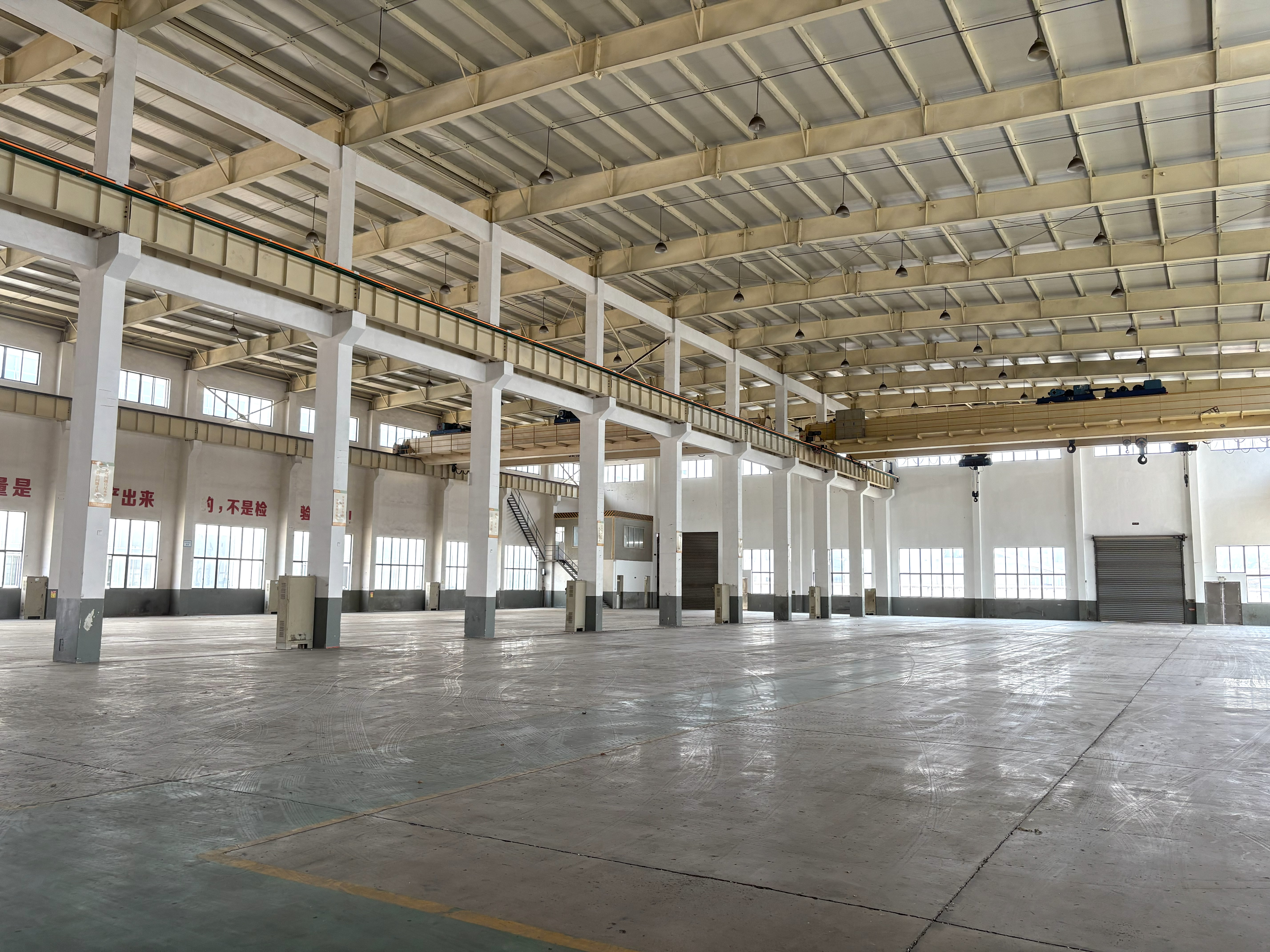
The capability behind those numbers includes a 43-engineer R&D team and 50 granted patents, among them invention patents covering AGV-driven battery PACK insertion robots. For a buyer, the operational question is whether the supplier can hold a delivery schedule and support the line after commissioning, not whether the portfolio is wide.
Step-by-Step: Building Your Own Cost & Yield Comparison
Six steps convert the manual / semi-automatic / fully automatic question into a defensible calculation.
- Fix the output target in PPM, then in packs per day. Convert your cell format and pack configuration into a required cycle time. A 1P96S CTP pack and a blade-cell pack do not convert at the same rate, which is why published line figures are always tied to a model: 4 PPM for ZZX2406, and 6 PPM (30 minutes per pack) for ZZX2501.
- Build capital expenditure per level. Request a configured quotation for the semi-automatic and fully automatic versions of the same line instead of comparing catalogue prices, because automation scope — not brand — is the main cost variable. Publicly listed turnkey CTP lines sit between US$1,000,000 and US$3,000,000 per set.
- Translate yield rates into cost. Apply published welding qualification rates (one-time ≥99.5%, final ≥99.95% on ZZX2313) to your own annual pack volume to estimate rework hours and scrap allowance. Then estimate the same figures for a manual process using your own operator data. The difference is the annual value of automation.
- Price labor and skill dependency. Count headcount per shift at each level, then add recruitment and training cost for skilled welding operators. Labor-intensive lines carry wage inflation and turnover risk that never appear in a capex comparison.
- Test flexibility against your product roadmap. Confirm cell format and pack configuration compatibility before comparing prices. Published compatibility for Zonzsin's automatic industrial car battery pack assembly line covers 280/314/587Ah cells and 1P52S/1P104S packs.
- Write acceptance criteria into the contract. Zonzsin's stated acceptance criteria are FAT and online FAT. Commercial terms are MOQ 1 unit, delivery EXW Shanghai / FOB Shanghai / FCA Shanghai, and 50% advance payment by T/T with the 50% balance within 3 business days after the BL date.
Manual vs Semi-Automatic vs Fully Automatic: Comparison Table
| Criterion | Manual | Semi-Automatic | Fully Automatic |
|---|---|---|---|
| Role of people | All stations operator-driven | Operators handle loading, cell feeding and transfer; welding and EOL test automated | Minimal operator intervention; automated material flow, welding and testing |
| Cycle time benchmark | Governed by operator pace | 4 PPM semi-automatic CTP baseline; Zonzsin ZZX2406 published at 4 PPM, ZZX2501 at 6 PPM (30 min per pack) | Roughly 12–16 PPM in published industry comparison notes; Zonzsin module PACK line published up to 16 PPM |
| Welding quality control | Depends on operator skill; varies by shift | Program-controlled laser welding; Zonzsin EV pack line ZZX2313 published at one-time ≥99.5% and final ≥99.95% | Same program-controlled welding applied with automated handling, which reduces variation introduced by manual transfer |
| Direct labor per shift | Highest | Moderate | Lowest |
| Initial investment | Lowest | Moderate | Highest — publicly listed turnkey CTP lines range from US$1,000,000 to US$3,000,000 per set |
| Cost per pack trend | Labor-dominated; rises with wage inflation and volume | Falls as volume grows; rework bounded by published qualification rates | Lowest at high sustained volume |
| Product change flexibility | Highest | Moderate; cycle time, automation, logo, color and configuration specified at order | Lowest without re-engineering |
| Typical fit | Prototype and low-volume custom packs | Mid-volume EV and ESS production | High-volume EV traction and standardized ESS packs |
The table is not a ranking. It is a decision grid: the correct level is the lowest automation level that still holds your required output and your acceptable rework rate at your local labor cost.
Use Cases: Matching Automation Level to Project Type
EV traction pack production
Automotive OEMs building traction packs at high daily volume are the clearest case for fully automatic operation, where automated handling keeps operator count low and welding consistency stable across shifts. Zonzsin's EV battery pack assembly line, model ZZX2313, is published with the ≥95% single-machine operation rate and the ≥99.5% / ≥99.95% welding qualification figures, and is listed for EV industry, energy storage, and automotive OEM applications.
Energy storage and stationary packs
Stationary storage packs built on 314Ah prismatic cells usually call for a semi-automatic or fully automatic configuration depending on volume. The ZZX2406 CTP line covers 314Ah and 587Ah cells in 1P96S for energy storage, EV, and commercial and industrial applications. Because ESS pack designs change more often than traction packs, the ability to specify cycle time, automation, logo, color, and configuration at the order stage is a practical advantage.
Mixed-product plants and format transitions
Plants expecting to move from 280Ah to 314Ah and later to 587Ah cells should verify compatibility before choosing an automation level. Published compatibility for Zonzsin's automatic industrial car battery pack assembly line covers 280/314/587Ah cells and 1P52S/1P104S packs.
Field case: one year of operation in India
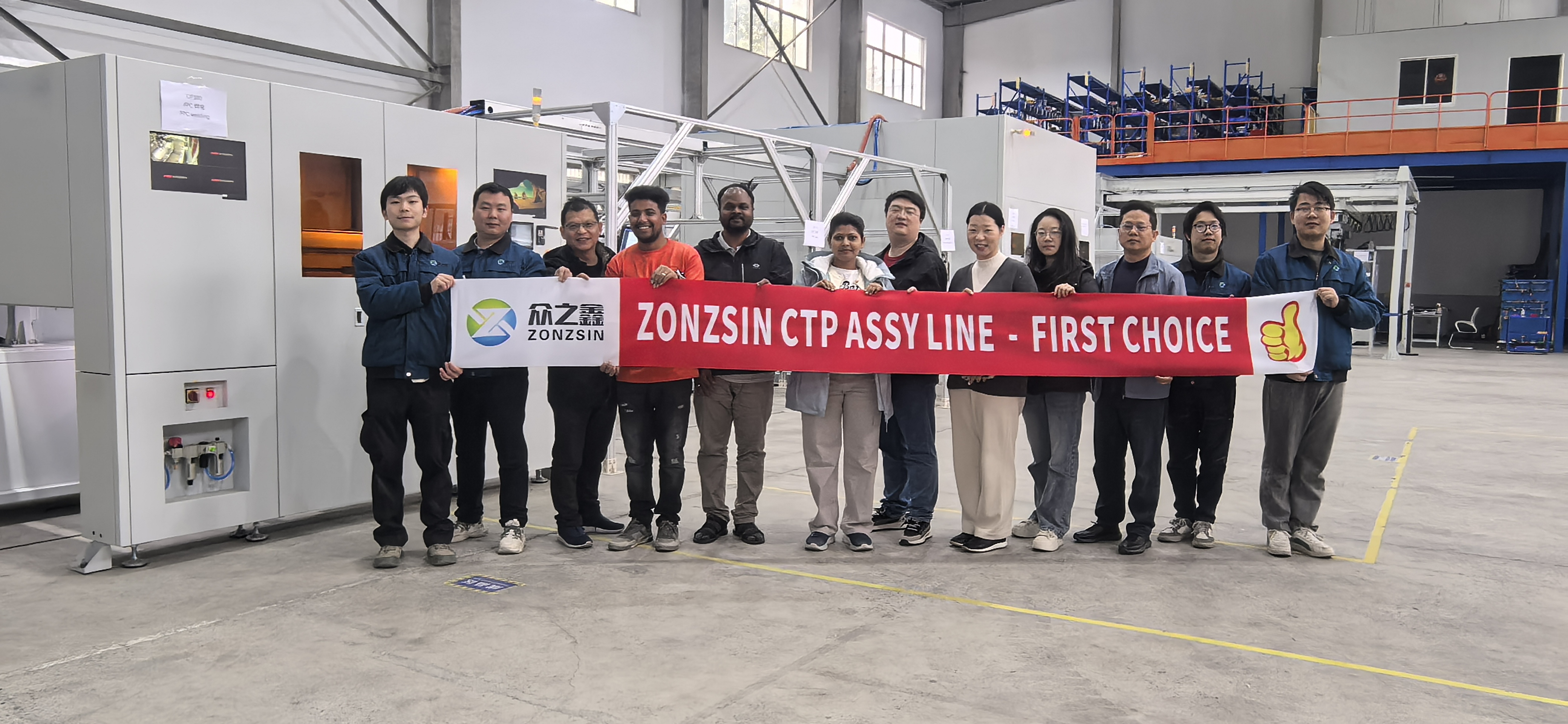
An installed Zonzsin line in India has run for one year with stable operation, according to company case data. The line has been used by an automotive OEM, an energy storage system integrator, a battery cell and pack manufacturer, and an EPC turnkey contractor. The recorded highlight is a U-shaped layout that saves floor space, combined with user-friendly operation — a reminder that layout and operability belong in the automation-level decision, not only headcount and PPM.
Pilot and low-volume custom projects
Semi-automatic lines often serve as the entry configuration for new pack designs, because the same platform can be specified at a higher automation level later if volume justifies it.
Frequently Asked Questions
Does a battery pack assembly line have to come from an ISO 9001 certified supplier, and what does the certificate need to cover?
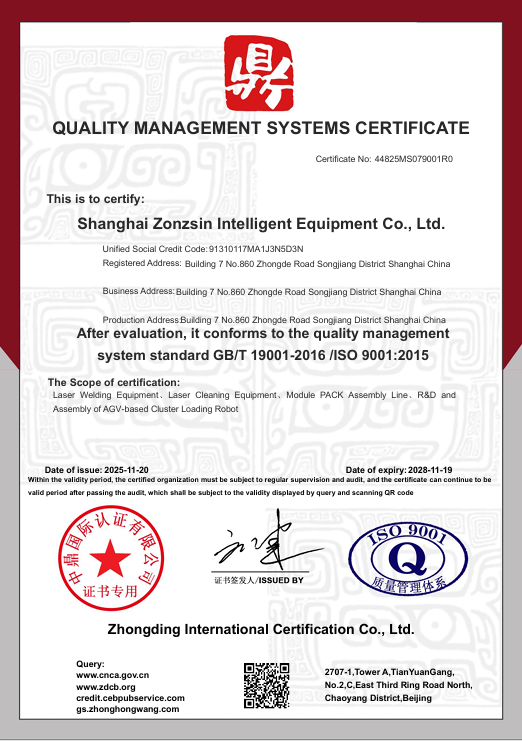
Certification scope matters more than the certificate itself, because a quality management system certificate is only relevant if it covers the activities the supplier actually performs. Zonzsin's certificate, number 44825MS079001R0, was issued by ZDCB to the GB/T19001-2016 / ISO 9001:2015 standard, with validity from 20 November 2025 to 19 November 2028. The certified scope covers laser welding equipment, laser cleaning equipment, module PACK assembly line, and the R&D and assembly of AGV-based cluster loading robots. Buyers comparing automation levels should confirm that the scope covers the welding and line-assembly stations being purchased, not only the company name on the document.
Can one platform run in both semi-automatic and fully automatic mode, and which cells can it handle?
Zonzsin supplies lines in OEM and ODM modes and allows buyers to specify cycle time, automation level, logo, color, and configuration, so semi-automatic and fully automatic operation are configuration choices within the same platform family; both modes are controlled from a touch screen with program control. Published cell and pack compatibility includes 314Ah and 587Ah prismatic cells in 1P96S on the ZZX2406 CTP line, and 280/314/587Ah cells in 1P52S/1P104S configurations on the automatic industrial car battery pack assembly line. Throughput is published at 4 PPM for ZZX2406 and 6 PPM (30 minutes per pack) for ZZX2501.
What should a buyer budget, and where does the money actually go?
Publicly listed pricing for a complete turnkey CTP battery pack production line typically ranges from US$1,000,000 to US$3,000,000 per set, and that spread is driven mainly by automation scope, process coverage, and testing depth. The cheapest configuration is not automatically the lowest cost: published welding qualification rates of ≥99.5% one-time and ≥99.95% final on the ZZX2313 EV pack line define how much rework and scrap the line generates, and those rates depend on programmed welding rather than operator skill. Minimum order quantity is 1 unit.
How is a line validated before full commitment?
Zonzsin's stated acceptance criteria are FAT (factory acceptance test) and online FAT, and quality control follows 100% testing. Because the minimum order quantity is 1 unit, a single line can be ordered and validated before any larger rollout. As an existing reference, an installed line in India has been in stable operation for one year, used by an automotive OEM, an energy storage system integrator, a battery cell and pack manufacturer, and an EPC turnkey contractor.
What is the lead time, and how do the commercial terms work?
Typical lead time is 3–5 months, with a monthly production capacity of 3 units. Delivery terms are EXW Shanghai, FOB Shanghai, or FCA Shanghai, and payment terms are 50% advance by T/T with the 50% balance within 3 business days after the BL date. To move from comparison to costing, request a configured quotation based on your cell format and target PPM — the Zonzsin team can be reached through www.zonzsin.com, katty.liu@zonzsin.com, or WhatsApp +86 134-8282-9368.
Conclusion
Manual, semi-automatic, and fully automatic battery pack assembly lines are three different cost structures, not three quality tiers. Manual lines minimize entry capital and maximize flexibility, which suits prototypes and low-volume custom packs. Semi-automatic lines automate welding and end-of-line testing while people handle material flow, which limits rework and stabilizes quality without a full automation budget. Fully automatic lines carry the highest initial investment and return the lowest cost per pack once volume is sustained — supported by published figures such as 4 PPM on the ZZX2406 semi-automatic CTP line, 6 PPM on ZZX2501, ≥95% single-machine operation rate, and ≥99.5% one-time / ≥99.95% final welding qualification on ZZX2313.
The decision rule is straightforward: choose the lowest automation level that can still hold your required output and your acceptable rework rate at your own labor cost. When volume and cell format push past what operators can hold consistently, the investment case for automation closes quickly.
Next Step: Get a Configured Cost & Yield Estimate
Share your cell format (for example 314Ah or 587Ah), pack configuration, and target PPM, and Zonzsin can return a configured line proposal covering automation level, station scope, throughput, and acceptance terms.
Download the product brochure: Zonzsin Product Brochure (PDF)
Contact: katty.liu@zonzsin.com · Tel / WhatsApp +86 134-8282-9368 · www.zonzsin.com

Have Questions or Need More Details?
Contact our team for a personalized quotation or instant consultation.
Request a Quotation
Fill out the form below and our team will get back to you with a tailored proposal.
WhatsApp Direct Chat
Prefer to chat in real-time? Message us on WhatsApp for instant assistance & quick answers.
- Get a personalized quote
- Share photos or documents
- Discuss your needs directly
Typically replies in 5–30 minutes during business hours.