
What Is a Battery Pack Insertion Robot for ESS Containers? A Beginner's Guide
A battery pack insertion robot for ESS containers is handling equipment that lifts a finished lithium battery pack to the height of a rack slot inside a containerized energy storage enclosure, aligns the pack, pushes it into the slot, and reverses the motion when a pack has to come out again. It replaces the forklift, sling and multi-operator routine that many container assembly lines still depend on, and it turns pack loading into a repeatable station with a cycle time you can plan around.
This guide explains the category from the ground up: why inserting packs into a container is a separate production problem, what the machine is built from, the three drive types used for container work — crawler-driven, AGV-driven and rail-fixed — the published specifications that actually matter when you compare them, and the conditions under which each type is usually the preferred choice. Model-level detail comes from Shanghai Zonzsin Intelligent Equipment Co., Ltd. (Zonzsin), a Shanghai-based manufacturer founded in 2019 that builds ESS battery pack insertion robots and automatic battery pack assembly lines.
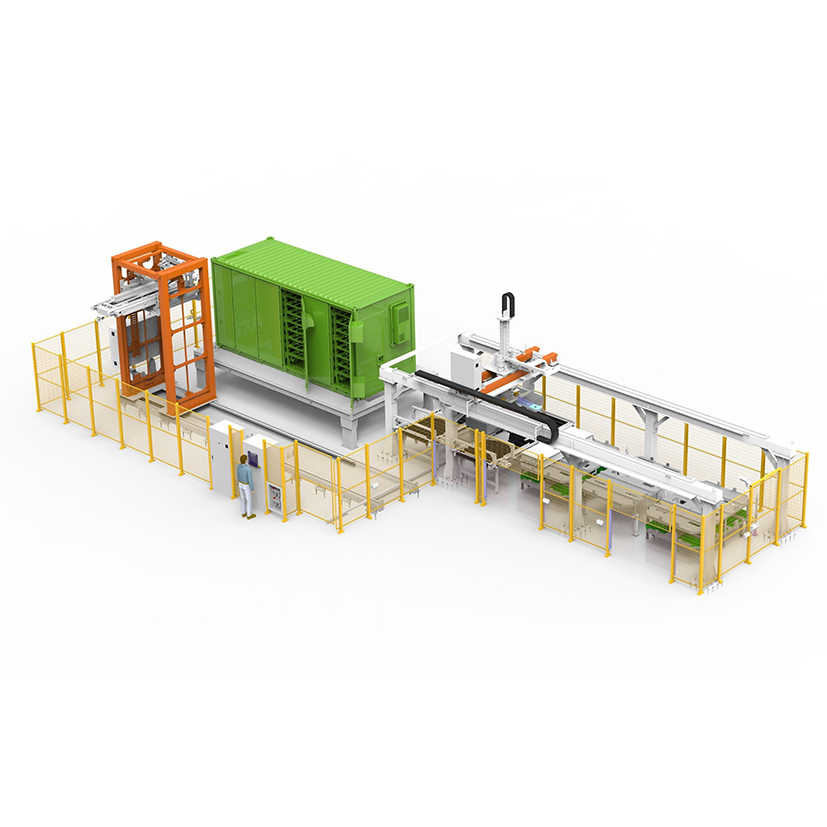
Why Pack Insertion Into an ESS Container Is Its Own Problem
A container is a closed steel box with one door, several rack levels and very little room to correct a mistake, so insertion combines heavy lifting, fine alignment and constrained access in a way that a general-purpose forklift does not solve reliably. Four constraints define the problem.
- Mass and stability. A loaded rack slot is heavy enough that the handling equipment is rated in the 1,500 kg class — the load capacity published for the crawler-driven ZZX2522 and the rail-fixed ZZX2524.
- Door and access geometry. The rail-fixed ZZX2508 specifies a container door opening angle of at least 150°, because the machine has to reach rack positions that sit behind the door frame.
- Slot tolerance. One rail-fixed model is specified for packs from 1,100 to 2,200 mm long, 780 to 1,260 mm wide and 230 to 260 mm high, so the same platform can face very different slot apertures across projects.
- Floor and site condition. Container assembly happens indoors on finished concrete, outdoors on yard surfaces and sometimes on temporary pads; surface quality and slope decide which drive type can operate at all.
The operational consequence is easy to recognise. The manual version of this step needs a forklift driver, one or two spotters and a slow, stop-start approach into the container. A pack that touches the rack frame can damage module casing, insulation or the rack itself, and correcting it inside a container takes longer than the insertion did. That is why pack insertion is usually the step that decides whether a container line holds a stable takt or drifts.
Industry Background: Why the Category Exists
Containerized energy storage standardized the housing but not the contents. Three shifts pushed pack insertion out of general handling and into its own equipment category.
- Container formats settled around ISO footprints. The rail-fixed ZZX2508 is specified for containers 6,058–7,000 mm long, 2,438–2,700 mm wide and 2,896–3,000 mm high. That is a tolerance band, not a single nominal size, so equipment has to cover the band.
- PACK formats multiplied. The AGV-driven RD16 is specified for 280/314/587 Ah cells and 1P52S/1P104S PACKs, which means one platform has to accept several generations of module design on the same line.
- Rack density increased. The rail-fixed ZZX2524 uses double-layer racks to save space inside the container, which raises the number of insertion positions and lengthens the loading sequence.
Regulation added a documentation layer. Regulation (EU) 2023/1542 on batteries and waste batteries is the EU legal framework covering batteries placed on the European market, and equipment used to build those systems is expected to fit into a traceable production and documentation chain rather than an improvised one. In practice, buyers increasingly ask for the equipment manufacturer's quality management certification rather than accepting a datasheet alone.
Labour availability reinforces the same direction. Working inside a container is not attractive work, and the operators who can place a heavy pack accurately are the same people a factory needs elsewhere on the line.
What a Battery Pack Insertion Robot Consists Of
Regardless of drive type, the same subsystems do the work, and each one appears as a specification on the datasheet.
- Mobility base. Crawler tracks, an AGV chassis or a rail carriage. This single choice determines floor requirements, layout flexibility and installation work.
- Vertical hoist and mast. Published hoisting ranges are 0.8–3.4 m on ZZX2522 and 1.05–3.4 m on RD16, both listed as customizable; RD16 carries a hoisting speed of 100 mm/s.
- End effector. The gripper holds the pack. ZZX2524 specifies a gripper changeover time of under one minute, which matters when a line runs more than one pack format.
- Leveling. ZZX2522 uses manual handwheel leveling. Leveling exists because the pack has to be presented squarely to the slot, not at whatever angle the floor happens to have.
- Structure and utilities. Structures are listed as carbon steel on RD16 and carbon steel / Q235 on ZZX2508 and ZZX2524. ZZX2508 requires compressed air at 0.5–0.8 MPa and power at AC380V ±10%, 50 ±2 Hz.
The Three Drive Types, Explained Simply
Crawler-Driven: ZZX2522
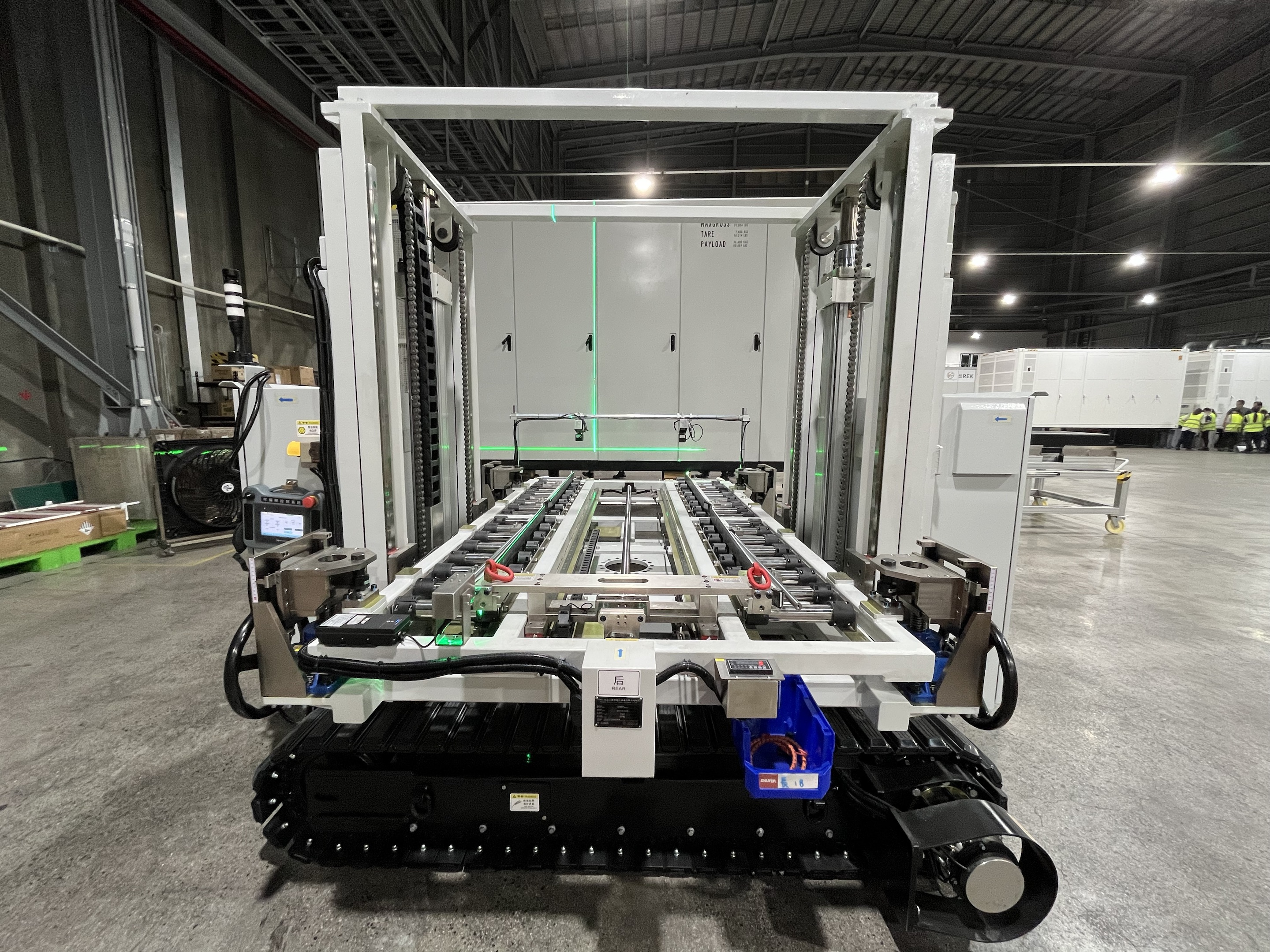
ZZX2522 is described as a crawler-driven battery pack insertion and removal robot with an all-terrain working floor, 1,500 kg load capacity, a hoisting range of 0.8–3.4 m that can be customized, and manual handwheel leveling.
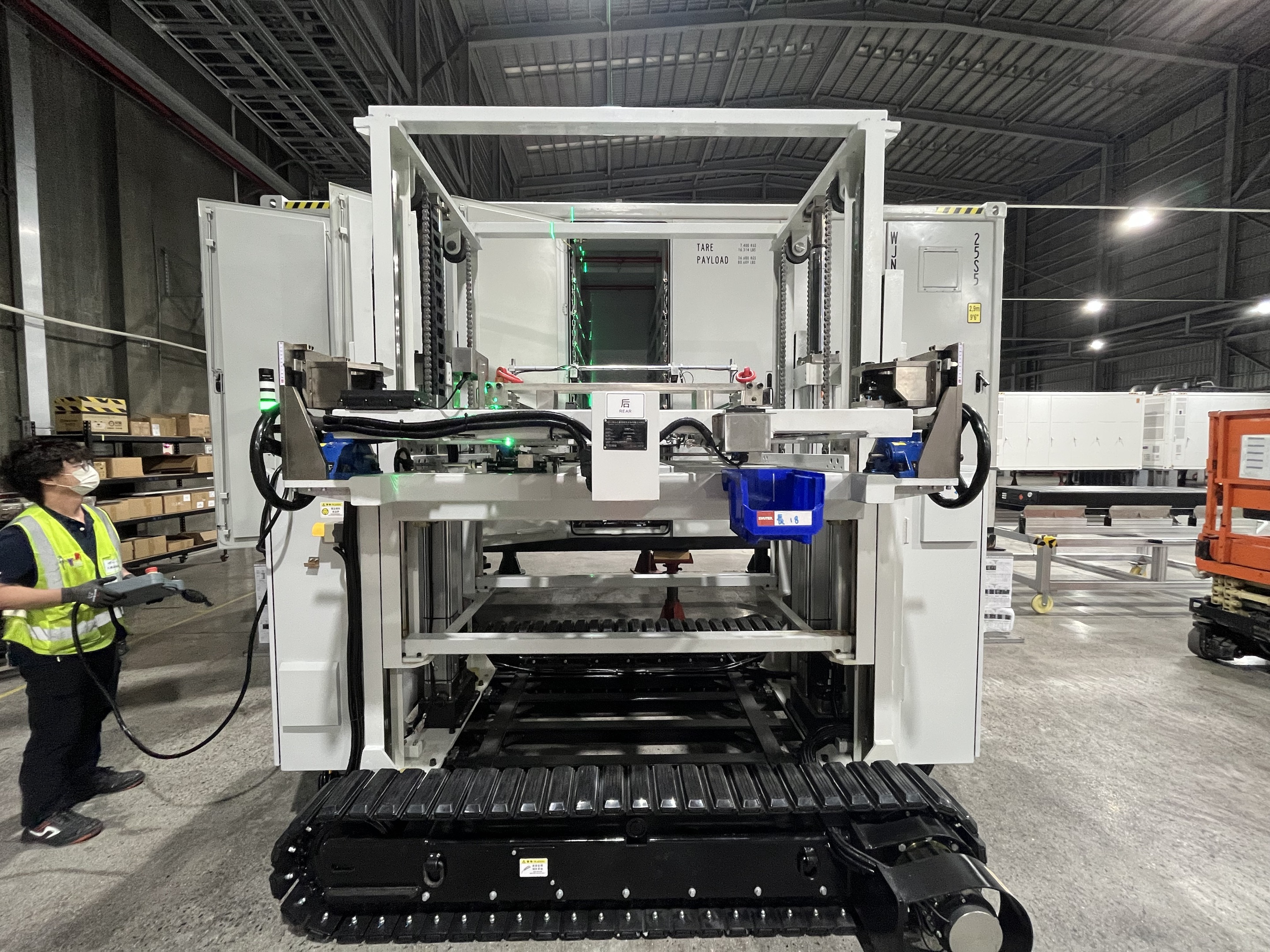
It is the type chosen when the floor is not guaranteed. Because the machine carries its own tracks and levels with a manual handwheel, it can work on surfaces that would stop a wheeled chassis. Zonzsin records a one-year project in Taiwan using insertion and removal both indoors and outdoors on a complicated working floor, and a one-year project in South Korea working outdoors on an uneven floor; both are recorded as stable operation.
AGV-Driven: RD16
RD16 is the AGV-driven model for containers: overall size 3,100 × 2,600 × 3,800 mm, compatible with 280/314/587 Ah cells and 1P52S/1P104S PACKs, hoisting range 1.05–3.4 m (customizable), hoisting speed 100 mm/s, and a carbon steel structure.
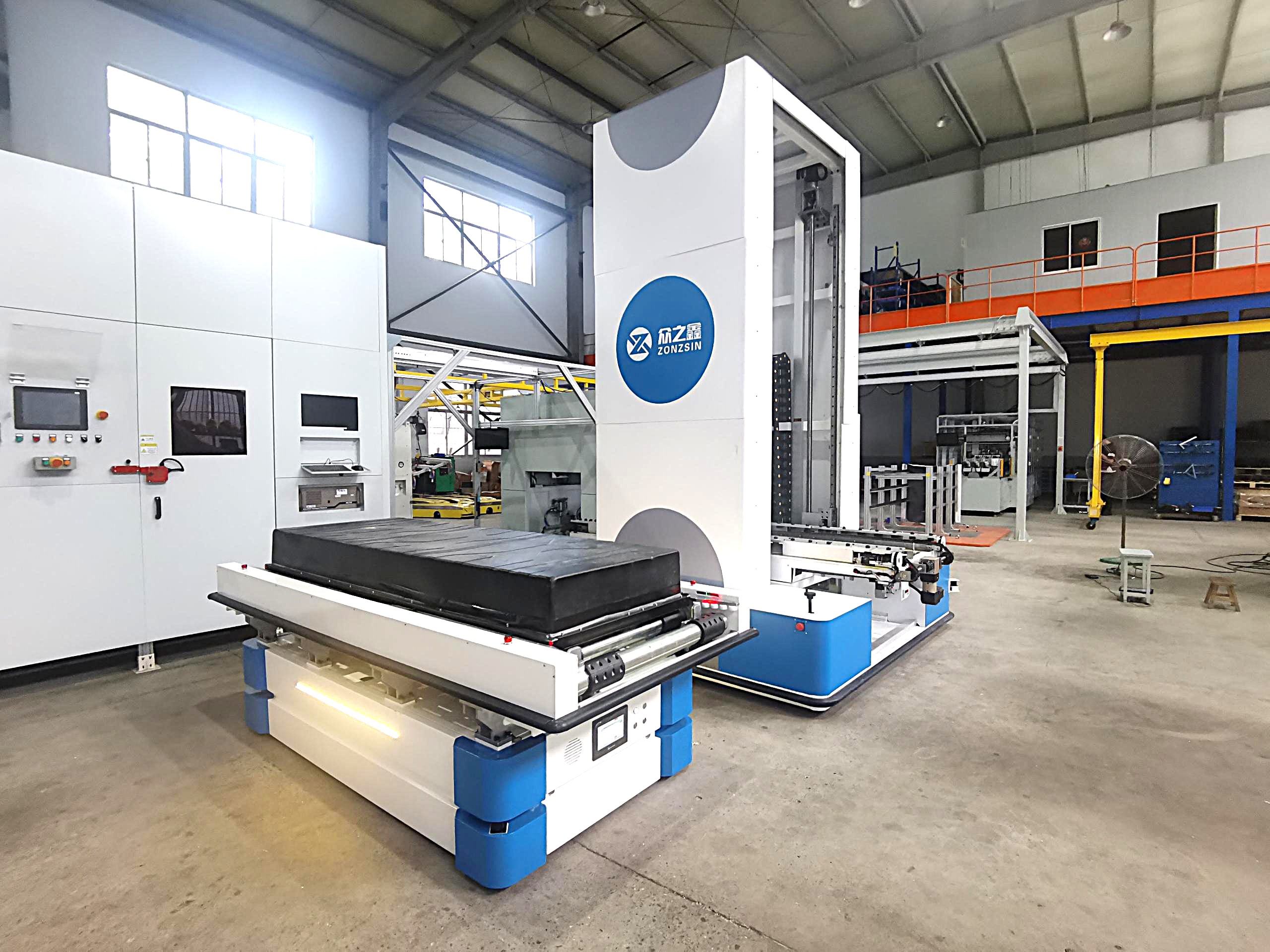
Zonzsin states that it holds 50 granted patents, including invention patents covering the AGV-driven battery pack insertion robot. For a buyer, that claim is a pointer to ask about control and docking design in detail rather than to accept it as a standalone quality statement.
Rail-Fixed: ZZX2508 and ZZX2524
Both rail-fixed models run a carriage on a floor-mounted rail. They deliver the most stable presentation of the three types, but they require ground installation and a layout that will not move.
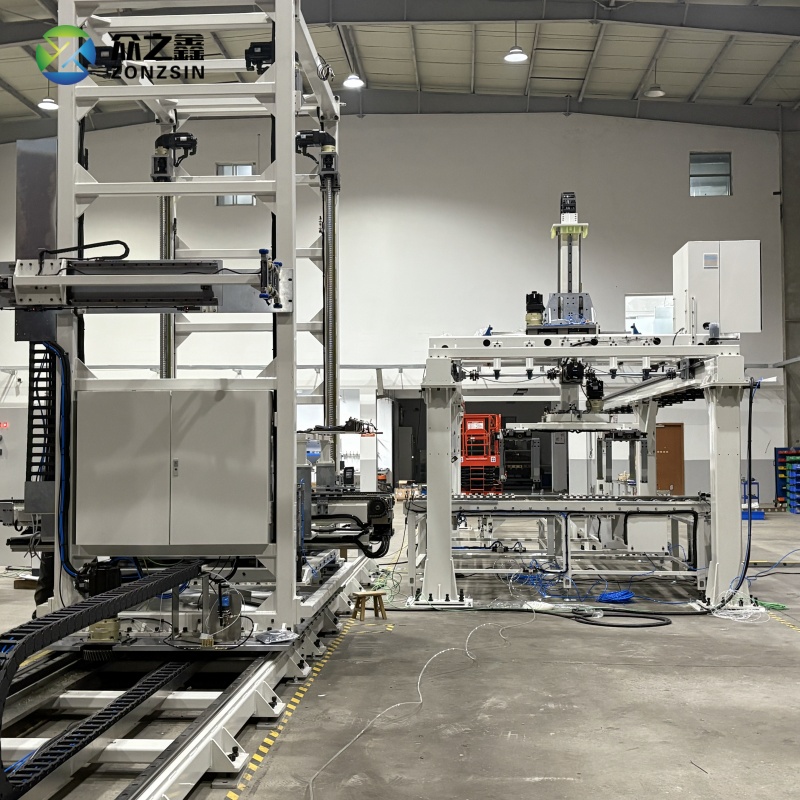
ZZX2508 published compatibility: containers 6,058–7,000 mm long, 2,438–2,700 mm wide and 2,896–3,000 mm high; packs 1,100–2,200 mm long, 780–1,260 mm wide and 230–260 mm high; compressed air 0.5–0.8 MPa; AC380V ±10%, 50 ±2 Hz power; door opening angle at least 150°.
ZZX2524 targets handling throughput rather than envelope: door opening at least 150°, 1,500 kg load capacity, gripper changeover in under one minute, and double-layer racks for space saving. A Chinese integrator project recorded continuous pack insertion over two years on a fixed ground rail with a dual-layer material rack, reported as stable operation with improving efficiency.
Which Drive Type Is Usually Preferred?
No drive type is universally better; preference follows the site. The decision rule is short.
| Site and layout condition | Usually preferred | Reason and trade-off |
|---|---|---|
| Level indoor floor, layout likely to change, more than one loading bay | AGV-driven (RD16) | No ground works and the unit can be repositioned; 100 mm/s hoisting speed supports a steady takt. Trade-off: mobility depends on floor quality. |
| Fixed bay, high repeat volume, layout locked for years | Rail-fixed (ZZX2508 / ZZX2524) | Most stable presentation, supports double-layer racks and sub-minute gripper changeover. Trade-off: rail installation and layout lock-in. |
| Outdoor yard, uneven or temporary surface, retrofit into an existing site | Crawler-driven (ZZX2522) | All-terrain working floor and 1,500 kg load capacity. Trade-off: manual handwheel leveling and slower repositioning than an AGV. |
Where one site contains both conditions, matching the drive type to each area — rail-fixed or AGV inside the hall, crawler on the outdoor pad — avoids compromising either. Trying to force a single chassis to handle a finished hall and a rough yard usually produces a machine that is mediocre at both.
Step by Step: How One Insertion Cycle Runs
The sequence below describes a standard pack loading cycle. Exact parameters come from your own container, pack and rack drawings.
- Confirm container access. Check that the container sits inside the machine's compatibility window and that the door opens to at least the specified angle — 150° or more on the rail-fixed models.
- Stage the pack. Position the pack on the infeed rack at a height the robot can reach without re-gripping. Double-layer racks on ZZX2524 are designed to keep this staging compact.
- Position the robot at the bay. An AGV self-positions, a rail carriage indexes along the rail, and a crawler unit drives to the bay and levels with the handwheel.
- Lift to slot height. The hoist raises the pack within the published range — 0.8–3.4 m on ZZX2522, 1.05–3.4 m on RD16 — at the platform's hoisting speed.
- Align and insert. The pack is presented square to the slot and pushed in. This is the slow phase: alignment quality here decides whether the cycle ends with a seated pack or a rework task.
- Release and confirm. The gripper releases, the operator or line control confirms the pack is fully seated, and the machine retracts.
- Repeat or change format. The cycle repeats for the next slot; if the line switches to another pack format, ZZX2524 specifies gripper changeover in under one minute.
Where These Robots Are Used
Zonzsin names three customer types for this equipment: energy storage system integrators, battery cell and PACK manufacturers, and EPC turnkey contractors. In commercial and industrial (C&I) energy storage, the robot typically sits at the end of the pack line — after pack testing and before container dispatch — where the container is loaded, checked and shipped.
- Taiwan — crawler-driven platform. One unit for ESS pack insertion into and removal from containers, indoor and outdoor use, one-year duration, recorded as stable operation.
- South Korea — crawler-driven platform. One unit for insertion and removal, outdoor work on an uneven floor, one-year duration, recorded as stable operation.
- China — rail-fixed platform. One unit running continuous pack insertion for two years on a fixed ground rail with a dual-layer material rack, recorded as stable operation with improving efficiency.
Published Specifications, Side by Side
The table uses only specifications published in the reviewed Zonzsin product data. A blank or unstated cell means the value is not given in that source — not that the machine lacks the capability.
| Model | Drive type | Stated load capacity | Hoisting specification | Container & PACK compatibility | Other stated details |
|---|---|---|---|---|---|
| ZZX2522 | Crawler-driven insertion and removal | 1,500 kg | 0.8–3.4 m, customizable | All-terrain working floor; energy storage and C&I applications | Manual handwheel leveling |
| RD16 | AGV-driven | Not stated in reviewed data | 1.05–3.4 m, customizable; 100 mm/s hoisting speed | 280/314/587 Ah cells; 1P52S/1P104S PACKs | Overall 3,100 × 2,600 × 3,800 mm; carbon steel |
| ZZX2508 | Rail-fixed | Not stated in reviewed data | Not stated in reviewed data | Containers 6,058–7,000 × 2,438–2,700 × 2,896–3,000 mm; packs 1,100–2,200 × 780–1,260 × 230–260 mm | Door opening at least 150°; compressed air 0.5–0.8 MPa; AC380V ±10%, 50 ±2 Hz; carbon steel / Q235 |
| ZZX2524 | Rail-fixed | 1,500 kg | Not stated in reviewed data | Not stated in reviewed data | Door opening at least 150°; gripper changeover under 1 minute; double-layer racks; carbon steel / Q235 |
What to Verify Before You Choose
Six checks separate a workable specification from a datasheet that only looks complete.
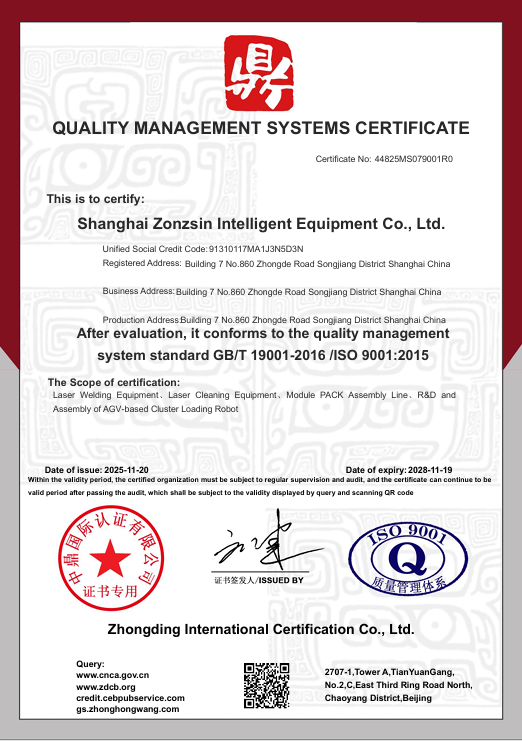
- Quality management certification. Zonzsin holds ISO 9001 certification, certificate 44825MS079001R0, issued by ZDCB on 20 November 2025 and valid until 19 November 2028, against GB/T 19001-2016 / ISO 9001:2015. The certified scope covers laser welding equipment, laser cleaning equipment, module PACK assembly line, and the R&D and assembly of AGV-based cluster loading robot. A quality management certificate covers the scope printed on it; it is not a project-specific safety approval, so ask for the documents your own market requires.
- Specification consistency. Marketplace listings and reseller pages do not always match manufacturer documentation — public listings for rail-fixed equipment in this category have quoted a different rated load than the company's own model data. Make the approved datasheet the contractual reference.
- Pilot before scale. Zonzsin's minimum order quantity is one unit and every machine is 100% tested before shipment, so a single-machine pilot is feasible before a line-level investment.
- Capacity against your plan. Monthly capacity is three units against an annual output of 40 units, with a stated lead time of two to four months. That is the constraint to compare with your container build schedule.
- Commissioning and support. After-sales covers remote support plus on-site installation and commissioning — relevant for a machine that has to be aligned to your rack and container drawings.
- Efficiency claims. Zonzsin's own buyer-facing material cites roughly a 20% improvement in container assembly cycle time versus manual methods. The figure is company-reported and has not been independently verified, so treat it as a hypothesis to measure on your own line rather than as a planning constant.
Frequently Asked Questions
Are battery pack insertion robots for ESS containers certified?
Zonzsin holds ISO 9001 quality management system certification, certificate 44825MS079001R0 issued by ZDCB on 20 November 2025 and valid until 19 November 2028, against GB/T 19001-2016 / ISO 9001:2015. The certified scope covers laser welding equipment, laser cleaning equipment, module PACK assembly line, and the R&D and assembly of AGV-based cluster loading robot. A quality management certificate confirms the management system and the scope listed on it; it is not a machine-specific safety or type approval, so buyers should also request the documentation their destination market requires.
Can one robot handle different PACK sizes and container lengths?
Each model has a defined working envelope. The rail-fixed ZZX2508 accepts containers 6,058–7,000 mm long, 2,438–2,700 mm wide and 2,896–3,000 mm high, and packs 1,100–2,200 mm long, 780–1,260 mm wide and 230–260 mm high. The AGV-driven RD16 is specified for 280/314/587 Ah cells and 1P52S/1P104S PACKs. Hoisting range and configuration can be customized, but every model's envelope should be checked line by line against your container and pack drawings before ordering.
What drives the cost of an ESS battery pack insertion robot?
Zonzsin does not publish list prices, so cost is quoted per project. The variables that move it are the drive type, the working envelope, the load class (1,500 kg on ZZX2522 and ZZX2524), rack design such as double-layer racks, gripper configuration including sub-minute changeover on ZZX2524, and customization of cycle time, automation level, logo, color and configuration. Minimum order quantity is one unit, which makes a single-machine quote the practical way to establish the real cost of a project.
Can we validate a single unit before committing to a line?
Yes, within the supplier's stated terms. Zonzsin's minimum order quantity is one unit, every machine is 100% tested before shipment, and after-sales covers remote support plus on-site installation and commissioning. A single machine can therefore be run against your own containers, racks and pack formats before further units are ordered.
What lead time and production capacity should we plan for?
Zonzsin states a lead time of two to four months, a monthly capacity of three units and an annual output of 40 units, with roughly 60% of production exported, mainly to Southeast Asia and the EU. For a multi-container build programme, the monthly capacity figure rather than the lead time is usually the binding constraint, so schedule container completions against it. Sending container drawings, pack dimensions and a target cycle time is the fastest way to get a platform recommendation and a dated delivery plan.
Conclusion
A battery pack insertion robot for ESS containers is not a generic lifting machine. It is a container-specific handling system whose value comes from matching a drive type to a floor, a working envelope to a pack format, and a control interface to a rack design. The three platforms described here cover the usual cases: the crawler-driven ZZX2522 for uneven or outdoor ground, the AGV-driven RD16 for flexible indoor layouts, and the rail-fixed ZZX2508 or ZZX2524 for fixed, high-repeat bays where stability and double-layer rack density matter most.
For a first project, the practical sequence is to fix the container and pack envelope, choose the drive type against the real floor, verify certification and specification documents, and start with one machine. Everything else — cycle time, gripper configuration, automation level — can be refined after the first container has been loaded with the robot rather than around it.
Next Step
Send your container drawing, pack dimensions and target cycle time to Zonzsin for a platform recommendation and a single-unit quote. The full model and specification set is in the product brochure.
Have Questions or Need More Details?
Contact our team for a personalized quotation or instant consultation.
Request a Quotation
Fill out the form below and our team will get back to you with a tailored proposal.
WhatsApp Direct Chat
Prefer to chat in real-time? Message us on WhatsApp for instant assistance & quick answers.
- Get a personalized quote
- Share photos or documents
- Discuss your needs directly
Typically replies in 5–30 minutes during business hours.