
Mixed PACK Formats Slowing Container Lines? ESS Battery Pack Insertion Robot for Containers
A container line that runs one PACK format has no changeover problem. A line that runs three has a changeover problem on every shift, and the minutes rarely disappear where operators expect them. The insertion stroke is short. The time goes into swapping the gripper, re-datuming the container at the door, and re-checking the first pack of the new format before the line is released again.
The fit-first answer is to buy against the envelope rather than the feature list. The rail-fixed ZZX2508 is specified around the box it can work in: containers from 6058 mm to 7000 mm long, 2438 mm to 2700 mm wide and 2896 mm to 3000 mm high, and PACKs from 1100 mm to 2200 mm long, 780 mm to 1260 mm wide and 230 mm to 260 mm high. The rail-fixed ZZX2524 documents a gripper changeover time of under one minute, a 1500 kg load capacity and a door opening angle of at least 150°. Envelope, changeover, load and door angle are the four numbers that decide whether a mixed-format line flows or stalls.
This guide sets out the assessment order, separates the parts of changeover a machine can remove from the parts it cannot, and marks which values in the current specification are model-specific and must be re-confirmed before an order.
Where changeover time actually goes
A changeover on a container ESS line is not one event. It is four stacked steps, and only one of them is a property of the robot you buy.
- Tooling change. The gripper that matches the handling points of the incoming PACK has to be exchanged. This is the step the ZZX2524 specification quantifies: gripper changeover in under one minute.
- Fixture and interface adaptation. PACK compatibility and fixture adaptation are listed as a special project requirement for container insertion work, which means the interface between a specific PACK and the machine is confirmed per format, not assumed from the envelope.
- Container re-datum. Door opening, docking roller position and the alignment of the target rack level with the insertion path. Both rail-fixed models list a door opening angle of at least 150°, which describes the clearance condition at the container face that the insertion path is designed around.
- First-piece verification. Someone has to confirm that the first pack of the new format is seated correctly before the line runs at rate. This step does not shorten because the gripper changed quickly.
Changeover friction, as used in this article, is the sum of those four steps in minutes per format change. A sub-minute gripper swap only produces a fast changeover when the other three steps are also short and pre-planned.
Why container ESS lines end up handling more than one PACK format
The projects described in the supplied case set are run by energy storage system integrators, battery cell and PACK manufacturers, and EPC turnkey contractors. All three roles sit between a battery supply side with more than one PACK specification and a container side that is built to a single rack layout, so the same line is asked to absorb format differences that originate upstream.
Documented working conditions for this application are continuous or shift-based production in the ESS and C&I energy storage industries, with reference sites in China, France, South Korea, Sweden, Taiwan and the United States. Some of those sites are indoor, some outdoor, and some are described as all-terrain or uneven ground. The reference operating temperature band is 20 to 30 °C.
The function the equipment is bought for is stated plainly in the product documentation: fully automatic moving and PACK insertion, cycle time improvement, batch and continuous production on a container energy storage line, with manual and remote-controller operating modes available. That is a statement of intended function and documented application, not a measured throughput figure for a given line.
The fit-first approach: envelope, clearance, load, station chain
Fit-first means the first question is not which model is more advanced, but which documented envelope covers every PACK format your line will realistically see. A format that falls outside the envelope is not a changeover problem at all; it is a separate handling problem, and it should be excluded from the line balance before a machine is selected.
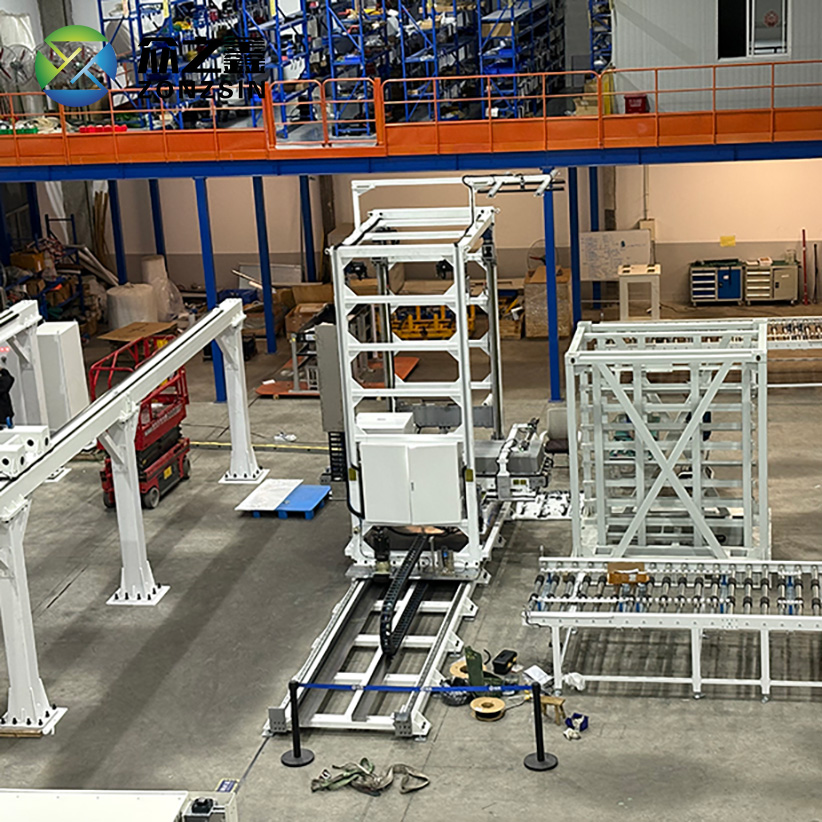
| Documented parameter | ZZX2508 (rail-fixed) | ZZX2524 (rail-fixed) |
|---|---|---|
| Compatible container | L 6058–7000 mm; W 2438–2700 mm; H 2896–3000 mm | Not itemised in the supplied model sheet |
| Compatible PACK | L 1100–2200 mm; W 780–1260 mm; H 230–260 mm | Not itemised in the supplied model sheet |
| Door opening angle | ≥150° | ≥150° |
| Load capacity | Not itemised in the supplied model sheet | 1500 kg |
| Gripper changeover time | Not itemised in the supplied model sheet | Under 1 minute |
| Space arrangement | Not itemised in the supplied model sheet | Double-layer racks |
| Power supply | AC380V ±10%, 50 ±2 Hz | Not itemised in the supplied model sheet |
| Compressed air | 0.5–0.8 MPa | Not itemised in the supplied model sheet |
| Main material | Carbon steel / Q235 | Carbon steel / Q235 |
Values are company-reported product specifications for the named models. Where a cell reads “not itemised in the supplied model sheet”, the value is absent from that model's specification as supplied here; it does not mean the capability is missing. Confirm any required value with the manufacturer before purchase.
Two consequences follow from reading the table in this order. First, the 6058 mm lower bound of the container range corresponds to the 20ft container class, so 20ft container racks sit at the bottom of the fit window rather than outside it. Second, the PACK envelope is wide in length (1100–2200 mm) but narrow in height (230–260 mm), which tells a planner that length variation between formats is the normal case to design the line around, while a PACK outside that height band needs a different conversation entirely.
Step-by-step: assessing a mixed-format line in seven checks
- Build a PACK register before anything else. List every format the line will handle with its length, width, height and mass, and mark the smallest and largest of each. Formats outside 1100–2200 mm length, 780–1260 mm width or 230–260 mm height fall outside the documented ZZX2508 envelope and must be handled separately or discussed as a customization.
- Match the container envelope. Confirm that the containers at your site fall inside 6058–7000 mm length, 2438–2700 mm width and 2896–3000 mm height. Longer or taller container variants outside this window are not covered by the supplied ZZX2508 specification.
- Check clearance at the container face. The documented door opening angle of at least 150° is the condition the insertion path is designed around. If site practice cannot open doors to that angle, resolve it before the machine specification is frozen.
- Size the changeover step honestly. Take the documented gripper changeover of under one minute on the ZZX2524, then add your own fixture adaptation time and first-piece verification time. Only the first element is a machine property.
- Map the station chain around the robot. Container, docking roller, gripper, transfer AGV, working desk, material rack, platform ladder, PLC and MES are the documented elements of this application. A robot that fits the envelope but sits in a chain with no docking roller or no rack discipline will not deliver a fast changeover.
- Confirm site prerequisites. ESD protection, fire-prevention measures, temperature, humidity and cleanliness control, and PACK compatibility or fixture adaptation are listed project requirements. For the ZZX2508, also confirm a supply of AC380V ±10% at 50 ±2 Hz and compressed air at 0.5–0.8 MPa.
- Write the acceptance criteria against your own PACK register.Zonzsin applies 100% testing to its build and provides remote support plus on-site installation and commissioning. Acceptance should be written around your format list, not around a single demonstration PACK.
A changeover budget you can fill in
Changeover planning fails when it is treated as one number. The table below splits the four steps into rows and shows what each row is determined by, so a line planner can see which minutes a machine decision can remove.
| Changeover step | What sets the duration | Affected by machine choice? |
|---|---|---|
| Gripper swap | Tooling design and exchange mechanism | Yes — documented at under 1 minute on ZZX2524 |
| Fixture adaptation | PACK interface and handling points | Partly — requires per-format confirmation |
| Container re-datum | Docking, door clearance, rack level alignment | Partly — relates to the ≥150° door condition |
| First-piece verification | Inspection routine and release authority | No — a process decision |
| Format sequencing | Production plan: batching or interleaving | No — a planning decision |
Fill the right-hand column with your own measured minutes per step. No duration in this article is presented as a measured site result.
Batching or interleaving across formats
Once the changeover budget is written down, the planning question becomes arithmetic rather than intuition: changeover load per shift equals the number of format changes per shift multiplied by the total minutes per change. Reducing either factor reduces the load.
Batching reduces the number of changes. It costs work-in-process inventory and floor space, and it needs material racks that can hold several PACK formats between runs. The ZZX2524 lists double-layer racks as part of its space arrangement, which speaks directly to how much intermediate stock a station can hold without expanding its footprint.
Interleaving reduces inventory but multiplies the changeover count. It only becomes practical when the whole changeover budget is short — not just the gripper swap. A line with a sub-minute gripper change but a long fixture confirmation step is still a batching line in practice.
Documented deployments and what each one matches
Three container projects in the supplied case set show the pattern differences that matter to a mixed-format decision, and each is reported for one unit.
A Chinese energy storage project used a rail-fixed machine for continuous PACK insertion and fully automatic loading, with a reported duration of two years, stable operation and improving efficiency. The stated highlights were a stable, fixed ground rail for safe working, dual-layer material racks for space utility, and versatile module options. That profile matches a fixed-position line where container docking is repeatable and floor space is the constraint.
A South Korean project and a Taiwanese project both used crawler-driven machines for insertion into and removal from containers, each reported at one year and stable operation. The South Korean site is described as outdoor on an uneven working floor; the Taiwanese site as indoor and outdoor use on a complicated floor. Both profiles point to sites where the machine has to reach the container rather than the container reaching a fixed station.
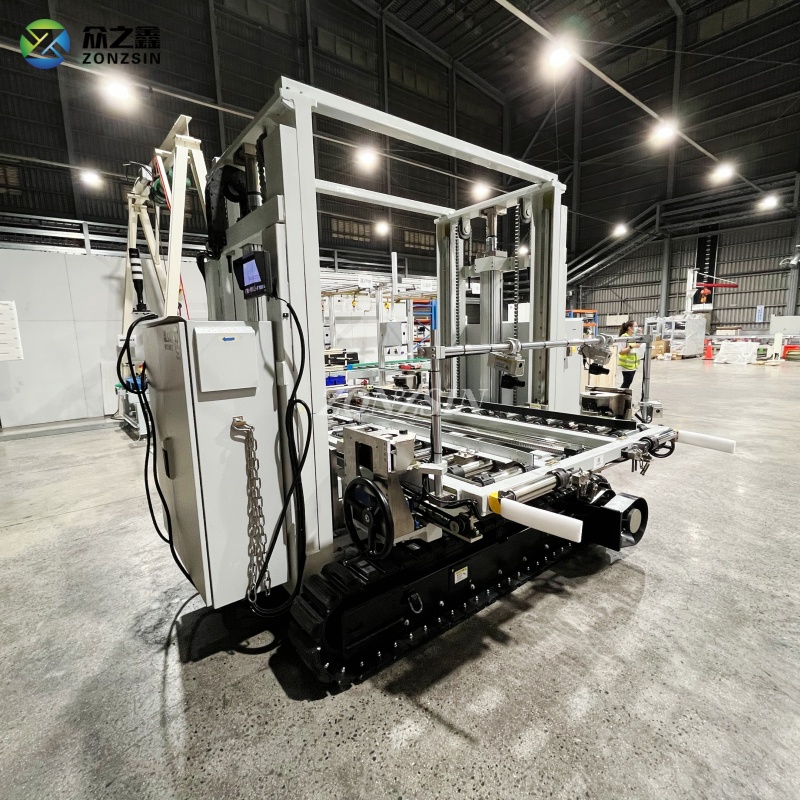
Case outcomes are reported as supplied for one unit each, over the stated durations. They describe those deployments and are not a forecast of performance on a different line.
Rail-fixed, AGV, or crawler: documented differences
The platform choice is separate from the format question, but it changes how changeover is executed. The table compares documented characteristics only, across the four container insertion models in the current range.

| Model | Drive type | Documented fit and handling values | Notable documented constraint |
|---|---|---|---|
| ZZX2508 | Rail-fixed | Container L 6058–7000 / W 2438–2700 / H 2896–3000 mm; PACK L 1100–2200 / W 780–1260 / H 230–260 mm; door ≥150°; AC380V ±10%, 50 ±2 Hz; air 0.5–0.8 MPa | Requires a fixed ground rail installation |
| ZZX2524 | Rail-fixed | Load 1500 kg; gripper changeover under 1 minute; door ≥150°; double-layer racks | Container and PACK envelopes are not itemised on the supplied model sheet |
| RD16 | AGV-driven | Unit size L3100 × W2600 × H3800 mm; 280/314/587 Ah cells and 1P52S/1P104S PACKs; hoisting range 1.05–3.4 m (customizable); hoisting speed 100 mm/s | No load capacity or gripper changeover figure on the supplied specification |
| ZZX2522 | Crawler-driven | Hoisting range 0.8–3.4 m (customizable); load 1500 kg; all-terrain working floor; manual handwheel levelling | Insertion and removal platform; levelling is manual rather than automatic |
This is a characteristics comparison, not a ranking. Each model is intended for container ESS pack insertion, but the supplied specifications are company-reported and are not standardised test results, so no performance advantage should be read into any row.
Limits of a fit-first decision
- Envelope fit is not fixture fit. A PACK inside 1100–2200 mm length is inside the mechanical envelope, but the interface still has to be adapted. Fixture adaptation is a listed project requirement and belongs in the acceptance criteria.
- The gripper figure is model-specific. The under-one-minute changeover and the 1500 kg load capacity are documented for the ZZX2524. They should not be applied to the ZZX2508 without written confirmation.
- Rail-fixed means ground works. The rail bed, docking roller and container docking discipline are site responsibilities, and they gate the changeover you actually achieve.
- Site safety items are not machine features. ESD protection, fire prevention, and temperature, humidity and cleanliness control are listed requirements of this application and are owned by the facility, not delivered by the robot.
- A robot does not set line throughput alone. PACK presentation, rack layout, PLC and MES integration and operator release routines all sit inside the same cycle.
FAQ
What compliance checks still sit outside a fit-first robot decision?
Machine fit and battery-product compliance are separate workstreams. In the EU, Regulation (EU) 2023/1542 sets the legal framework for batteries and waste batteries; that framework addresses the battery product, not whether a given robot suits your container. In parallel, this application lists ESD protection, fire-prevention measures, and temperature, humidity and cleanliness control as project requirements. Ask the supplier for the declaration and documentation package that applies to your destination market, and keep it separate from the mechanical specification.
Can one rail-fixed robot cover PACKs from 1100 mm to 2200 mm long?
The ZZX2508 specification states a compatible PACK range of 1100–2200 mm length, 780–1260 mm width and 230–260 mm height. Formats inside that box fall within the documented mechanical envelope; formats outside it do not. Being inside the envelope is not the same as being fully adapted, because PACK compatibility and fixture adaptation are listed as project-specific requirements and must be confirmed per format.
How much line time does a gripper change really take?
The ZZX2524 specification documents a gripper changeover time of under one minute. That figure covers the tooling exchange only. Total changeover also includes fixture adaptation for the incoming format, container re-datum at the door, and first-piece verification before the line is released — steps the machine specification does not quantify.
Does the 1500 kg load capacity apply to every Zonzsin model?
No. The 1500 kg figure is documented for the rail-fixed ZZX2524 and the crawler-driven ZZX2522. The ZZX2508 specification supplied here itemises the container and PACK envelope, door opening angle, power supply and compressed air rather than load capacity, and the AGV-driven RD16 specification itemises hoisting range and hoisting speed instead. Compare any figure against the actual PACK mass plus fixture mass for the model you intend to buy.
What drives the budget on a mixed-format project?
Four cost drivers follow from the changeover structure: the number of gripper and fixture sets your format register requires, the level of automation and PLC or MES integration, the scope of customization across cycle time, automation, logo, color and configuration, and the site works around the rail bed or docking area. No price is published in the supplied material, so a quotation has to be built from your format list rather than from a catalogue number.
How do we validate a mixed-format line before committing?
Build the validation around your own PACK register rather than a single demonstration format. Zonzsin applies 100% testing to its build, offers customization across cycle time, automation, logo, color and configuration, and provides remote support plus on-site installation and commissioning. The practical sequence is to submit the full format list with dimensions and masses, agree the fixture plan per format, and write acceptance around first-piece verification for each format on that list.
What lead time and capacity should a project plan for?
Documented supply parameters are a minimum order quantity of one unit, a lead time of two to four months, a monthly capacity of three units and an annual output of 40 units. Shanghai Zonzsin Intelligent Equipment Co., Ltd. was founded in 2019, operates a 6000 m² facility with 90 employees and a 43-engineer R&D team, holds 50 granted patents, and exports roughly 60% of production, mainly to Southeast Asia and the EU. For a mixed-format line, reserve the production slot as soon as the format register and fixture plan are agreed. A current product brochure is available for download, and the team can be reached at katty.liu@zonzsin.com or +86 134-8282-9368 to review a PACK list against the envelopes above.
Conclusion
Mixed PACK formats slow a container line because changeover is usually managed as one undivided block of time. Split into its four steps, the picture becomes actionable: the gripper swap on the rail-fixed ZZX2524 is documented at under one minute, the door clearance condition is at least 150°, the load capacity is 1500 kg, and the ZZX2508 defines the container box at 6058–7000 mm length, 2438–2700 mm width and 2896–3000 mm height and the PACK box at 1100–2200 mm length, 780–1260 mm width and 230–260 mm height.
The fit-first sequence is therefore unglamorous but reliable: register every format, exclude what falls outside the envelope, confirm fixtures per format, confirm clearance at the door, then decide whether formats are batched or interleaved. Everything the machine can shorten is documented; everything it cannot shorten is a site or planning decision that a supplier conversation should surface before the order.
Next step: send your PACK dimension and mass list and your container sizes to Shanghai Zonzsin Intelligent Equipment Co., Ltd., and ask for the fit check against the ZZX2508 and ZZX2524 envelopes before specifying fixtures.
Download the product brochure: Product brochure (PDF)
Contact: katty.liu@zonzsin.com · +86 134-8282-9368 · Building 22, No.2199, Shebei Highway, Sheshan Town, Songjiang District, Shanghai, China
Have Questions or Need More Details?
Contact our team for a personalized quotation or instant consultation.
Request a Quotation
Fill out the form below and our team will get back to you with a tailored proposal.
WhatsApp Direct Chat
Prefer to chat in real-time? Message us on WhatsApp for instant assistance & quick answers.
- Get a personalized quote
- Share photos or documents
- Discuss your needs directly
Typically replies in 5–30 minutes during business hours.