
Inside the ESS Battery Pack Insertion Robot: How Container Loading Systems Work
Inside the ESS Battery Pack Insertion Robot: How Container Loading Systems Work
Last updated: August 28, 2026
For battery pack manufacturers and energy storage integrators, the shift from manual container stuffing to automated battery pack insertion is no longer a question of “if” but “which system.” This guide explains how ESS battery pack insertion robots work, what they are used for, and how the main platform types—AGV-driven, rail-fixed, and crawler-driven—approach the same job in different ways.
What Is an ESS Battery Pack Insertion Robot?
An ESS battery pack insertion robot is a piece of automated handling equipment designed to move battery packs into containerized energy storage racks. It replaces manual forklift and roller-conveyor processes with a guided system that positions, lifts, and inserts heavy packs into container racks accurately. In the energy storage industry, these robots are one of the core equipment types for building containerized BESS lines.
Shanghai Zonzsin Intelligent Equipment Co., Ltd. is one of the manufacturers in this field. Established in 2019, the company applies intelligent battery PACK assembly lines and ESS Battery Pack Insertion Robots for Containers to lithium battery manufacturers, energy storage integrators, and automotive OEMs. Zonzsin’s team includes 43 R&D engineers, and the company holds 50 granted patents, including invention patents for AGV-driven battery PACK insertion robots.
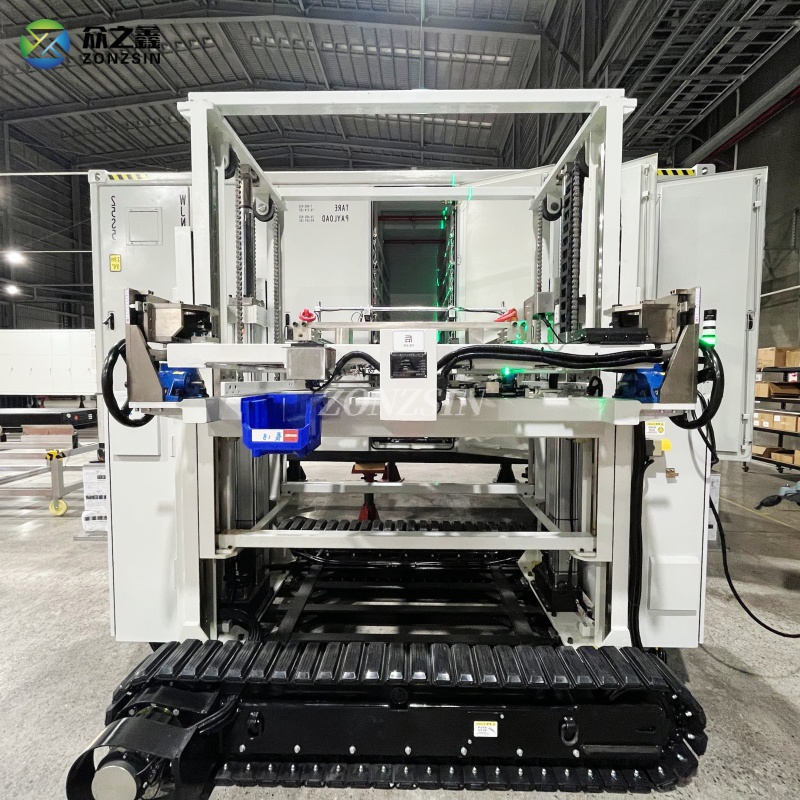
Modern insertion robots are built to handle heavy packs inside container racks with guided movement and precise docking.
Why Container Battery Pack Insertion Needs Automation
As battery energy storage systems scale up, containerized BESS solutions have become a major market segment. The containerized BESS market was valued at approximately USD 11.75 billion in 2025 and is expected to grow at a compound annual growth rate (CAGR) of 24.1% through 2035, according to Insightace Analytic. While the overall BESS market size estimates vary by research firm, the direction is clear: containerized projects are a growing part of the energy storage landscape.
Containerized storage introduces a specific production bottleneck: inserting battery packs into racks inside a 20ft or 40ft container. Battery packs used in this segment typically weigh hundreds of kilograms, and the insertion process must be completed without damaging pack surfaces, connectors, or rack structures. Manual methods often require multiple workers, long cycle times, and careful coordination. Automated insertion robots address these constraints with guided lifting, positioning, and docking functions.
This is why battery pack insertion robots are showing up not only in large battery factories, but also in energy storage integrator plants that assemble containerized systems from third-party packs.
Three Core Approaches to Battery Pack Insertion
There is no single “best” type of battery pack insertion robot. The right platform depends on the production floor, the container layout, and the operating environment. The three most common types are AGV-driven, rail-fixed, and crawler-driven systems.
AGV-Driven Battery Pack Insertion Robots
AGV-driven battery pack insertion robots are mounted on autonomous guided vehicles. They can travel to different container positions and dock with the container opening. This approach gives plants flexibility when multiple container lines or container sizes need to be served by one robot.
Zonzsin’s AGV-driven model is the RD16. Key facts about the RD16 are:
- Dimensions: 3100 × 2600 × 3800 mm
- Hoisting range: 1.05–3.4 m (customizable)
- Hoisting speed: 100 mm/s
- Compatibility: 280/314/587Ah cells; 1P52S/1P104S PACKs
- Material: carbon steel
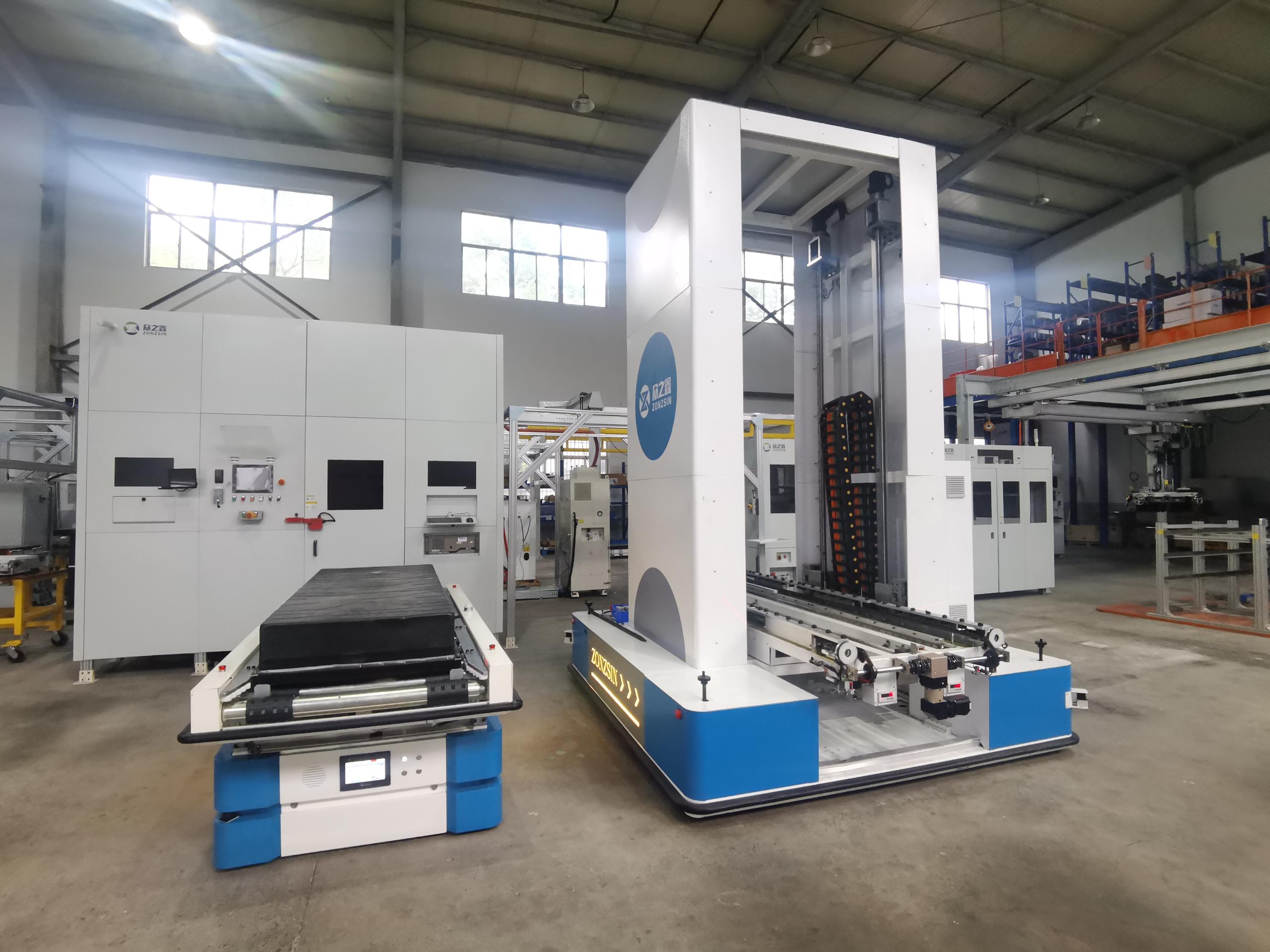
The RD16 is an AGV-driven insertion robot with a customizable hoisting range and 100 mm/s hoisting speed.
In production, the AGV platform lets the robot move between containers, which is particularly useful for batch or continuous production where the container is stationary and the insertion system needs to serve multiple lines.
Rail-Fixed Battery Pack Insertion Robots
Rail-fixed battery pack insertion robots run on a fixed rail system and are designed for lines where the container is brought to a defined docking position. They are typically faster to integrate because the robot does not need to manage its own navigation path.
Zonzsin offers two rail-fixed models:
ZZX2508: A rail-fixed battery PACK insertion robot with the following specifications:
- Compatible container dimensions: L 6058–7000 mm, W 2438–2700 mm, H 2896–3000 mm
- Compatible PACK dimensions: L 1100–2200 mm, W 780–1260 mm, H 230–260 mm
- Compressed air: 0.5–0.8 MPa
- Power: AC380V ±10%, 50 ±2 Hz
- Door opening angle: ≥150°
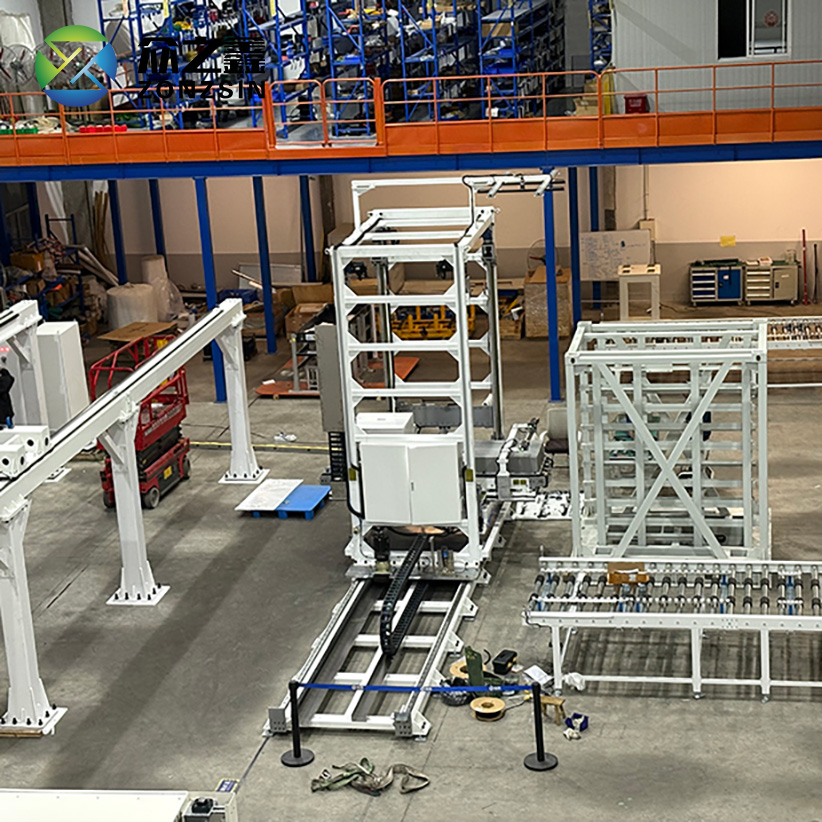
The ZZX2508 is designed for controlled container and PACK dimension ranges with a door opening angle of at least 150 degrees.
ZZX2524: A rail-fixed battery PACK insertion robot with a focus on load capacity and quick changeover:
- Load capacity: 1500 kg
- Door opening angle: ≥150°
- Gripper changeover time: <1 minute
- Space-saving double-layer rack configuration
Crawler-Driven Battery Pack Insertion Robots
Crawler-driven battery pack insertion robots use tracked undercarriages to move across uneven or unprepared surfaces. They are designed for all-terrain conditions, where wheeled AGVs or fixed rails are not practical.
Zonzsin’s crawler-driven model is the ZZX2522. It is a battery PACK insertion & removal robot with the following characteristics:
- Hoisting range: 0.8–3.4 m (customizable)
- Working floor: all-terrain
- Load capacity: 1500 kg
- Leveling function: manual handwheel leveling
- Material: carbon steel / Q235 (corpus lists “carton steel / Q235”)
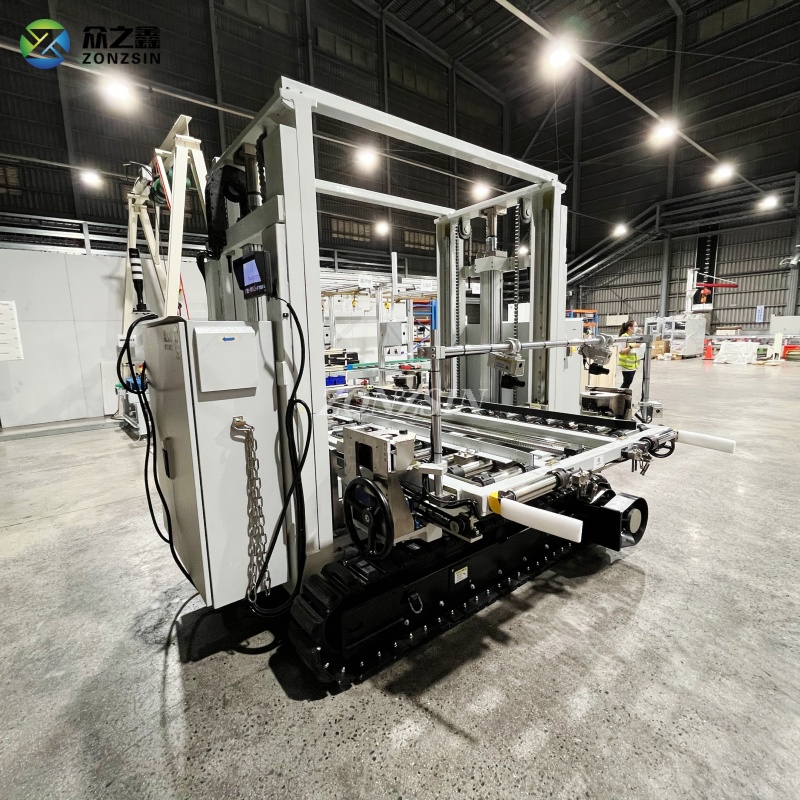
The ZZX2522 uses a crawler chassis and manual handwheel leveling for sites where floor conditions are not uniform.
How the Insertion Process Works, Step by Step
The exact sequence varies by equipment, but a typical container battery pack insertion workflow looks like this:
- Container preparation. The empty container is positioned at the loading station, and the container door is opened. The required door opening angle for Zonzsin rail-fixed robots is at least 150°, which supports clear access for the gripper and lifting mechanism.
- Robot positioning. An AGV-driven robot navigates to the container; a rail-fixed robot remains on its track; a crawler-driven robot travels across the floor to the target position.
- Pack pickup. The insertion robot picks up the battery pack from a material rack, working desk, or docking roller using a gripper or lifting attachment.
- Lifting and translation. The pack is lifted to the required rack height. On the RD16, for example, the hoisting range is 1.05–3.4 m with a hoisting speed of 100 mm/s.
- Insertion into rack. The system moves the pack into the container rack slot, using positioning feedback to guide the pack onto the rack rails.
- Release and return. The gripper releases the pack, retracts, and the robot moves to pick up the next pack or the container is moved to the next station.
Depending on the production layout, the robot may also perform the reverse operation: removing packs from container racks during maintenance or recycling processes.
Where These Robots Are Used
Battery pack insertion robots are used in several project types, including:
- Container energy storage line production: where battery packs are installed into container racks at the factory before the container is shipped to the project site.
- C&I energy storage integration: where system integrators assemble small-to-medium storage units into standard containers for commercial and industrial customers.
- Batch and continuous production lines: where the insertion robot is integrated with PLC and MES controls to support scheduled production.
According to Zonzsin’s application scenario data, these systems are commonly used in China, France, South Korea, Sweden, Taiwan, and the United States. The working temperature range for the crawler-driven system’s application scenario is 20–30°C with continuous or shift production.
Selection Considerations by Platform
When choosing between AGV-driven, rail-fixed, and crawler-driven systems, buyers typically evaluate five factors:
| Selection Factor | AGV-Driven (e.g., RD16) | Rail-Fixed (e.g., ZZX2508 / ZZX2524) | Crawler-Driven (e.g., ZZX2522) |
|---|---|---|---|
| Floor condition | Prepared, smooth floors | Fixed path with rail | All-terrain / uneven surfaces |
| Mobility | High; can move between containers | Limited to rail path | High; not limited by rail or smooth floor |
| Load capacity | Not specified in citable data | 1500 kg (ZZX2524) | 1500 kg |
| Typical customization | Hoisting range | Container and PACK dimensions | Hoisting range |
| Leveling system | Not specified in citable data | Not specified in citable data | Manual handwheel leveling |
This table intentionally avoids ranking one type above another. The correct choice depends on the project environment: a smooth indoor floor with multiple containers favors an AGV; a single-line layout with fixed container positions may be more cost-effective with a rail-fixed robot; an outdoor or rough surface favors a crawler.
Automation and Production Integration
Insertion robots do not work in isolation. They are typically connected to a wider production system that includes a transfer AGV, container docking rollers, grippers, working desks, material racks, platform ladders, PLC controllers, and MES software.
In an automated container stuffing line, the PLC coordinates the sequence: when the container arrives, when the robot can enter, and when the next pack should be delivered. The MES system records which pack was installed in which position, allowing traceability. This is especially important in energy storage projects, where battery packs may have different cell chemistries or production batches and need to be matched to rack positions in a controlled way.
Special project requirements also matter. Application scenarios for Zonzsin’s insertion robots include ESD protection, fire prevention measures, temperature/humidity and cleanliness control, and PACK compatibility or fixture adaptation.
For plants that already operate battery pack assembly lines, the insertion robot can be positioned as the final material-handling step before container shipment. Zonzsin’s battery assembly line, for example, has been reported to achieve a one-time welding qualification rate of 99.5% and a final qualification rate of 99.95% using precision vision control, according to EIN Presswire. While these quality metrics relate to the assembly line rather than the insertion robot itself, they illustrate the broader standard of controlled automation in battery production.
Operational Considerations for Buyers
Before purchasing an ESS battery pack insertion robot, buyers should confirm at least the following:
1. Container and Pack Dimensional Compatibility
The equipment must match the container sizes and pack sizes used in the project. For example, the ZZX2508 states a compatible container range of L 6058–7000 mm, W 2438–2700 mm, H 2896–3000 mm and a compatible PACK range of L 1100–2200 mm, W 780–1260 mm, H 230–260 mm. If your container or pack falls outside these ranges, customization is required.
2. Load Capacity
Battery pack weight is a key constraint. The ZZX2524 and ZZX2522 both specify a load capacity of 1500 kg. Buyers handling heavier packs need to request a custom configuration.
3. Hoisting Range and Speed
Rack heights determine the required hoisting range. The RD16 offers a hoisting range of 1.05–3.4 m (customizable) at a hoisting speed of 100 mm/s. The ZZX2522 offers a hoisting range of 0.8–3.4 m (customizable).
4. Floor Conditions and Mobility
If the insertion station is indoors with smooth floors, all three types may be feasible. If the container is loaded outdoors on gravel or uneven ground, a crawler-driven system such as the ZZX2522 is a more relevant option. If the robot needs to switch between multiple container lines without rail infrastructure, an AGV-driven platform is designed for that use case.
5. Control and Leveling
Check how the equipment is leveled before operation. The ZZX2522 uses manual handwheel leveling; this matters when it is deployed on terrain that is not perfectly flat. The AGV-driven and rail-fixed systems may rely on their own docking mechanisms, but this must be confirmed with the manufacturer.
6. Changeover and Flexibility
For plants running different pack types, gripper changeover time affects productivity. The ZZX2524 specifies a gripper changeover time of less than one minute. If frequent format changes are expected, this should be a stated requirement in the RFQ.
Frequently Asked Questions
What is an ESS battery pack insertion robot for containers?
An ESS battery pack insertion robot is automated equipment that moves heavy battery packs into racks located inside containerized energy storage systems. It handles lifting, positioning, and insertion with guided movement, replacing manual stuffing methods in battery factories and energy storage integrator plants.
What are the main types of battery pack insertion robots?
The main types are AGV-driven systems, which travel to the container; rail-fixed systems, which run on a fixed track; and crawler-driven systems, which use tracked undercarriages for all-terrain conditions. Zonzsin’s corresponding models are the RD16, ZZX2508/ZZX2524, and ZZX2522.
What is the load capacity of these insertion robots?
Zonzsin’s ZZX2524 and ZZX2522 both have a load capacity of 1500 kg. The load capacity for the RD16 is not specified in the product data provided, so buyers with heavier packs should confirm the rating directly with the manufacturer.
Which container sizes are compatible with rail-fixed insertion robots?
The ZZX2508 is compatible with containers measuring 6058–7000 mm in length, 2438–2700 mm in width, and 2896–3000 mm in height. It also requires a door opening angle of at least 150°. Packs must be within 1100–2200 mm in length, 780–1260 mm in width, and 230–260 mm in height for standard compatibility.
How long does it take to switch grippers on the ZZX2524?
The gripper changeover time on the ZZX2524 is less than one minute, allowing the robot to adapt quickly when different pack types or rack configurations are used in production.
Can these robots be customized?
Yes. Hoisting range is customizable on the RD16 and ZZX2522. The broader Zonzsin engineering team, which includes 43 R&D engineers, supports customized solutions for container dimensions, pack compatibility, and fixture adaptation. For a new project, it is recommended to send the actual container and pack drawings to the manufacturer before defining the final specification.
Need to evaluate a specific container loading layout?
Download the product brochure to review model specifications, or contact Zonzsin’s team to confirm compatibility for your project.
Contact: Katty.liu · katty.liu@zonzsin.com · +86 134-8282-9368
Have Questions or Need More Details?
Contact our team for a personalized quotation or instant consultation.
Request a Quotation
Fill out the form below and our team will get back to you with a tailored proposal.
WhatsApp Direct Chat
Prefer to chat in real-time? Message us on WhatsApp for instant assistance & quick answers.
- Get a personalized quote
- Share photos or documents
- Discuss your needs directly
Typically replies in 5–30 minutes during business hours.