
ESS Battery Pack Insertion Robots Compared: Platform Selection and Cost Logic for 2026
ESS Battery Pack Insertion Robots Compared: Platform Selection and Cost Logic for 2026
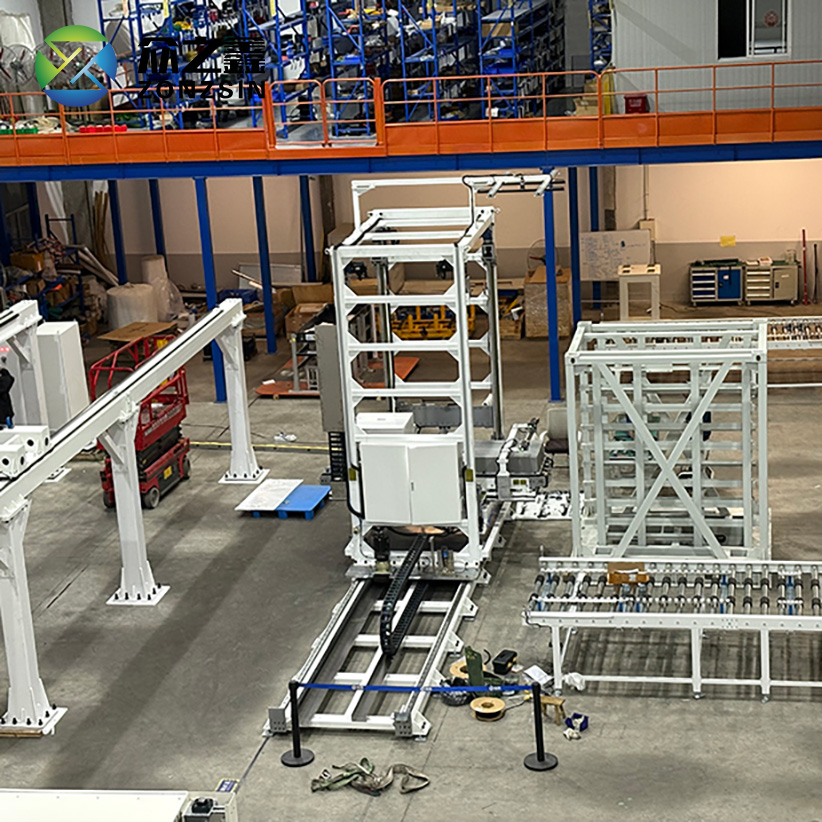
When an energy storage factory reaches the container assembly stage, the decision is rarely about whether to automate. It is about which automation platform should carry a battery pack weighing up to 1,500 kg into a 20ft or 40ft container rack, and whether that platform will hold up across years of two-shift operation. This article compares the main ESS battery pack insertion robot platforms, explains the cost and reliability logic behind each option, and provides a decision framework for manufacturing and engineering teams in 2026.
What Is an ESS Battery Pack Insertion Robot for Containers?
An ESS battery pack insertion robot for containers is a heavy-duty automated loading system that moves battery packs from a staging area into the racks installed inside energy storage containers. The robot handles tasks that are difficult to standardize with manual labor: precise alignment, careful insertion into narrow rack slots, and stable movement of loads often exceeding one ton.
In practice, the term covers several different platform designs. The most common configurations are AGV-driven, rail-fixed, and crawler-driven systems. Each platform moves differently, docks differently, and fits a different factory layout. Choosing among them is a decision about floor space, throughput, flexibility, and total cost of operation, not simply a choice between automation and manual work.
Industry Background: Why Containerized BESS Is Driving Automation Demand
Containerized battery energy storage systems represent a major and fast-growing segment of the BESS market. According to Insightace Analytic, the containerized BESS market was valued at approximately USD 11.75 billion in 2025 and is expected to grow at a CAGR of 24.1% through 2035. The broader BESS market was estimated at around USD 50.81 billion in 2025 by MarketsandMarkets, with projections reaching USD 105.96 billion by 2030. These figures point to a clear operational reality: more containerized storage projects mean more battery packs must be inserted into container racks under tight delivery schedules.
For manufacturers and integrators, this creates a bottleneck. Manual insertion is slow, physically demanding, and inconsistent. Automated insertion systems address that bottleneck, but they introduce new variables: floor layout, container positioning, rack tolerances, and maintenance requirements. Understanding these variables is the core of the selection process.
Platform Comparison: AGV-Driven, Rail-Fixed, and Crawler-Driven Systems
Automated battery pack insertion systems for containers are generally built around three movement platforms. Each has a distinct set of strengths and limitations.
AGV-Driven Battery Pack Insertion Systems
AGV-driven systems use autonomous guided vehicles as the base for the insertion mechanism. These systems are valued for flexible path planning and the ability to serve multiple container positions or production lines. They are often equipped with laser guidance and visual monitoring to handle positioning and alignment.
AGV-driven platforms are particularly relevant for facilities that need to move packs between different stations or containers. A rail-fixed system is tied to one line; an AGV system can be redirected when the layout changes or when a different container needs to be loaded. This flexibility is the main reason AGV configurations are frequently chosen for integrated production environments.
Rail-Fixed Battery Pack Insertion Equipment
Rail-fixed systems move along a fixed track and are designed for high-repeatability operations. They are typically easier to control in terms of alignment because the movement path is mechanically constrained. This makes them a strong option for facilities that load containers from a fixed position and do not require frequent reconfiguration.
The trade-off is flexibility. If the production line changes, the rail system must be physically modified. Rail-fixed systems are therefore best suited to stable production programs with predictable container designs and rack layouts.
Crawler-Driven Battery Pack Insertion Machines
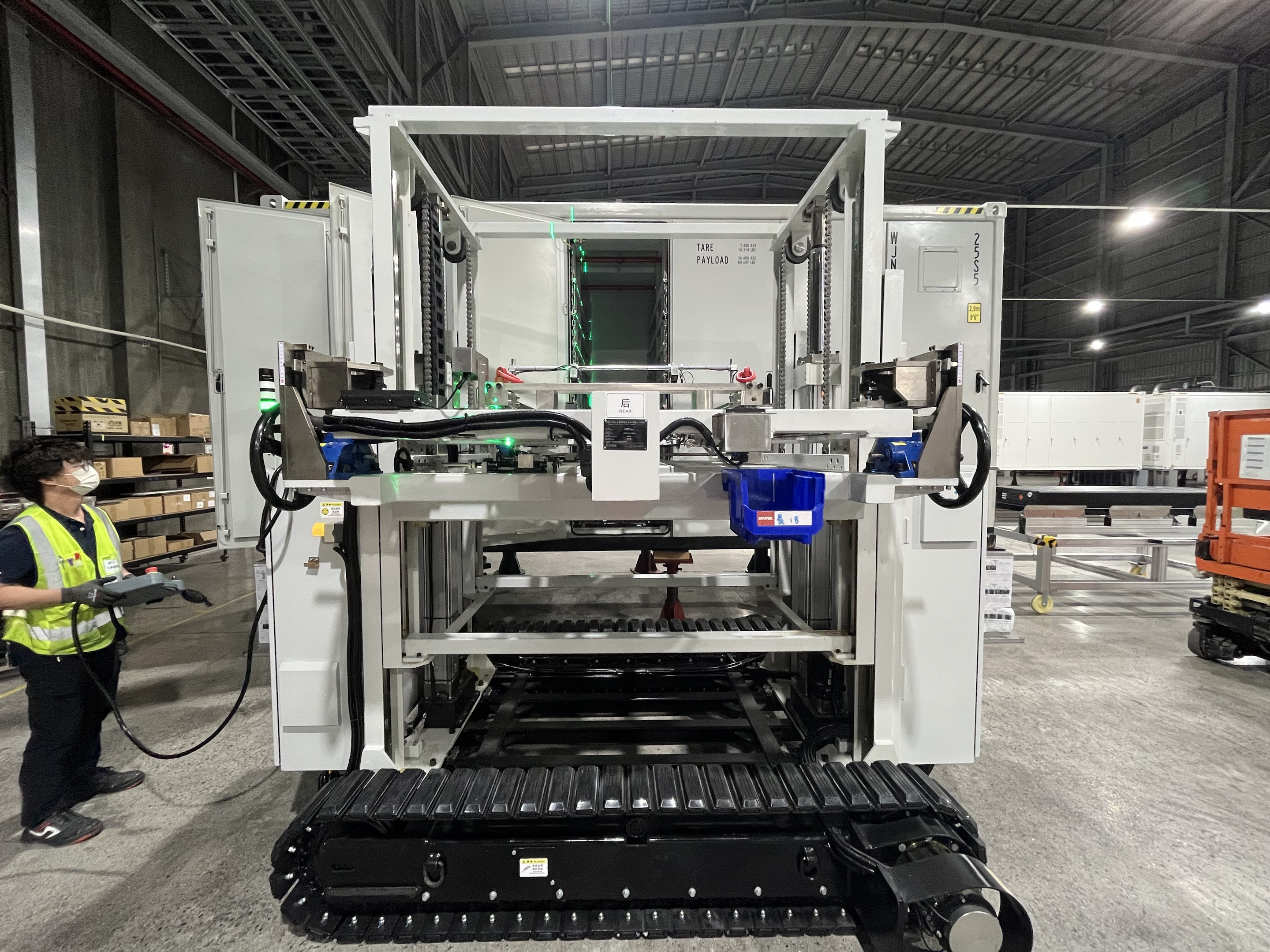
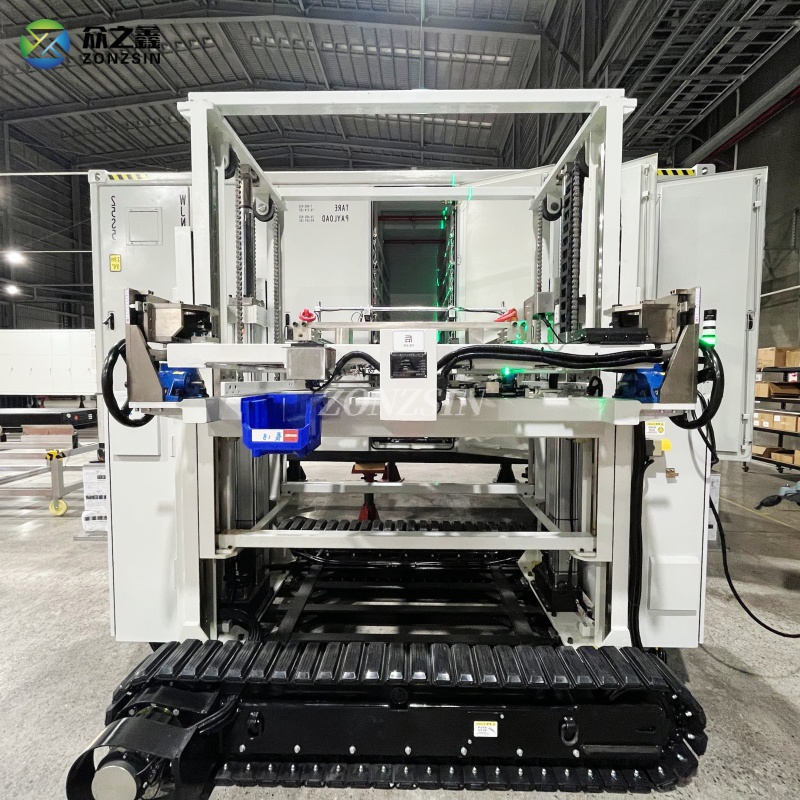
Crawler-driven machines use tracked movement instead of wheels. Tracked platforms can handle rougher floor conditions and distribute heavy loads over a larger contact area. They are typically considered for environments where floor flatness is not ideal or where the machine must move across thresholds and uneven surfaces inside the factory.
The crawler platform trades some precision and speed for terrain tolerance. In facilities with good floors, wheeled AGV platforms may offer smoother movement and easier integration with guided navigation systems. Crawler-driven systems are a practical alternative when floor conditions rule out wheeled or rail solutions.
What the Market Is Asking in 2026: Decision Criteria, Not Just Specifications
At the decision stage, buyers are no longer asking what automation does. They are asking which automation configuration is justified by their production volume, layout, and cost structure. The essential comparison is not only AGV versus rail versus crawler; it is also automated insertion versus manual insertion versus standardized competitor equipment.
For 2026, the practical decision criteria are:
- Load capacity and container compatibility: The system must handle the actual pack weight and reach the rack height inside standard 20ft and 40ft containers.
- Floor layout and movement requirements: Does the system need to serve one fixed position or multiple positions?
- Throughput and cycle time: How many containers must be loaded per shift?
- Integration depth: Does the insertion robot need to communicate with the assembly line and upstream processes?
- Maintenance and lifecycle cost: Which platform minimizes downtime and long-term maintenance?
These criteria matter more than isolated machine specifications because they determine whether the robot will still be the right choice after the first year of operation.
Detailed Solution: What a High-Performance ESS Battery Pack Insertion Robot Should Deliver
Shanghai Zonzsin Intelligent Equipment Co., Ltd. builds ESS battery pack insertion robots for containers and automatic battery pack assembly lines. Zonzsin was founded in 2019, operates from a 6,000 m² facility, and employs around 90 people, including 43 R&D engineers. The company reports an annual output capacity of approximately 40 units and exports about 60% of its production, primarily to Southeast Asia and the EU. Zonzsin holds 50 granted patents, including invention patents related to AGV-driven battery pack insertion robots.
For decision-makers evaluating suppliers, these first-party facts define what a specialized manufacturer can offer. A dedicated R&D team of 43 engineers supports customized line integration, which is one of the most important capabilities when a battery pack insertion robot must fit into an existing container assembly process.
According to verified product data, Zonzsin AGV-driven models support load capacities up to 1,500 kg and offer 5-DOF docking for standard 20ft and 40ft container racks. The 5-DOF docking capability means the robot can adjust multiple axes to align the pack with the rack slot, which reduces the risk of positioning deviation during insertion.
How the Zonzsin System Compares with Manual Methods and Standardized Equipment
The core difference of the Zonzsin product is robotic automation. Compared with manual insertion methods and competitors' standardized equipment, the system offers higher consistency, stable throughput, and support for customized line integration. These differences produce concrete operational results.
- 30% manpower savings: Automated insertion reduces the number of operators required for container loading.
- 20% cycle time savings: The robotic system completes insertion faster than manual methods.
- 10% lower total cost: Combined savings in labor, maintenance, and operational losses lower the overall cost of the insertion process.
- Less maintenance: Robust automation reduces the frequency of repairs and adjustments.
Reliability is higher than manual methods and standardized competitor equipment because robotic consistency eliminates human variation. The expected lifespan is also longer because the system is designed with robust automation and lower maintenance needs. Energy efficiency is reflected in the 20% cycle time saving, which reduces the energy consumed per container loaded.
It must be noted that these figures are based on company-published buyer guides and customer-facing materials. A buyer should validate them against their own production data during a site trial or line simulation.
Suitable Production Scenarios
The product is suitable for three main production scenarios:
- C&I factory: Commercial and industrial battery production facilities that need consistent container loading.
- Energy storage factory: Facilities that assemble containerized BESS units as a core product.
- Gigawatt factory: High-volume facilities where throughput and repeatability are critical.
These scenarios share a common feature: container loading is a repeated, high-volume operation where manual labor creates variability and cost. Automation delivers the most value in these environments.
Step-by-Step Decision Process for Selecting the Right Platform
For a factory that is comparing AGV, rail-fixed, and crawler-driven insertion systems, the following step-by-step approach reduces the risk of choosing the wrong platform.
Step 1: Define the Container and Pack Profile
Document the exact battery pack weight, dimensions, rack layout, and container type. The chosen system must reach the highest rack position and carry the heaviest pack without exceeding its rated capacity. If the pack weighs up to 1,500 kg, the robot must have a rated payload above that figure.
Step 2: Map the Movement Path
Identify where packs arrive, where containers are staged, and how many positions the robot must serve. If one insertion station serves multiple containers, an AGV-driven or crawler-driven platform is more practical. If one container type is loaded repeatedly at a fixed position, a rail-fixed system is worth evaluating.
Step 3: Measure the Floor Conditions
Check floor flatness, thresholds, and the path between the pack staging area and the container. Wheeled AGV platforms usually require smooth floors for accurate navigation. Crawler platforms tolerate rougher conditions. Rail systems avoid floor quality issues altogether but require a fixed track installation.
Step 4: Set Throughput and Integration Targets
Define the required containers per shift and the upstream integration requirements. Ask whether the insertion robot must receive data from the assembly line or send status signals to a central control system. Customized line integration is often necessary when the robot is not an isolated machine.
Step 5: Compare Total Cost of Operation
Compare not only purchase price but also installation, maintenance, energy consumption, and labor cost per container. A 10% lower total cost and 30% manpower saving can justify a higher initial investment when evaluated over the machine's lifespan.
Step 6: Validate with a Trial or Simulation
Run the system against your own container racks and pack dimensions before committing to a full line integration. Process risk assessment and testing are the standard enterprise measures used to confirm that positioning and safety controls work in the actual environment.
Use Cases: Where Each Platform Configuration Wins
Use Case 1: Multi-Position Gigawatt Factory
A gigawatt-scale battery factory produces packs continuously and loads containers from several staging positions. An AGV-driven system is the strongest fit because it can move between positions and adapt to changing production sequences. The Zonzsin AGV-driven models, with capacities up to 1,500 kg and 5-DOF docking, are designed for this type of flexible, high-throughput environment.
Use Case 2: Fixed-Position Container Loading Line
A C&I energy storage factory loads one container design at a fixed station. A rail-fixed system provides mechanical alignment and predictable cycle times. This configuration sacrifices flexibility but offers simplicity in control and maintenance.
Use Case 3: Factory with Uneven Floors
A facility with aging concrete floors and thresholds between zones may not suit a wheeled AGV. A crawler-driven machine distributes the load over tracks and moves reliably on uneven surfaces. The trade-off is a more complex movement mechanism and potentially slower positioning.
Use Case 4: Automated Line Integration
A manufacturer wants the insertion robot to operate as part of a fully automatic assembly line. Zonzsin's system supports customized line integration, which means the robot can be synchronized with upstream pack assembly and downstream container sealing processes. This is the scenario where robotic automation provides the greatest return.
Comparison Table: Platform Characteristics and Decision Relevance
| Platform | Movement | Best For | Main Limitations | Key Decision Factor |
|---|---|---|---|---|
| AGV-driven | Autonomous wheeled movement | Multi-position loading, gigawatt factories, integrated lines | Requires smooth floors and navigation infrastructure | Flexibility and path planning |
| Rail-fixed | Fixed track movement | Stable production programs, fixed container positions | Difficult to reconfigure when line layout changes | Mechanical alignment and repeatability |
| Crawler-driven | Tracked movement | Rough floors, uneven surfaces | Higher mechanical complexity, slower positioning | Terrain tolerance and load distribution |
The table summarizes typical platform characteristics. The actual choice depends on the specific factory layout and production program.
Risk Control: Positioning and Safety Considerations
Automated battery pack insertion involves heavy loads moving into narrow rack slots. The two main risks are positioning deviation and collision or extrusion. A well-designed system controls these risks through multiple layers.
Laser Guidance and Visual Monitoring
Laser guidance keeps the robot on its intended path, while visual monitoring confirms the alignment between the battery pack and the rack slot. These technologies reduce positioning deviation before it causes damage.
Emergency Stop and Alarm Systems
Emergency stop buttons and alarm indicator lights give operators immediate control when an abnormal condition is detected. These safety mechanisms are a basic requirement for any automated insertion system.
Process Risk Assessment and Testing
Manufacturers should conduct process risk assessment and testing before the system is deployed in full production. This validation step verifies that the control logic, safety sensors, and mechanical tolerances work together in the real environment.
Standards and Compliance Context
Buyers should also be aware of the regulatory context for automated BESS equipment.
For North American market access, Energy Storage Systems must comply with UL 9540, the Standard for Energy Storage Systems and Equipment, which covers safety of enclosures and moving parts. In the EU, BESS containers require CE marking under Regulation (EU) 2023/1542, including compliance with the Low Voltage Directive and Machinery Directive for automated handling equipment. These standards affect the overall container design and the automated equipment used inside it, so the insertion robot supplier should be able to provide the relevant documentation for the machinery they deliver.
FAQ
Is automated battery pack insertion safer than manual insertion for container racks?
Automated systems reduce the number of operators working near heavy moving loads and use laser guidance, visual monitoring, emergency stop buttons, and alarm indicator lights to control positioning deviation and collision risk. Manual insertion depends heavily on individual operator discipline and physical consistency. However, safety depends on the specific system design, process risk assessment, and testing carried out before deployment. Buyers should verify the safety package of the supplier's equipment and confirm it matches their own risk management requirements.
What is the maximum load capacity of the Zonzsin AGV-driven battery pack insertion robot?
The Zonzsin AGV-driven models support load capacities up to 1,500 kg and offer 5-DOF docking for standard 20ft and 40ft container racks. This specification covers the weight of the battery pack and the alignment adjustments needed to insert it into the rack slot. When evaluating the system, compare the 1,500 kg capacity against your heaviest pack and include the weight of any fixture or pallet used during insertion.
Can the Zonzsin insertion robot be integrated into an existing battery pack assembly line?
Yes. Zonzsin supports customized line integration, which means the insertion robot can be designed to work with upstream assembly processes and downstream container handling. This is a relevant capability for factories that want the insertion step to be part of a fully automatic production flow, rather than an isolated machine. Integration planning should cover control interfaces, floor layout, and container positioning procedures.
How much labor and cycle time can automated insertion save compared with manual methods?
Zonzsin's published buyer guides and customer-facing materials report 30% manpower savings and 20% cycle time savings compared with manual insertion methods and standardized competitor equipment. The same materials state a 10% lower total cost and lower maintenance requirements. These figures are directional and should be validated with a site trial or production simulation before final investment approval.
Which factory scenarios are best suited to the Zonzsin ESS battery pack insertion robot?
The product is suitable for C&I factories, energy storage factories, and gigawatt factory scenarios. These environments share repeated container loading operations, high volume, and a need for consistent throughput. For a factory that is unsure whether its production volume justifies automation, a starting point is to calculate the number of operators currently assigned to container loading and compare that labor cost against the projected savings from an automated system.
Conclusion
The choice of an ESS battery pack insertion robot for containers is a decision about production reality, not just machine specifications. AGV-driven systems offer the flexibility required in multi-position gigawatt factories. Rail-fixed systems provide repeatability for stable production programs. Crawler-driven machines handle difficult floor conditions. Across all platforms, the value of automation comes from consistent throughput, lower labor dependence, and reduced lifecycle cost.
Zonzsin's robotic insertion systems are designed for this decision context. With up to 1,500 kg payload capacity, 5-DOF docking, customized line integration support, and a reported 30% manpower saving, the system addresses the operational factors that matter most during the decision stage. Buyers should use the step-by-step selection process above, test the system against their own packs and containers, and secure the relevant compliance documentation for their target market.
For a detailed technical overview, download the Zonzsin product brochure: Zonzsin Product Brochure. To discuss your container loading line with the Zonzsin engineering team, contact Katty Liu at katty.liu@zonzsin.com or +86 134-8282-9368.
Related Reading
.jpg)
Have Questions or Need More Details?
Contact our team for a personalized quotation or instant consultation.
Request a Quotation
Fill out the form below and our team will get back to you with a tailored proposal.
WhatsApp Direct Chat
Prefer to chat in real-time? Message us on WhatsApp for instant assistance & quick answers.
- Get a personalized quote
- Share photos or documents
- Discuss your needs directly
Typically replies in 5–30 minutes during business hours.