
CTP vs Traditional Assembly: A Data-Driven Comparison for Battery Pack Buyers
CTP vs Traditional Assembly: A Data-Driven Comparison for Battery Pack Buyers
Buyers comparing a cell-to-pack (CTP) assembly line with a traditional module-based line are usually handed the same three numbers: cycle time, welding qualification rate, and floor space. Those numbers only become decision-grade when they are tied to a specific line model, a specific cell format, and a specific pack configuration. This comparison sets CTP against traditional module-based assembly using documented line data from Shanghai Zonzsin Intelligent Equipment Co., Ltd. together with published market figures, and it shows how to normalize supplier claims before a purchase order is signed.
Problem Definition: A Scope Question Before a Technical One
In a traditional module-based flow, cells are first assembled into modules, covering cell stacking, busbar welding, module housing and module-level testing. Those modules are then inserted into the pack enclosure, where high-voltage connections, cooling, sealing and end-of-line testing take place. In a CTP flow, the module sub-assembly is removed and cells are placed directly into the pack structure, so the enclosure absorbs functions that module hardware previously performed.
Removing a stage changes the measurable profile of a line in four places:
- Joining count. Fewer intermediate interfaces generally mean fewer welding and fastening operations per pack, which is why CTP lines are often assessed on welding qualification rate rather than welding speed alone.
- Handling and insertion. Loading cells directly into pack structures increases the importance of insertion precision and gripper tooling design.
- Quality-gate position. In a module-based flow, defects can be contained at module level. In CTP, more quality risk moves downstream, so one-time and final welding qualification rates become the controlling metrics.
- Footprint. Removing module sub-assembly changes how much floor space the process needs, which turns layout, U-shape or straight-line, into a commercial variable rather than an engineering detail.
The buyer's difficulty is that these variables are routinely compared across mismatched scopes. A documented example from Zonzsin's own product data makes the point: the ZZX2501 blade battery PACK assembly line is specified at 6 PPM, equal to 30 minutes per pack, while the ZZX2406 CTP line is documented at 4 PPM in a semi-automatic configuration for 314Ah and 587Ah cells in a 1P96S pack. Both are automatic battery pack assembly lines from the same manufacturer, but they are not interchangeable numbers.
Before any comparison table is meaningful, three definitions have to be fixed: is PPM stated per pack or per module; is the welding figure a one-time pass rate or a final pass rate; and is the rate a single-machine figure or a whole-line figure.
Practical rule: a cycle-time figure without a model, a cell format and a pack configuration is a marketing number, not a procurement number. Ask for the configuration sheet behind it.
Industry Background: Why This Comparison Went Mainstream
CTP is no longer a niche architecture. According to Spherical Insights, the global cell-to-pack battery market was valued at USD 18.35 billion in 2023 and is projected to reach USD 75.93 billion by 2033. Adoption data from ResearchInChina shows how quickly the concept entered volume vehicle programs: by 2023, CTP technology was integrated into nearly 50% (48.6%) of new energy vehicles sold in China, rising from 13 models in 2021 to 57 models by late 2023.
The equipment side is expanding on a comparable trajectory. MarketsandMarkets projects the battery manufacturing equipment market to grow at a CAGR of 18.8% between 2025 and 2030, reaching USD 36.94 billion. Major equipment players named in that market include Lead Intelligent Equipment, Yinghe Technology and Hitachi High-Tech, alongside specialised line builders such as Zonzsin.
Cell formats are shifting at the same time. The energy storage industry has moved from the 280Ah benchmark to 314Ah formats to improve energy density and reduce assembly cost (Highstar / InfoLink). Zonzsin's CTP line documentation already covers 314Ah and 587Ah cells in a 1P96S pack, which means format compatibility is now a specification question rather than a future-proofing question.
For a buyer in the evaluation stage, the consequence is straightforward. The architecture decision locks in cell handling, welding quality control, footprint, utility requirements and supplier support for the life of the line. Comparing CTP and module-based options on headline numbers alone systematically underestimates that commitment.
What a CTP Line Looks Like in Documented Data
The supplier behind the documented figures
Shanghai Zonzsin Intelligent Equipment Co., Ltd. is a Shanghai-based manufacturer founded in 2019 that builds automatic battery pack assembly lines and ESS battery pack insertion robots for containers. The company serves lithium battery manufacturers, energy storage integrators and automotive OEMs, employs 90 people including a 43-engineer R&D team, holds 50 granted patents covering areas such as AGV-driven battery PACK insertion robots, operates a 6,000 m² facility, and exports about 60% of output to Southeast Asian and European markets. Its equipment is reported in service in Europe, the USA, Japan, South Korea and India.
Documented performance data on the CTP and automatic lines
Three Zonzsin line models carry publishable parameter data, and they are the basis for any honest CTP comparison:
- ZZX2406, CTP battery PACK assembly line: cycle time 4 PPM, semi-automatic automation level, cells 314Ah and 587Ah, pack configuration 1P96S, footprint L58000 × W11000 × H3800, applicable to energy storage, EV and C&I projects.
- ZZX2501, blade battery PACK assembly line: cycle time 6 PPM, equal to 30 minutes per PACK, compressed air 0.6–0.8 MPa, electrical requirement AC 380V ±10% at 50±0.5 Hz, applicable to EV industry and energy storage.
- ZZX2313, EV battery PACK assembly line: single-machine operation rate ≥95%, one-time welding qualification rate ≥99.5%, final welding qualification rate ≥99.95%, compressed air 0.5–0.8 MPa, electrical requirement AC 380V ±10%, applicable to EV industry, energy storage and automotive OEMs.
The welding figures deserve specific attention because they are the clearest quality signal in the data set. A one-time qualification rate of 99.5% describes what passes on the first attempt; a final qualification rate of 99.95% describes what passes after any permitted touch-up or rework. The gap between the two numbers is the rework load the line will carry. On a CTP line, where there is no module-level containment stage, that gap directly affects takt stability, rework labour and end-of-line throughput, so buyers should request both figures rather than accepting a single welding yield number.
Layout, space utilization and maintenance
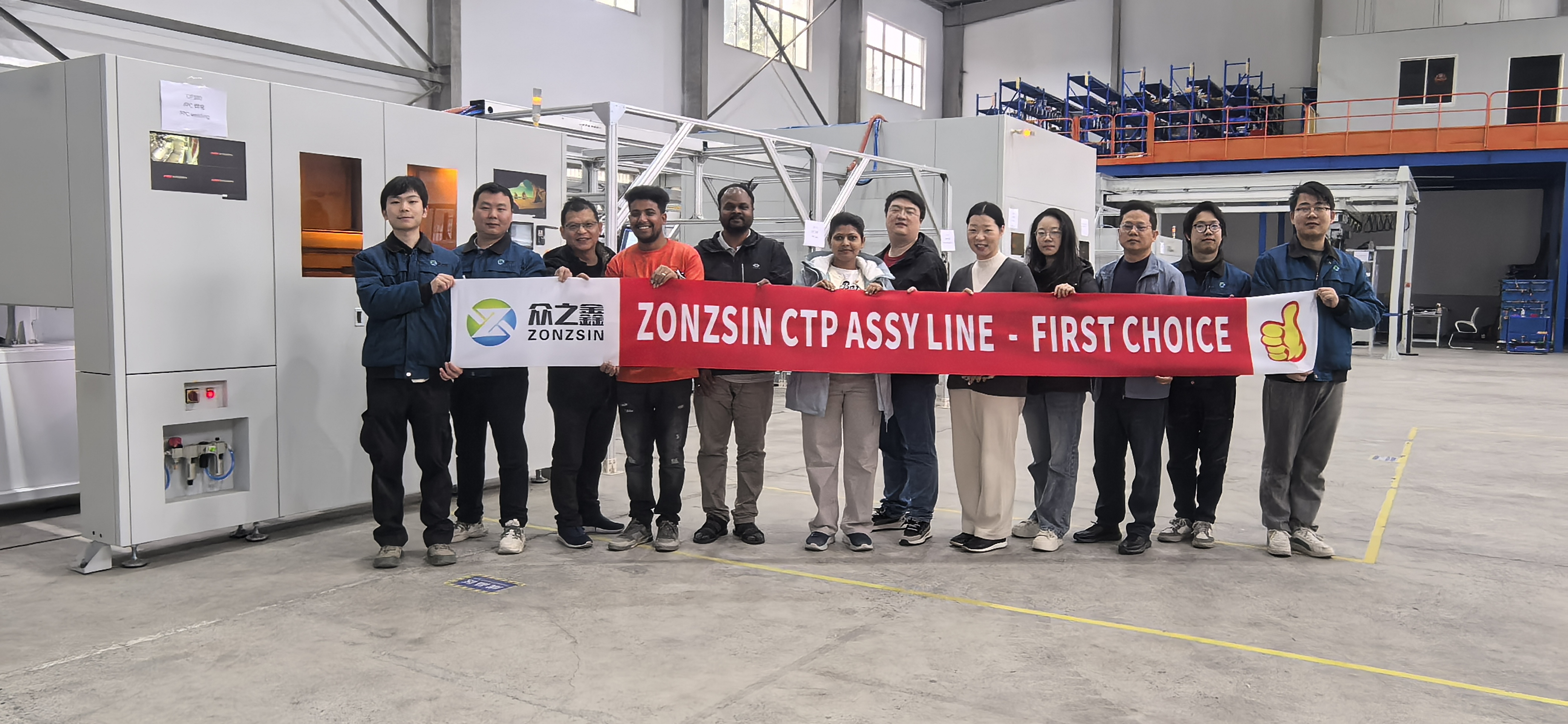
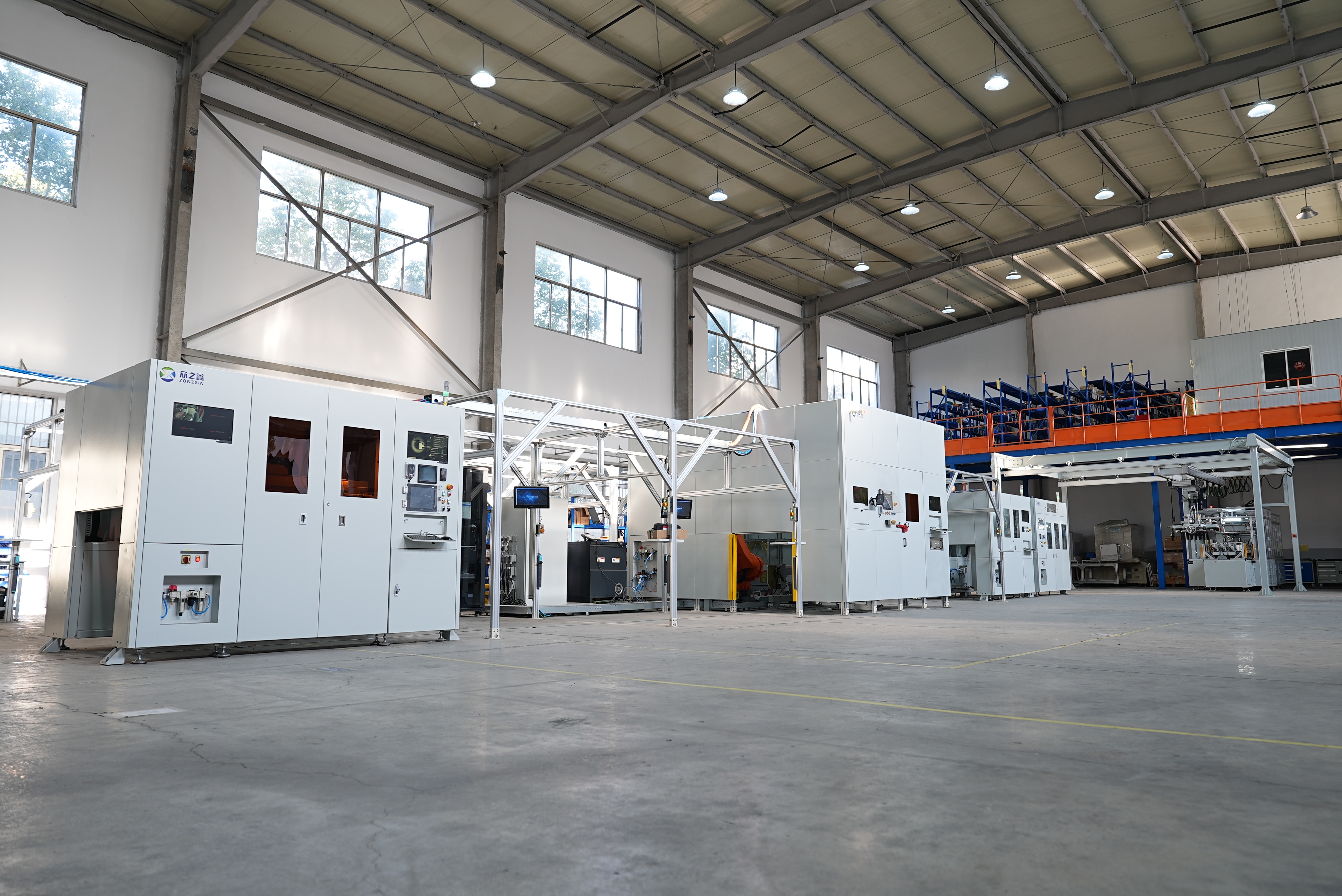
Footprint data is often the deciding factor in brownfield plants. The documented ZZX2406 CTP line occupies L58000 × W11000 × H3800 with a carbon steel / Q235 structure, which sets minimum slab dimensions, building clear height and material-flow paths. In its India deployment, Zonzsin records a U-shape layout chosen for space saving and user-friendly operation; the same deployment has been in stable operation for one year.
On maintenance, Zonzsin states that modular design supports superior product reliability and a 20% lower maintenance expenditure. That figure is a manufacturer claim about maintenance cost structure, not a statement about cycle time or output, and buyers should keep those two categories separate when they build a comparison model.
Compliance and quality scope
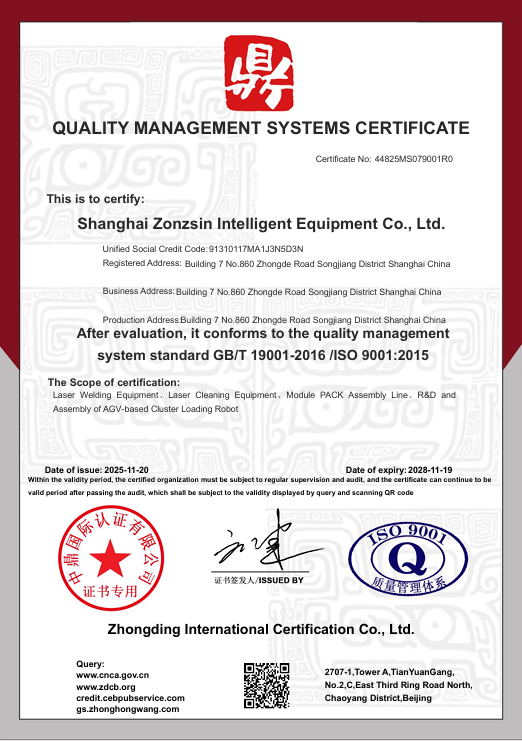
Zonzsin holds ISO 9001 certificate 44825MS079001R0, issued by ZDCB on 20 November 2025 and valid until 19 November 2028 under GB/T19001-2016 / ISO 9001:2015. The certified scope covers laser welding equipment, laser cleaning equipment, module PACK assembly line, and R&D and assembly of AGV-based cluster loading robot. Quality control on delivered lines follows 100% testing.
Step-by-Step: Running a Data-Driven CTP vs Module-Based Comparison
Step 1 - Fix the pack specification first
Write down the cell format, the pack configuration and the target industry before contacting suppliers. A 314Ah and 587Ah CTP line serving a 1P96S pack is a different machine from a blade-cell line, and mixing those scopes is the single most common source of misleading comparisons. If your roadmap covers both EV and energy storage products, state that explicitly, because customization scope changes accordingly.
Step 2 - Normalize the cycle-time definition
Ask whether the quoted PPM refers to final pack output or to an intermediate station, and whether it includes buffer and rework time. Documented references show why this matters: 6 PPM on the ZZX2501 blade line equals 30 minutes per pack, while the ZZX2406 CTP line is documented at 4 PPM. Neither number is better in isolation; they describe different products.
Step 3 - Set the welding quality gate and the rework rule
Define the one-time and final welding qualification rates you will accept before quotations are issued, and require the supplier to state both. The ZZX2313 documentation uses one-time ≥99.5% and final ≥99.95%, with a single-machine operation rate of ≥95%. Those three values together give a realistic view of throughput; any one of them alone does not.
Step 4 - Compare footprint and layout, not machine count
Request the line envelope in millimetres and the proposed layout. The ZZX2406 envelope of L58000 × W11000 × H3800 and the U-shape layout used in the India deployment show how layout decisions translate into building cost and material-flow efficiency. A compact layout can matter more than a marginal cycle-time difference in an existing plant.
Step 5 - Verify the compliance scope and acceptance protocol
Check that the supplier's quality certificate actually covers the product you are buying, then align the acceptance protocol. Zonzsin documents FAT and online FAT as acceptance options, supported by 100% testing. Separately, note that pack-level market access standards such as IEC 62133-2, UL 1642 and UL 2054 (per UL Solutions) apply to the finished pack rather than to the line that builds it.
Step 6 - Confirm commercial and support terms
Documented commercial terms from Zonzsin: minimum order quantity 1 unit, delivery EXW Shanghai, FOB Shanghai or FCA Shanghai, and payment of 50% advance by T/T with the 50% balance due within 3 business days after the B/L date. Lead time is 3 to 5 months against a monthly production capacity of 3 units. After-sales covers remote support and on-site installation and commissioning. Customization under OEM/ODM production covers cycle time, automation level, logo, color and configuration.
Use Cases: Where Each Configuration Fits
Energy storage packs on 314Ah and 587Ah cells
The format migration from 280Ah to 314Ah cells has moved ESS pack builders toward configurations that handle larger prismatic cells in fewer, longer strings. A documented CTP configuration such as the ZZX2406, specified for 314Ah and 587Ah cells in a 1P96S pack at 4 PPM, is aimed at that segment, including energy storage, EV and commercial and industrial applications.
EV and blade-cell programs
Blade-cell and EV programs often run on longer cycle-time definitions. The ZZX2501 blade battery PACK assembly line is documented at 6 PPM, or 30 minutes per pack, while the ZZX2313 EV line is documented at welding qualification rates of ≥99.5% one-time and ≥99.95% final with a single machine operation rate of ≥95%, applicable to EV, energy storage and automotive OEM production.
Multi-format plants and brownfield space limits
Plants running more than one product family should treat customization as a specification, not an upgrade. Documented customizable items include cycle time, automation level, logo, color and configuration. For brownfield sites, the U-shape layout used in Zonzsin's India deployment shows what space-oriented design looks like in practice: the layout is recorded as space saving and user-friendly, which matters when the hall already exists.
Documented reference: India CTP deployment
One documented reference project is a single automatic battery PACK assembly line deployed in India and used for battery PACK assembly by an automotive OEM, an energy storage system integrator, a battery cell and PACK manufacturer, and an EPC turnkey contractor. It is recorded as in stable operation after one year, with the U-shape layout noted for space saving. That combination of stable output plus compact layout is the kind of evidence a buyer should ask to see from any supplier, rather than accepting a reference list without application detail.
Comparison Table: CTP vs Traditional Module-Based Assembly
Table 1 compares the two architectures on dimensions that can be documented or reasoned about without speculation. Where a number is not available from published product data, the cell states that explicitly rather than filling the gap.
| Comparison dimension | Traditional module-based (MTP) | CTP | Documented data point |
|---|---|---|---|
| Pack architecture | Cells are built into modules first, then inserted into the pack; module housings, busbars and fasteners sit between cell and pack | Module stage removed; cells are placed directly into the pack structure | ZZX2406 is documented as a CTP line for 314Ah and 587Ah cells in a 1P96S pack |
| Joining and welding scope | More interfaces generally mean more joining steps, and defects can be contained at module level | Fewer intermediate interfaces; more quality risk sits downstream at pack level | ZZX2313: one-time welding qualification ≥99.5%, final qualification ≥99.95%, single-machine operation rate ≥95% |
| Cycle time | Not documented in this data set for a Zonzsin module-based line | 4 PPM on the ZZX2406 CTP line in a semi-automatic configuration; 6 PPM, or 30 minutes per PACK, on the ZZX2501 blade-cell line | Cycle time is model- and configuration-specific and should be quoted that way |
| Footprint and layout | Module sub-assembly normally requires a separate process area | Direct cell-to-pack flow supports more compact layouts | ZZX2406: L58000 × W11000 × H3800. India deployment documented with a U-shape layout for space saving |
| Automation and customization | Depends on the configuration ordered | Documented semi-automatic CTP configuration; automation level is a customization item | Customizable items documented: cycle time, automation, logo, color, configuration (OEM/ODM) |
| Quality management scope | Supplier quality system applies | Supplier quality system applies | ISO 9001 certificate 44825MS079001R0; scope covers module PACK assembly line, laser welding equipment, laser cleaning equipment, AGV-based cluster loading robot |
| Maintenance profile | Depends on configuration and tooling | Modular design is stated by the manufacturer to support lower maintenance expenditure | Zonzsin states a 20% lower maintenance expenditure attributed to modular design |
Table 2 lists the model-level parameters as published, which is the granularity a buyer should request from every supplier in a shortlist. Blank cells are open specification items to be confirmed in writing, not assumptions to be carried into a budget.
| Parameter | ZZX2406 | ZZX2313 | ZZX2501 |
|---|---|---|---|
| Line type | CTP battery PACK assembly line | EV battery PACK assembly line | Blade battery PACK assembly line |
| Cycle time | 4 PPM | Not documented in this data set | 6 PPM; 30 minutes per PACK |
| Automation level | Semi-automatic | Not documented in this data set | Not documented in this data set |
| Cell and pack format | 314Ah and 587Ah; 1P96S | Not documented in this data set | Not documented in this data set |
| Welding qualification rate | Not documented in this data set | One-time ≥99.5%; final ≥99.95% | Not documented in this data set |
| Single-machine operation rate | Not documented in this data set | ≥95% | Not documented in this data set |
| Utilities | Not documented in this data set | Compressed air 0.5–0.8 MPa; AC 380V ±10% | Compressed air 0.6–0.8 MPa; AC 380V ±10%, 50±0.5 Hz |
| Footprint | L58000 × W11000 × H3800 | Not documented in this data set | Not documented in this data set |
| Applicable industry | Energy storage; EV and C&I | EV industry; energy storage; automotive OEMs | EV industry; energy storage |
FAQ: CTP vs Traditional Assembly for Battery Pack Buyers
Which certifications and standards should a buyer verify on a CTP battery pack assembly line?
Two separate layers matter. The first is the equipment supplier's quality management system: Zonzsin holds ISO 9001 certificate 44825MS079001R0, issued by ZDCB on 20 November 2025 and valid until 19 November 2028 under GB/T19001-2016 / ISO 9001:2015, with a certified scope covering laser welding equipment, laser cleaning equipment, module PACK assembly line, and R&D and assembly of AGV-based cluster loading robot. Buyers should confirm that the specific line being purchased falls inside that scope rather than assuming one certificate covers an entire product range. The second layer is pack-level market access: lithium-ion battery packs must comply with standards such as IEC 62133-2 for global markets and UL 1642 / UL 2054 for North America, and those apply to the finished pack built on the line, not to the line itself.
Can one CTP line handle different cell formats and different cycle times?
Documented configurations show how flexibility is expressed in practice. The ZZX2406 CTP line is specified for 314Ah and 587Ah cells in a 1P96S pack at 4 PPM in a semi-automatic configuration, while the ZZX2501 blade battery PACK assembly line is documented at 6 PPM, equal to 30 minutes per pack. Zonzsin lists cycle time, automation level, logo, color and configuration as customizable items under OEM/ODM production. The discipline for buyers is simple: a PPM figure is only valid for the exact model, cell format and pack configuration it was measured on, so request the configuration sheet behind the number instead of comparing headline PPM across suppliers.
What drives the cost of a CTP line, and how are commercial terms structured?
No price is quoted here, because configuration drives cost. On a CTP line, the documented customization variables, namely cycle time, automation level, configuration and the cell format to be handled (314Ah or 587Ah), are the factors that change scope, tooling and engineering effort, and a footprint such as L58000 × W11000 × H3800 feeds directly into civil works and building cost. Documented commercial baseline: minimum order quantity 1 unit, delivery EXW Shanghai, FOB Shanghai or FCA Shanghai, and payment of 50% advance by T/T with the 50% balance due within 3 business days after the B/L date. A configuration-specific quotation is the only reliable basis for budget comparison.
How can we validate a line before accepting it?
Acceptance testing is documented as FAT and online FAT, so the line can be inspected at the factory and, where applicable, reviewed remotely before shipment, supported by 100% testing in quality control. Because the minimum order quantity is 1 unit, a single line can be ordered for a validation build rather than committing to a multi-line program at once. The most detailed available reference is the India deployment: a CTP battery PACK assembly line used for battery PACK assembly by an automotive OEM, an energy storage system integrator, a battery cell and PACK manufacturer, and an EPC turnkey contractor, recorded as in stable operation after one year, with a U-shape layout noted for space saving and user-friendly operation.
What is the typical lead time, and what support comes with delivery?
Documented lead time is 3 to 5 months against a monthly production capacity of 3 units, so delivery slots are a genuine planning constraint rather than a formality. After-sales service covers remote support plus on-site installation and commissioning. The engineering base behind that support is a 43-engineer R&D team, 50 granted patents and a 6,000 m² manufacturing facility, with roughly 60% of output exported to Southeast Asian and European markets. For a project-specific schedule and a configuration review, the next step is to download the product brochure and send your pack specification, including cell format, pack configuration and target output, to the Zonzsin team at katty.liu@zonzsin.com or +86 134-8282-9368, or via www.zonzsin.com, so that cycle time, welding qualification targets and footprint can be quoted for your exact configuration.
Conclusion: Compare Lines, Not Brochures
The CTP versus traditional assembly decision is not settled by architecture preference. It is settled by data quoted in a comparable way. Documented figures such as 6 PPM, or 30 minutes per pack, on the blade line, 4 PPM on the CTP line, one-time welding qualification ≥99.5% and final ≥99.95% on the EV line, a single-machine operation rate of ≥95%, a L58000 × W11000 × H3800 footprint, and a one-year India reference only become useful once they are matched to the model, the cell format and the pack configuration you intend to build. Buyers who normalize those definitions before requesting quotations end up comparing production lines rather than marketing claims.
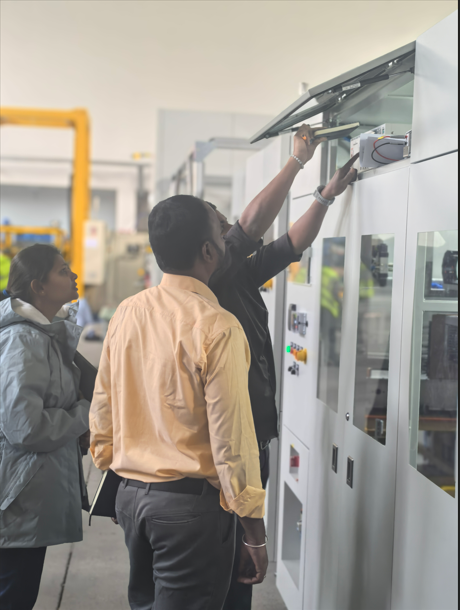
Next step: if you are comparing CTP and module-based configurations for a defined cell format, pack design and target output, Zonzsin can respond with model-level data, including cycle time, welding qualification targets, footprint and utility requirements, for the configuration you are evaluating.
Product brochure: download the Zonzsin product brochure
Contact: Katty Liu - katty.liu@zonzsin.com | Tel / WhatsApp: +86 134-8282-9368 | www.zonzsin.com
Have Questions or Need More Details?
Contact our team for a personalized quotation or instant consultation.
Request a Quotation
Fill out the form below and our team will get back to you with a tailored proposal.
WhatsApp Direct Chat
Prefer to chat in real-time? Message us on WhatsApp for instant assistance & quick answers.
- Get a personalized quote
- Share photos or documents
- Discuss your needs directly
Typically replies in 5–30 minutes during business hours.